


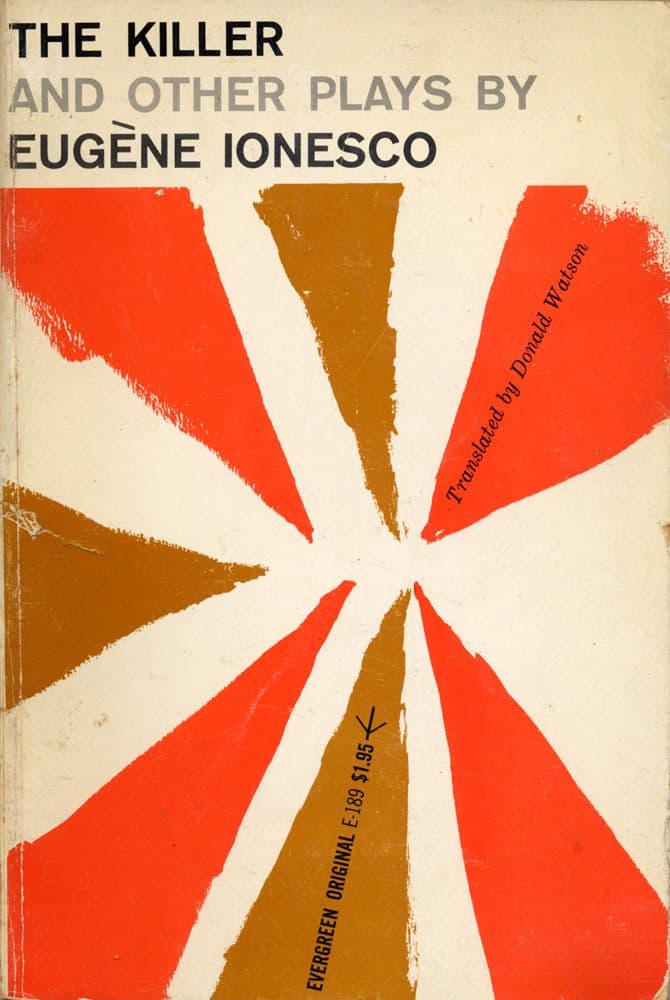
The Killer (Tueur sans gages)
The Killer is the first of Ionesco's Bérenger plays, tracing the everyman's discovery of a 'radiant city' that turns out to harbor a serial murderer the authorities have given up trying to catch. The play's central mechanism is the confrontation between Bérenger's rational humanism and a killer who is physically unremarkable and entirely impervious to argument. In the climactic monologue, Bérenger exhausts sympathy, patriotism, Christianity, and nihilism trying to persuade the killer to stop, only to conclude that reason has no purchase on the destructive impulse that inhabits the city.
Key Insights
✦What is the central argument of The Killer, and what does it reject?
The play's central argument is staged in Bérenger's climactic monologue, where he attempts to persuade the killer that murder is wrong. He cycles through sympathy, patriotism, Christianity, and nihilism, searching for a premise the killer will accept. What The Killer rejects is the Enlightenment premise that reason and moral argument can dislodge violence once it has settled into a society. The killer does not argue back; he is small, unremarkable, and indifferent. Ionesco told Claude Bonnefoy that the killer represents 'the fall, original sin'—a slackening of attention, the paralysis bred by habit . The play's target is not a specific ideology but the complacency that allows a city to accommodate a murderer as a permanent feature of its landscape.
✦How does the 'radiant city' function in the play, and why did Ionesco insist critics misread it?
The radiant city is the play's first act: an impeccably designed urban development where the architecture is perfect, the climate is ineffable, and no one will live because a killer drowns residents in the artificial lake . Ionesco complained that critics interpreted the radiant city as a satire of modern industrial technology. He insisted it meant a city 'shining with light,' a place of genuine happiness that had been 'entered by a destructive spirit' . The distinction matters because it shifts the play's meaning. If the city is a technological dystopia, the killer is its logical product. If the city is genuinely radiant, the killer is an intrusion—a fall from grace rather than a symptom of modernity. Ionesco's reading makes the play darker: happiness is possible, but it is always vulnerable to a destructive force that no design can exclude.
✦What is the significance of the killer's briefcase, and how does it structure the search?
The killer's briefcase is the play's material clue, passed from the killer to Bérenger's friend Edward and then into Bérenger's possession. It contains evidence that Bérenger uses to track the murderer through the city. But the briefcase also functions as a comic and ominous prop: in the third act, a slapstick routine in which several actors wrestle for control of it breaks the tension before the final confrontation . The object is a parody of the detective story's central device—the clue that leads to resolution. In The Killer, the briefcase leads Bérenger to the murderer, but the murderer cannot be explained or stopped. The detective narrative is set up only to be dismantled, leaving Bérenger face to face with a violence that has no motive to uncover.
✦How did the play's 1960 New York production shape its American reception?
The New York Times review of the Seven Arts Theatre production, which opened in March 1960 with Hiram Sherman as Bérenger, was sharply divided. The critic praised the first two acts as 'original, unpretentious and lively,' finding the satire of technological civilization effective and the second act 'acidly entertaining' . But the third act drew harsh judgment: the review called it 'pretentious, prolix' and suggested that Ionesco was not a strong enough thinker to sustain the monologue . This reception established a pattern that has followed the play: its first half is widely admired for its visual comedy and social observation, while its long climactic speech is often seen as dramatically inert. Later revivals have sometimes cut the monologue, a choice that betrays the play's central argument even as it may improve its pacing.
✦How does The Killer relate to Ionesco's later play Rhinoceros?
The Killer is the first of Ionesco's four Bérenger plays, followed by Rhinoceros (1959), Exit the King (1962), and A Stroll in the Air (1963) . The structural parallel between the two most famous plays is unmistakable: both culminate in a long monologue in which Bérenger tries to persuade an interlocutor—the killer, or the rhinoceros—that their course of action is wrong. But the outcomes differ. In Rhinoceros, Bérenger's resistance, however futile, is a defiant assertion of humanity. In The Killer, Bérenger concludes that 'there is no hope and that it is useless to try and dissuade the killer' . Rhinoceros has become Ionesco's most performed play; The Killer remains a rarer, darker work, perhaps because its ending offers no consolation, not even the dignity of resistance.
✦What is the textual and translation history of The Killer?
Ionesco wrote the play in 1957–1958, and it was published by Gallimard in 1958 as Tueur sans gages . The first French production was at the Théâtre Récamier on February 27, 1959, directed by José Quaglio; a German-language production had premiered earlier in Darmstadt . The first English translation, by Donald Watson, was published by Grove Press in 1960 in the volume The Killer and Other Plays, which also includes Improvisation; or, The Shepherd's Chameleon and Maid to Marry . Watson's translation remains the standard English version. A 2014 New York revival used a new translation by Michael Feingold, and a 2021 BBC Radio 3 adaptation by Dan Rebellato reimagined the play as a contemporary political thriller .
Wealthy Psyche is an intellectual archive. We do not host, distribute, or sell book copies — physical or digital. We provide structured knowledge to help you think better, faster.