


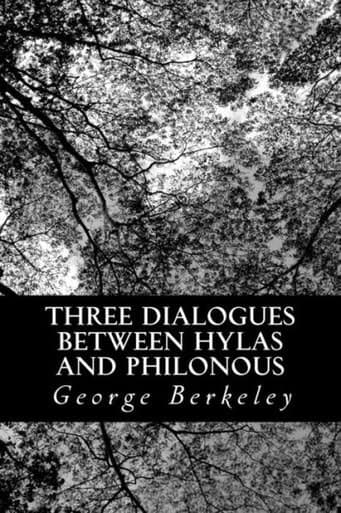
Three Dialogues between Hylas and Philonous
Berkeley's Three Dialogues is a dramatic restatement of immaterialism, written after the Principles met with incredulity. The central mechanism is the systematic dismantling of material substance through perceptual relativity and the conceivability argument: Hylas concedes that secondary qualities are mind-dependent, then that primary qualities are too, and finally that matter itself is an incoherent posit. Philonous argues that this position, far from being skeptical, is the only one that saves ordinary experience from the skeptic's doubts. The dialogue form allows Berkeley to stage the conversion of a materialist rather than simply assert the doctrine.
Key Insights
✦What is the central claim of the Three Dialogues, and why did Berkeley rewrite the Principles in dialogue form?
The central claim is that material substance does not exist and that physical objects are collections of ideas perceived by minds. Berkeley wrote the Dialogues because the Principles, published three years earlier, had met with incredulity: readers could not believe that a sane person would deny matter . The dialogue form was a strategic response. By staging the debate between Hylas (representing the materialist, particularly Locke) and Philonous (representing Berkeley), Berkeley could anticipate objections, dramatize the conversion of a skeptic, and present immaterialism as the vindication of common sense rather than its abandonment . The work's aim, as Berkeley states in the preface, is to treat more clearly and fully the principles laid down in the earlier book .
✦How does the argument from perceptual relativity work, and what does it accomplish?
Philonous uses perceptual relativity to show that qualities we take to be objective features of objects actually vary with the perceiver's condition and position. A mountain appears small from a distance; the same shape looks different under a microscope; heat feels pleasant to one hand and painful to another . Since an objective feature cannot change without a change in the object itself, these qualities cannot be objective. Philonous begins with secondary qualities like heat and colour, where the conclusion is relatively uncontroversial, then extends the argument to primary qualities like extension and figure. The cumulative effect is to leave Hylas with no quality that can be attributed to matter independently of a perceiving mind.
✦What is the conceivability argument, and how does it complete the case against matter?
The conceivability argument holds that we cannot form any idea of matter without sensible qualities. Try to conceive of a material substance stripped of all colour, texture, shape, and solidity, and nothing remains to conceive. Since we have no idea of matter apart from its sensible qualities, and those qualities are mind-dependent, the notion of mind-independent material substance is incoherent on empiricist principles . Hylas is forced to concede that he cannot attach any meaning to 'material substance' beyond the ideas it supposedly supports. Philonous does not need to prove that matter does not exist; he only needs to show that the concept is empty, and that is sufficient to dissolve the materialist's position.
✦How does Berkeley respond to the charge that immaterialism makes the world illusory or skeptical?
Philonous turns the charge of skepticism against Hylas. The materialist posits a world of matter behind our perceptions, but we can never know whether our perceptions resemble it, or even whether it exists. That is genuine skepticism. Immaterialism, by contrast, holds that the objects we perceive are the real things: the table I see and touch is the table, not a copy of some inaccessible material original . Berkeley insists that he is defending common sense against the philosophers who invented matter and then could not explain how we know it. The distinction between real things and imaginary ones survives: real things are ideas caused by God according to fixed laws, involuntary and coherent, while imaginary things depend on our own wills .
✦What changed in the 1734 edition, and does it affect the argument?
The 1734 edition was the third printing and the last in Berkeley's lifetime. It contains additions to the Third Dialogue, including two new objections from Hylas that turn on the charge that Philonous fails to observe parity of reasoning: his arguments against matter apply equally to spirit . The first is an inconceivability argument (we can no more conceive of a spirit than of matter), and the second is a substance argument. Philonous responds that we have a notion of spirit through inward feeling and reflection, not through an idea, and that the self is known as an active principle distinct from its perceptions . These additions sharpen the dialectic but do not alter the fundamental position.
✦How does the Three Dialogues relate to Locke's Essay Concerning Human Understanding?
The Dialogues are in large part a sustained critique of Locke's theory of substance and qualities. Hylas speaks for Locke when he defends the distinction between primary and secondary qualities and the notion of an unknown substratum supporting observable properties. Philonous attacks both positions: the primary/secondary distinction collapses under perceptual relativity, and the substratum is an unintelligible posit because we have no idea of it. Berkeley's strategy is to show that Locke's empiricism, followed consistently, leads to immaterialism rather than materialism. The Dialogues thus present Berkeley not as an opponent of empiricism but as the philosopher who drew out its radical consequences, completing a project that Locke had left inconsistent .
✦What is a common misconception about the Three Dialogues' conclusion regarding God?
A frequent misreading treats God as an ad hoc addition tacked onto the end of Berkeley's system to solve the problem of unperceived objects. In fact, God is integral to the argument from the beginning. Philonous argues that sensory ideas are involuntary—they impose themselves on us whether we will or not—and that their order and coherence exceed anything a finite mind could produce. Since ideas are passive and cannot cause themselves, they must be caused by another spirit, and the complexity of the world implies a wise and benevolent one . The famous question about the tree falling in the forest is answered not by positing a human observer but by the constant presence of the divine mind, which sustains the order of ideas even when no finite mind perceives them .
Wealthy Psyche is an intellectual archive. We do not host, distribute, or sell book copies — physical or digital. We provide structured knowledge to help you think better, faster.