


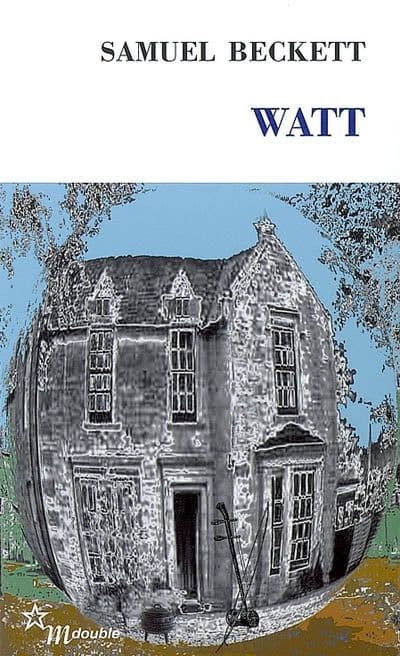
Watt

Watt follows its title character's arrival at Mr. Knott's house, where he serves as a servant and attempts to impose order on a world of meaningless objects and inexplicable routines. Its central mechanism is epistemological breakdown: Watt's obsessive enumeration of possible arrangements—of food, furniture, and people—fails to yield understanding, and language itself begins to dissolve into lists, inversions, and unnameable things. The novel's distinctive claim is that the attempt to explain the world is a form of exorcism that ultimately fails, leaving Watt unable to affirm anything, even his own existence, as real.
Key Insights
✦What is the central mechanism of Watt, and what does it reject?
The novel's mechanism is epistemological breakdown through obsessive enumeration. Watt, a servant in Mr. Knott's house, attempts to make sense of his world by cataloguing every possible arrangement of food, furniture, and people. These lists, which can run for pages, are efforts to exorcize the inexplicable by explaining it. What Watt rejects is the assumption that language and reason can capture reality. As the novel progresses, Watt's enumerations fail: a pot becomes 'not a pot' despite performing all the functions of a pot, and he can no longer affirm anything of himself without it seeming 'as false as if he had affirmed it of a stone' . The novel's method is to show reason consuming itself in the act of trying to master the world.
✦How did the wartime conditions of composition shape the novel's fragmented structure?
Beckett began Watt in Paris in February 1941 and continued it while fleeing the Gestapo, writing in Roussillon during the war years and finishing it in 1945 . He described it as written 'in dribs and drabs' and told Lawrence Harvey it was 'only a game, a means of staying sane, a way to keep my hand in' . This context is essential to the novel's form. The fragmented structure, the obsessive rituals, and the sense of waiting for something that never happens reflect the conditions of hiding and uncertainty. Beckett also kept the manuscript with him throughout the war, and it was later confiscated by British officials who suspected the cryptic nonsense they intercepted . The novel's incoherence is not a defect but a record of its composition under impossible conditions.
✦What is the significance of Mr. Knott, and why does Watt fail to understand him?
Mr. Knott is the novel's absent center, a figure whose routines and appearances Watt tries to master through observation and enumeration. Knott is described in contradictory ways, and his presence or absence is impossible to determine with certainty. Watt's failure to understand Knott is the novel's central failure: the servant cannot penetrate the master's logic because there is no logic to penetrate. Critics have read Knott as a god-like figure, an employer, or a psychoanalytic mother-figure, but the novel resists these reductions . What matters is that Watt's attempts to explain Knott produce only more elaborate descriptions that never yield comprehension. The relationship between servant and master is a closed system in which the subordinate's effort to know the superior is both necessary and futile.
✦How does the novel's language change over the course of the narrative?
The novel's language undergoes a visible deterioration that mirrors Watt's cognitive breakdown. The early chapters are relatively conventional, but as Watt's attempts to impose order fail, the prose becomes increasingly strange. Sentences invert their word order, lists proliferate, and words lose their referents. The addendum at the end of the novel, a collection of fragments and notes, pushes this dissolution further. This linguistic deterioration is not decorative; it enacts the novel's argument. If language cannot capture reality, then the novel must show language failing, not merely describe failure. Beckett's later work would develop this technique more radically, but Watt is the first extended demonstration of his method of using language against itself.
✦What was the novel's publication history, and why was it initially rejected?
Watt was completed in 1945 but not published until 1953, when Maurice Girodias's Olympia Press brought out a limited edition of 1,100 copies in Paris . No London, Dublin, or New York publisher would accept it at the time. The delay was due to the novel's difficulty and its resistance to conventional narrative expectations. Olympia Press was known primarily as a publisher of erotic fiction, making Watt an incongruous addition to its list. Grove Press, Olympia's American affiliate, published a larger edition in 1959, and the first British edition did not appear until 1963 . The novel's belated publication meant that it entered Beckett's oeuvre after Waiting for Godot had already made him famous, which shaped how readers approached this earlier, stranger work.
✦How does Watt relate to Beckett's other novels, particularly Murphy and the postwar trilogy?
Watt occupies a transitional position between Murphy and the trilogy of Molloy, Malone Dies, and The Unnamable. Like Murphy, it centers on a protagonist attempting to withdraw from the world, but where Murphy sought refuge in his mind, Watt seeks understanding through observation. The novel's breakdown of language and narrative anticipates the trilogy's more radical experiments. Beckett himself described Watt as having 'its place in the series' . The novel's composition during the war also marks a shift in Beckett's relationship to his Irish material: the landscape and details are drawn from his childhood in Foxrock, but the wartime context transforms them into something darker and more abstract . Watt is the hinge between the relative coherence of Murphy and the radical dissolution of the postwar work.
Wealthy Psyche is an intellectual archive. We do not host, distribute, or sell book copies — physical or digital. We provide structured knowledge to help you think better, faster.