


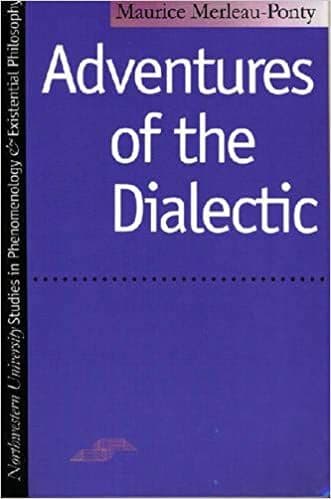
Adventures of the Dialectic

Merleau-Ponty's central target is the Marxist 'dialectic' that justifies revolutionary violence by positing history as a totalizing process moving inevitably toward freedom. He argues that this dialectic is a myth: history contains irreducible inertia, plurality, and ambiguity that no revolution can overcome. Through critical chapters on Weber, Lukács, Lenin, and Sartre, the book shows how the supposedly universal revolutionary class produces new particular ruling structures. Merleau-Ponty proposes instead a 'dialectic without synthesis' that acknowledges the permanent gap between intention and outcome, and a politics that abandons the dream of absolute truth-bearing power.
Key Insights
✦What is the central claim of Adventures of the Dialectic, and what does it reject?
The central claim is that the Marxist dialectic, as a philosophy of history that promises a final reconciliation of humanity with itself through revolution, is a myth. Merleau-Ponty argues that history contains an irreducible 'inertia'—a resistance, plurality, and opacity that no revolutionary action can fully overcome . He rejects the view that the Party can embody the true consciousness of the proletariat or that a permanent revolution can establish itself in power without creating new forms of oppression. The book's investigation of Weber, Lukács, Lenin, and Sartre is an attempt to 'go beyond the dialectic'—not to abandon political thought, but to think politics without the guarantee of a totalizing historical Reason .
✦What is the significance of the chapter on Sartre, and how did it affect their relationship?
The final chapter, 'Sartre and Ultrabolshevism,' is a sustained critique of Sartre's political philosophy, particularly as expressed in The Communists and Peace. Merleau-Ponty argues that Sartre's conception of the Party as the pure embodiment of revolutionary action stems from a fundamental flaw in his philosophy: the inability to conceptualize 'inertia'—the weight of institutions, circumstances, and the plurality of the working class . By apodictically identifying the true proletarian with the loyal Party follower, Sartre denies the possibility of independent political consciousness. This critique effectively ended the friendship between the two philosophers, and Sartre responded indirectly in Search for a Method and the Critique of Dialectical Reason .
✦What role does Max Weber play in the book's argument?
Weber serves as a crucial interlocutor for Merleau-Ponty's attempt to think history without the Marxist guarantee of meaning. Merleau-Ponty draws on Weber's 'ideal types' and his conception of a 'politics of understanding' that has learned to doubt itself . Weber represents a form of liberalism that acknowledges the ambiguity of historical action, in contrast to both Sartre's moralism and the dogmatic Marxism of the Party. The chapter on Weber prepares the ground for Merleau-Ponty's own position: a politics that abandons the search for absolute legitimacy and instead seeks a power that is 'not unjust,' one that operates through tacit consent and acknowledges its own limits .
✦What is the publication and translation history of the work?
Adventures of the Dialectic was first published in French as Les Aventures de la dialectique by Librairie Gallimard in Paris in 1955 . The English translation by Joseph Bien was published by Northwestern University Press in Evanston in 1973, as part of the Studies in Phenomenology and Existential Philosophy series . The translation runs 237 pages and includes an introduction by the translator. The book was written during a period of intense political reflection for Merleau-Ponty, following the publication of Humanism and Terror (1947) and preceding his death in 1961. It remains the most sustained statement of his critique of revolutionary Marxism.
✦How has the book been received, and what is its place in Merleau-Ponty's oeuvre?
Reception has been mixed, reflecting the book's controversial political content. A contemporary review in The Review of Metaphysics noted that the book continues Merleau-Ponty's attempts to come to grips with Marxism, focusing on the struggle between the proletariat and the Party for a valid revolutionary praxis . Later scholarship has recognized the book as a crucial document in the Merleau-Ponty-Sartre debate, with some arguing that Sartre's later work was shaped as a response to Merleau-Ponty's criticisms . Within Merleau-Ponty's oeuvre, it occupies a transitional position: it develops the political themes of Humanism and Terror while pointing toward the ontology of The Visible and the Invisible, particularly in its emphasis on ambiguity and the 'flesh' of history .
✦What is a common misconception about the book's political stance?
A frequent misconception is that Adventures of the Dialectic represents a straightforward abandonment of Marxism or a turn to liberal anti-communism. Merleau-Ponty's position is more nuanced. He does not reject Marx's insights into class and alienation; he rejects the philosophical framework that turns those insights into a guaranteed philosophy of history. The book's preface explicitly states that a philosophy of history and spirit is needed, but that one should not wait for perfectly elaborated principles before speaking philosophically about politics . Merleau-Ponty's target is dogmatic Marxism, not the entire tradition of critical social thought. His alternative is a 'new liberalism' that acknowledges conflict and ambiguity rather than promising their resolution .
Wealthy Psyche is an intellectual archive. We do not host, distribute, or sell book copies — physical or digital. We provide structured knowledge to help you think better, faster.