


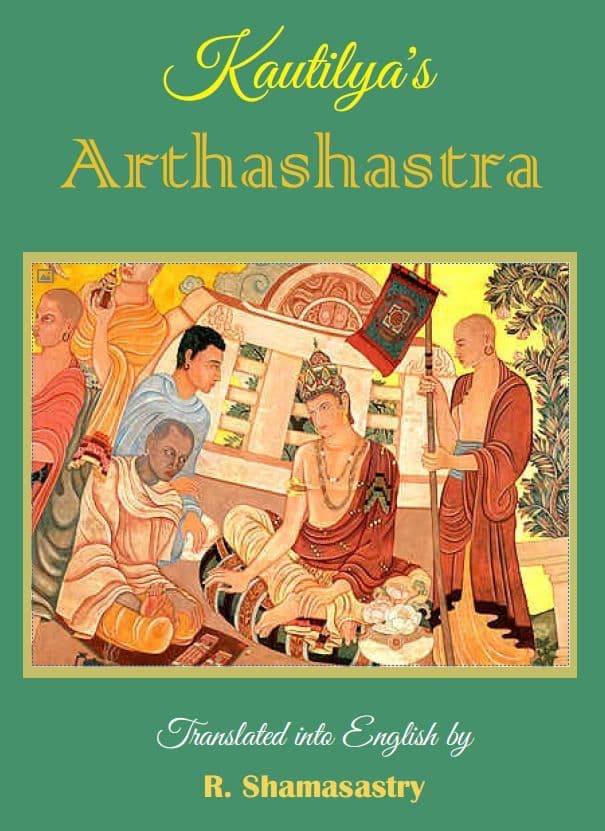
Arthashastra

The Arthashastra is a comprehensive Sanskrit treatise on statecraft, economic policy, and military strategy, traditionally attributed to Kautilya (Chanakya). Its central argument is that the state's prosperity and security depend on a rigorously administered treasury, a disciplined bureaucracy, and a pragmatic foreign policy. The text covers the duties of the king, the structure of government, taxation, law, espionage, and diplomacy. Modern scholarship, however, has established that the extant text is a composite work, expanded and redacted over centuries, rather than the product of a single author.
Key Insights
✦What is the central claim of the Arthashastra, and what does it reject?
The Arthashastra's central claim is that the state's power and security rest on a well-organized treasury, a disciplined and supervised bureaucracy, and a pragmatic, often ruthless, foreign policy. It rejects the idea that governance can be left to custom or moral suasion alone. The text presents a comprehensive manual: it details the king's duties, the appointment and surveillance of officials, systems of taxation and revenue collection, civil and criminal law, the management of spies, and the conduct of diplomacy and war . Its approach is utilitarian and empirical, aimed at the material prosperity of the state and the preservation of the king's authority, rather than at spiritual or ethical instruction.
✦Is the Arthashastra the work of a single author, Kautilya?
Modern scholarship has established that the extant Arthashastra is not the product of a single author. Thomas R. Trautmann's statistical analysis of the text's style in 1971 demonstrated that it is a composite work, with different sections exhibiting distinct stylistic features, indicating multiple authors or redactors over time . Mark McClish's more recent historiographical study explicitly rules out the possibility that the text could have been produced at one time by a single author . While the text is traditionally attributed to Kautilya (identified with Chanakya and Vishnugupta), the name functions more as a label of authority for a tradition of statecraft than as a reliable indicator of single authorship .
✦What is the textual history and estimated date of composition?
The Arthashastra was composed, expanded, and redacted over a long period, with scholarly estimates ranging from the 2nd century BCE to the 3rd century CE . The text was influential until around the 12th century, after which it disappeared from circulation until a manuscript was handed over to the Mysore Government Oriental Library at the beginning of the twentieth century . This rediscovery led to the first edition and translation by R. Shamasastry in 1915. The colophons of the text attribute it to Kautilya, but a concluding verse also mentions Vishnugupta as having 'did' the sutra and bhasya, a reference that has been interpreted as indicating a redactor rather than the original author .
✦How did the identification of Kautilya with Chanakya arise, and is it historically reliable?
The identification of Kautilya with Chanakya, the legendary minister of Chandragupta Maurya, appears to be a relatively late development. The name Vishnugupta first occurs in the text itself, where it is not necessarily identical with Kautilya. The old historical literature up to about the 4th century CE does not know of Vishnugupta; the name appears for Kautilya only after the 6th–7th century CE, a period when it was common for commentators to make fabrications about authorship and identifications . Trautmann's study of the literary history of the Chanakya legend concluded that the historicity of the supposed author is uncertain . The traditional attribution should therefore be treated as a matter of literary convention rather than secure historical fact.
✦What role does espionage play in the Arthashastra, and how extensive is the text's treatment of it?
Espionage is a central and extensive topic in the Arthashastra, reflecting the text's pragmatic and suspicious view of human nature and political life. The text categorizes spies into several types: 'classmate spies' (orphans trained in various arts and sciences), 'fiery spies' (desperados willing to confront danger), 'poisoners' (cruel and indolent individuals), and 'wandering spies' including women ascetics and shaven-headed women . These spies are deployed to monitor ministers, priests, army commanders, the heir-apparent, and other high officials, as well as to gather intelligence in foreign territories. The text prescribes elaborate procedures for their recruitment, disguise, and communication, and it emphasizes that the institutes of espionage should operate with such secrecy that spies do not know each other .
✦What are the main topics covered in the Arthashastra's fifteen books?
The Arthashastra is divided into fifteen books that cover a vast range of subjects. Book I concerns the king and his discipline, including the appointment of ministers and the institution of spies. Book II details the duties of government superintendents and covers the formation of villages, division of land, construction of forts, revenue collection, accounting, and the examination of government servants . Book III deals with law, Book IV with the removal of thorns (criminal administration), and Book V with the conduct of courtiers. Books VI through XIV concern foreign policy, war, and diplomacy, including the circle of states and the conduct of allies and enemies. Book XV covers the plan of a treatise and the thirty-two methods of treatment .
✦What is a common misreading of the Arthashastra's economic policy?
A common misreading treats the Arthashastra's economic policy as purely extractive, focused solely on filling the royal treasury through any means. The text does prescribe severe measures and even deceptive techniques for acquiring wealth in emergencies . However, it also articulates a sophisticated understanding of taxation's limits. Kautilya advises that taxation should be gradual, based on net profits rather than gross earnings, and that an article should be taxed only once. Excessive taxation is warned against, and officers who collect more than the allotted tax are to be punished. The rationale is pragmatic: the king should protect the goose that lays the golden egg, recognizing that oppressive assessments reduce the incentive to produce and ultimately diminish the state's revenue .
Wealthy Psyche is an intellectual archive. We do not host, distribute, or sell book copies — physical or digital. We provide structured knowledge to help you think better, faster.