


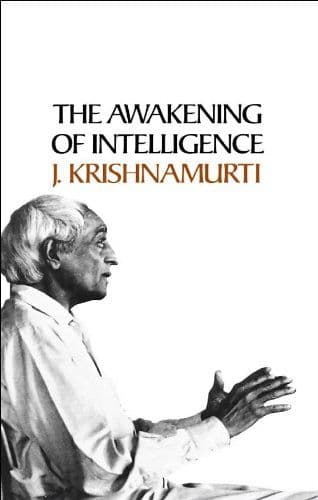
The Awakening of Intelligence

Krishnamurti's central argument is that intelligence is not the product of thought, knowledge, or accumulated experience, but a quality of mind that arises only when thought ceases to dominate psychological life. Through dialogues and talks spanning America, India, and Europe, he distinguishes the mechanical, measurable operation of thought from a choiceless awareness in which intelligence operates. This intelligence is not personal or cultivated; it is the perception of what is without the interference of the observer, and it alone can bring about a radical transformation of the mind.
Key Insights
✦What is the central claim of The Awakening of Intelligence, and what does it reject?
Krishnamurti's central claim is that intelligence is not the same as thought. Thought is a material, mechanical process geared to the measurable and the temporal; it is necessary for practical life but cannot solve psychological problems because it is itself the source of fragmentation . Intelligence, by contrast, is of a different order—it is not accumulated through knowledge or cultivated by discipline. The book rejects the assumption that more thinking, analysis, or belief can bring about clarity. Intelligence arises only when the mind is choicelessly aware, when the observer is not separate from the observed. This awakening is not an achievement but the perception of what is without distortion.
✦What is the distinction between thought and intelligence, and why does it matter?
Krishnamurti treats thought as the response of memory—a mechanical, measurable process that operates through images, conclusions, and the past. Intelligence is not the product of thought; it is a perception that is not conditioned by the known. The distinction matters because it determines whether the mind can be free. If intelligence were merely refined thought, then effort, discipline, and the accumulation of knowledge would be the path. But because intelligence is of a different quality, the attempt to become intelligent through thought only perpetuates the mechanical cycle. The awakening of intelligence requires the cessation of the psychological movement of thought, not its improvement.
✦How does the book's structure reflect its origin in talks and dialogues?
The book is a compilation of Krishnamurti's talks, discussions, and private conversations conducted since 1967 in America, India, and Europe . Its structure follows geography rather than a systematic argument: sections on America, India, and Europe, each containing talks and dialogues with interlocutors including Jacob Needleman, Alain Naudé, Swami Venkatesananda, and David Bohm . This origin explains the book's conversational, exploratory texture. Questions are raised and probed rather than answered definitively. The final dialogue with Bohm, 'On Intelligence,' crystallizes many of the themes developed throughout. The book is not a treatise to be studied but a record of inquiry to be entered into.
✦How did the book's publication and editorial history unfold?
The Awakening of Intelligence was first published in 1973 by Victor Gollancz in London and Harper & Row in New York . It was edited by Cornelia and George Wingfield Digby, who selected and arranged the material from talks and conversations spanning several years . A HarperCollins paperback edition followed in 1987, and the book has been reissued in various formats, including a Penguin Books India edition in 2000 and an unabridged audio edition narrated by Mike Fraser . The editorial mediation is significant: the Wingfield Digbys shaped scattered talks into a coherent volume, and readers should approach it as a curated presentation rather than a verbatim transcript.
✦How does the book relate to Krishnamurti's earlier and later works?
The Awakening of Intelligence extends the inquiry of Freedom from the Known (1969) and The First and Last Freedom (1954) into a more comprehensive survey of Krishnamurti's themes. Where the earlier books focused on the individual's psychological conditioning and the illusion of the observer, this volume broadens the scope to include discussions of good and evil, religious experience, meditation, and the nature of the sacred. The final dialogue with David Bohm anticipates The Ending of Time (1985), in which the two men would continue their investigation of thought, time, and insight. The book is thus a mid-point in Krishnamurti's published corpus, consolidating earlier insights while opening toward later dialogues.
✦What is a common misreading of the book's treatment of intelligence?
A common misreading takes the distinction between thought and intelligence as a counsel to abandon thinking altogether. This is not Krishnamurti's position. Thought has its proper place in the practical, technical, and functional domains of life. The problem is that thought has usurped a function it cannot perform: the resolution of psychological conflict, the attainment of security, the pursuit of the sacred. The book does not advocate the cessation of practical thought but asks whether a different faculty—intelligence, attention, choiceless awareness—can operate alongside thought without being contaminated by its fragmentary movement. Reading the book as anti-intellectualism flattens a subtle inquiry into a crude rejection of reason.
Wealthy Psyche is an intellectual archive. We do not host, distribute, or sell book copies — physical or digital. We provide structured knowledge to help you think better, faster.