


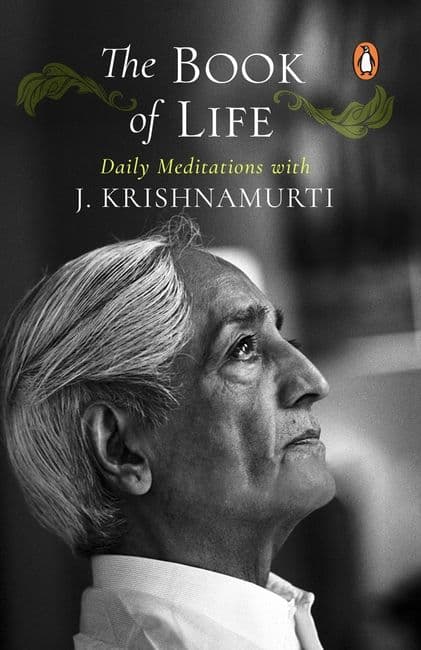
The Book of Life: Daily Meditations with Krishnamurti

The Book of Life is not a treatise but a structured daily reader: 365 selections drawn from Krishnamurti's talks and writings, arranged thematically over seven-day cycles that explore self-knowledge, authority, fear, desire, relationship, and meditation. Its central argument, reiterated across the year, is that truth is found in the active present—not through accumulated belief, authority, or psychological time. Each day's meditation invites the reader to observe the movement of the self without choice or condemnation, so that the transformation of the world begins with the transformation of one's own mind.
Key Insights
✦What is the central claim of The Book of Life, and how does its daily format embody it?
The central claim is that truth is found through living, in the active present, and not through the accumulation of belief, the following of authority, or the pursuit of psychological time. The daily format is not incidental: by presenting one short meditation for each day of the year, arranged in weekly thematic cycles, the book invites a practice of sustained attention rather than a single act of comprehension. Each entry poses a question or observation—about listening, fear, desire, or meditation—that the reader is meant to carry through the day. The format resists the temptation to treat the teachings as a body of knowledge to be mastered, insisting instead that insight must be renewed in the present .
✦How was the book compiled, and what are the implications of its editorial form?
The Book of Life is a curated collection, not a continuous work written by Krishnamurti. It presents 365 daily meditations selected from his published talks, dialogues, and writings, organized thematically over seven-day cycles across twelve months . This editorial mediation is essential to understanding the book: the coherence of each week's theme is the compiler's achievement, not Krishnamurti's own arrangement. The selections span material from as early as 1933 through 1968, which means the reader encounters Krishnamurti's voice across several decades of his teaching . The book should therefore be read as an introduction or a devotional companion, not as a systematic exposition of his philosophy.
✦How does the book's treatment of belief and authority relate to Krishnamurti's broader teaching?
One of the book's recurring themes is that belief—religious, political, or psychological—acts as a screen that prevents self-knowledge. In a passage selected for the collection, Krishnamurti asks whether the acceptance of belief is not a hiding place from the fear of emptiness, and concludes that a mind full of beliefs is 'not creative; it is merely repetitive' . This is continuous with his broader rejection of all authority, including the authority of teachers and scriptures. The Book of Life does not ask the reader to believe Krishnamurti; it asks the reader to observe the movement of belief in oneself. The daily format supports this by returning the reader repeatedly to the act of looking, rather than to the content of what is said.
✦What is a common misreading of the book's purpose?
A common misreading treats The Book of Life as a collection of inspirational affirmations or motivational quotes, to be read for comfort or uplift. This flattens the radical character of Krishnamurti's inquiry. The meditations are not affirmations; they are probes, often unsettling, into the ways the mind deceives itself. The book's title is not a promise that life will become easy, but an invitation to read the 'book' that one is—the accumulated fears, beliefs, and memories that constitute the self . Reading it as a source of daily reassurance misses the demand it makes: that the reader observe without choice, without seeking consolation, and without the hope of becoming something other than what is.
✦How does the book's publication history reflect its status as a posthumously assembled collection?
The Book of Life was published in 1995 by HarperSanFrancisco, nearly a decade after Krishnamurti's death in 1986 . It was assembled by editors from his existing corpus, and its publication date places it among the posthumous compilations that have continued to introduce his teachings to new readers. The book's subtitle, 'Daily Meditations with Krishnamurti,' signals its function as a companion rather than a primary text. Readers should be aware that the selections and their arrangement reflect editorial judgment, and that the book does not represent a work Krishnamurti himself conceived or authorized as a unified volume.
Wealthy Psyche is an intellectual archive. We do not host, distribute, or sell book copies — physical or digital. We provide structured knowledge to help you think better, faster.