


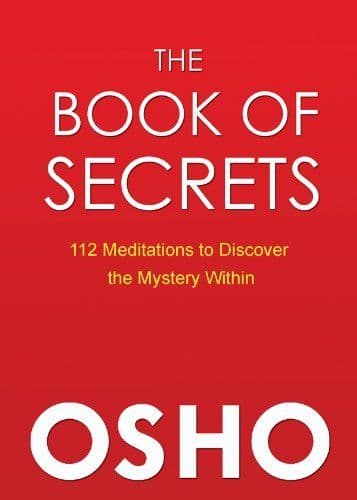
The Book of Secrets
The Book of Secrets is a transcription of Osho's discourses on the Vigyan Bhairav Tantra, an ancient Hindu text of 112 meditation techniques. Its distinctive mechanism is Osho's systematic reinterpretation: he treats each technique not as a ritual instruction but as a pointer toward witnessing consciousness, arguing that Tantra's real secret is awareness itself, not the specific method. The book's scale—over eighty discourses delivered between 1972 and 1973—makes it Osho's most sustained engagement with a classical Indian source, and its central claim is that these techniques are the source of all meditation methods worldwide.
Key Insights
✦What is Osho's central interpretive claim about the Vigyan Bhairav Tantra?
Osho's governing claim is that the Vigyan Bhairav Tantra is not a sectarian Hindu text but the source book of all meditation techniques known worldwide. He asserts that Buddhists, Sufis, and even Gurdjieff borrowed their methods from it, and that the 112 techniques are not about manipulating the mind but about finding the door outside the mind altogether . This universalizing move allows him to treat the text as a perennial manual of consciousness rather than a historical Tantric document. The book's method is therefore expansive rather than exegetical: each verse becomes an occasion for Osho to elaborate his own understanding of witnessing awareness, which he presents as the hidden essence behind all the specific techniques.
✦When were these discourses delivered, and how did they become a book?
The discourses were delivered in Bombay (Mumbai) between October 1, 1972, and November 8, 1973, comprising eighty talks in total . They were first published in 1974 by Harper & Row, with later editions from Thames and Hudson and other publishers . The original series was simply called Vigyan Bhairav Tantra; for book publication it was divided into five volumes titled The Book of the Secrets, each containing sixteen discourses. Later editions collected all eighty discourses into a single large volume, with the 1998 St. Martin's Press edition running over 1,100 pages . This publication history explains why different editions vary so dramatically in length and pagination.
✦Does Osho's presentation of the 112 techniques correspond to the Sanskrit original?
This is a genuinely contested question. A comparison posted on the Hinduism Stack Exchange noted that while the first two or three methods in Osho's book appear to match standard translations such as Swami Laxman Joo's, from around the fifth method onward Osho's presentations diverge significantly from the Sanskrit textual tradition . The forum questioner asked whether Osho rearranged the methods or introduced entirely new practices. No peer-reviewed scholarly study appears to have resolved this definitively. What is clear is that Osho did not present himself as a philological translator; his discourses are interpretive elaborations, and the techniques as he describes them may reflect his own understanding rather than a strict rendering of the Sanskrit verses.
✦How does The Book of Secrets differ from Osho's other discourse series on religious texts?
The Book of Secrets is Osho's most sustained engagement with a classical Indian source, dwarfing his treatments of the Gospel of Thomas or Atisha's lojong in scale and ambition. Unlike The Mustard Seed, where the Thomas sayings serve as brief launching points, the Vigyan Bhairav Tantra provides a structured sequence of 112 techniques that Osho works through systematically over eighty discourses. This gives the book a pedagogical architecture absent from his more free-form question-and-answer series. The text's sheer length—over a thousand pages in most editions—also distinguishes it: it is the closest Osho comes to a comprehensive commentary on a single Indian scripture, even as its interpretive liberties remain considerable.
✦How has the book been received by professional reviewers and scholars?
Scholarly and professional reception has been limited. The Library of Congress catalog description frames it neutrally as 'a contemporary approach to 112 meditations described in the Vigyan Bhairav Tantra,' noting Tantra's historical confinement to 'small, hidden mystery schools' . Reader reception, by contrast, has been substantial: Goodreads records thousands of ratings across editions, with average scores in the 4.1 to 4.6 range depending on the edition . This pattern—negligible academic attention alongside strong devotional readership—is characteristic of Osho's published discourse literature. No peer-reviewed critical study of The Book of Secrets as a textual or philosophical work appears to exist, and the book's status as a transcription of oral performances further complicates its evaluation as a work of scholarship.
✦What is the most common misconception about The Book of Secrets?
The most persistent misconception is that the book is a reliable guide to the Vigyan Bhairav Tantra's original meaning or a faithful translation of its Sanskrit verses. Osho himself did not claim this. His discourses treat the text as a springboard for his own teaching on awareness, and he freely universalizes its techniques as the common inheritance of all mystical traditions. Readers seeking a philologically grounded study of the Sanskrit text should consult translations by Swami Laxman Joo or Swami Satyasangananda Saraswati, which work verse by verse with the original language. The Book of Secrets is valuable as a record of Osho's interpretive genius and pedagogical style, not as a window onto the historical Vigyan Bhairav Tantra.
Wealthy Psyche is an intellectual archive. We do not host, distribute, or sell book copies — physical or digital. We provide structured knowledge to help you think better, faster.