


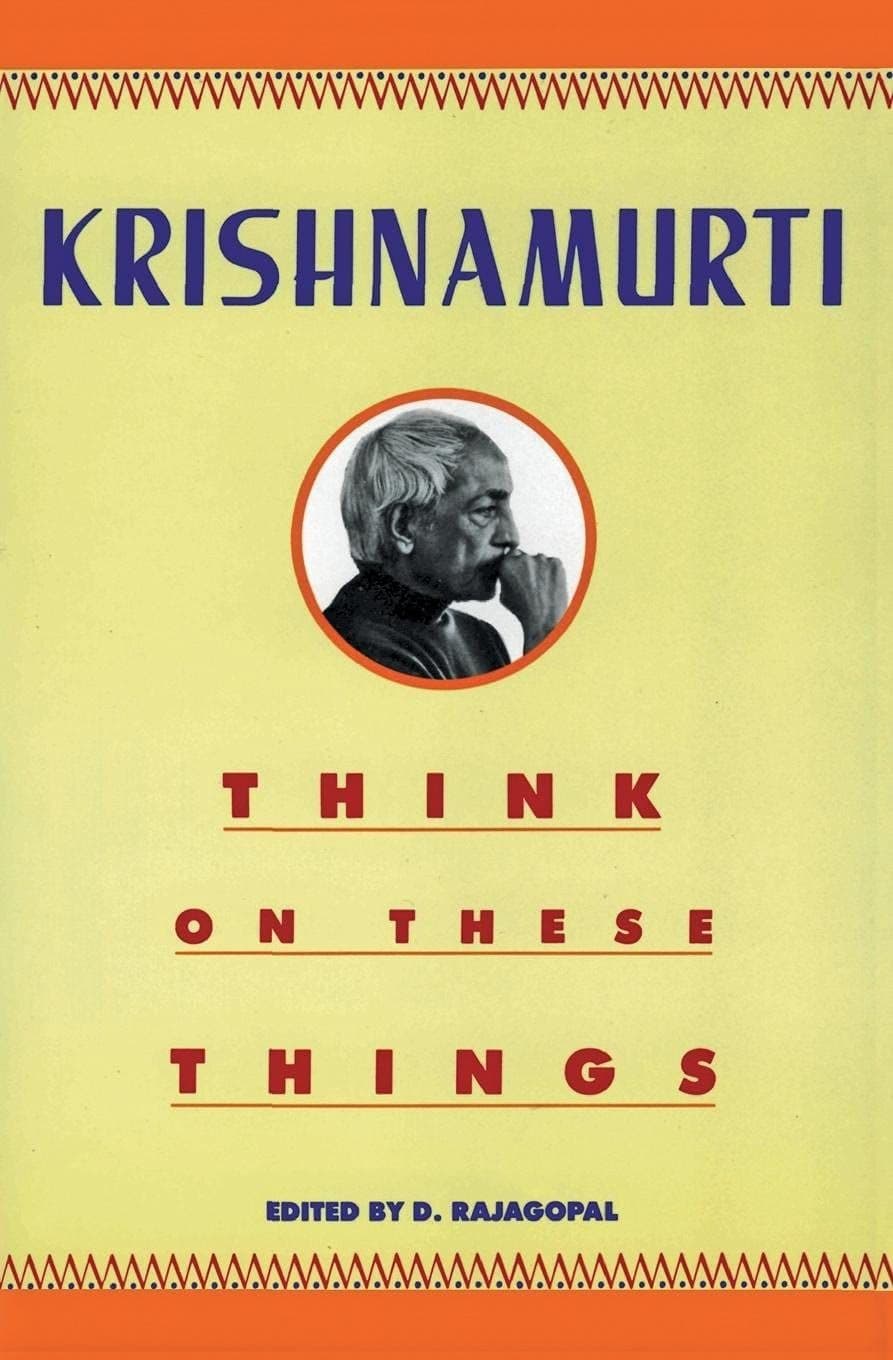
Think on These Things

Krishnamurti's central argument is that the transformation of society begins with the radical self-understanding of the individual, not with external reform. Through dialogues originally addressed to students and teachers in India, he examines how conditioning—by education, tradition, ambition, and fear—distorts perception and breeds conflict. The book's method is not prescription but inquiry: by observing 'what is' without the filter of ideal or prejudice, the mind discovers a choiceless awareness from which right action arises. Freedom, for Krishnamurti, is not the pursuit of a future ideal but the immediate seeing of fact.
Key Insights
✦What is the central claim of Think on These Things, and what does it reject?
Krishnamurti argues that the root of human conflict and social deterioration lies in the conditioned mind—the mind shaped by ambition, fear, tradition, and the pursuit of ideals. The book rejects the assumption that external reform, political revolution, or the following of authority can bring about fundamental change. Instead, it insists that transformation must begin with the individual's direct observation of 'what is,' without the distorting lens of what 'should be.' This observation is not a method to be practiced but a choiceless awareness in which the mind sees its own conditioning and, in that seeing, ceases to be bound by it. Freedom is thus not a future achievement but an immediate fact of perception.
✦What is 'choiceless awareness,' and how does it differ from concentration or disciplined attention?
Choiceless awareness is Krishnamurti's term for a state of observation in which the mind watches without selecting, judging, or condemning. It is not concentration, which implies an effort to focus on one thing and exclude others; nor is it a discipline to be cultivated through practice, which would presuppose a goal and a self that strives toward it. In the book's dialogues, Krishnamurti repeatedly returns to the distinction between the observer and the observed: as long as there is an observer who wants to change what is observed, there is conflict. Choiceless awareness arises when this division collapses, when the mind simply sees its own movement—envy, fear, ambition—without naming or resisting it. Out of this seeing comes a transformation that effort could never produce.
✦The material was originally presented as talks to students and teachers. How does this origin shape the book's form?
The book's origin in talks to students, teachers, and parents in India is evident in its form. Each chapter typically begins with a question posed by a student or a teacher—about fear, jealousy, ambition, or the meaning of education—and Krishnamurti responds not with a doctrine but with an invitation to inquire together. The editor's note describes the material as originally presented in this format, and the dialogues retain their conversational, probing quality . This origin explains why the book avoids systematic exposition: it is not a treatise but a series of experiments in shared attention, where the reader is invited to participate in the inquiry rather than receive conclusions. The result is more accessible than Krishnamurti's more formal works, though the underlying insights are the same.
✦How does the book treat the function of education, and how does this relate to Krishnamurti's broader work?
The opening chapter, 'The Function of Education,' sets the tone for the book. Krishnamurti argues that education as it is practiced—aimed at producing efficient workers, conformists, or achievers—conditions the mind and perpetuates conflict. The true function of education, he insists, is to help the individual discover freedom, which means understanding one's own conditioning and the ways in which fear and ambition distort perception. This theme runs through the book and connects it to Krishnamurti's broader educational work, including the schools he founded in India, England, and the United States. The book is not a manual for teachers but a challenge to the assumptions underlying all education: that the young must be shaped according to a pattern, and that knowledge alone constitutes intelligence.
✦How was the book edited, and what is its publication history?
The book was edited by D. Rajagopal, Krishnamurti's longtime associate and editor, and first published by Harper & Row in 1964 . Rajagopal's editorial role was significant: he selected and arranged the talks, shaping them into the book's twenty-chapter structure, and the volume's coherence is as much editorial as it is authorial. The book has been reissued many times, including a HarperCollins paperback in 1989 and a Jaico edition in 2024 . Its enduring popularity is reflected in the range of editions and translations, though readers should note that the editor's mediation means the book is not a verbatim transcript of Krishnamurti's talks but a curated presentation of them.
✦What is a common misreading of the book's rejection of authority and ideals?
A common misreading takes Krishnamurti's rejection of authority and ideals as a counsel of passivity or amorality—as if he were saying that one should simply accept whatever is and make no effort. This misreads the nature of choiceless awareness. Krishnamurti does not advocate inaction; he advocates action that arises from clear seeing rather than from the dictates of a conditioned mind. The rejection of ideals is not a rejection of values but a recognition that the pursuit of an ideal—of what 'should be'—diverts attention from what is, and that this diversion is itself a form of violence. The book's challenge is more demanding than conventional morality: it asks for an attention so total that the mind ceases to be the prisoner of its own past, and from that attention, right action is said to follow without effort or prescription.
Wealthy Psyche is an intellectual archive. We do not host, distribute, or sell book copies — physical or digital. We provide structured knowledge to help you think better, faster.