


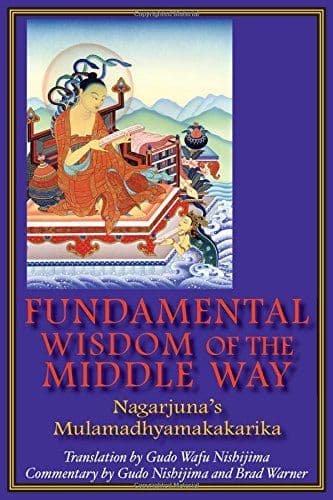
Mūlamadhyamakakārikā
The Mūlamadhyamakakārikā is the foundational Madhyamaka treatise in which Nāgārjuna dismantles the notion of svabhāva—inherent, independent existence—across every major Buddhist philosophical category, from causation and the aggregates to the self and nirvana. Its distinctive method is not to assert a new metaphysical position but to demonstrate that any theory positing intrinsic nature collapses into contradiction. Chapter XXIV, the 'Examination of the Four Noble Truths,' supplies the treatise's philosophical hinge: emptiness and dependent origination are coextensive, and only this identification rescues causality, ethics, and the Buddha's teaching from nihilistic dissolution .
Key Insights
✦What is the central claim of the Mūlamadhyamakakārikā, and what does it reject?
The MMK's governing thesis is that no phenomenon possesses svabhāva—inherent, independent existence—and that what exists at all exists only through dependent origination. What the text rejects is not existence as such but the metaphysical bedrock that earlier Buddhist schools, particularly the Sarvāstivādins, attributed to their dharma categories. Nāgārjuna argues that if anything existed by its own nature, it could not arise, cease, or enter into causal relations; since phenomena manifestly do arise and cease, they must lack intrinsic nature. Emptiness is therefore not a substance or a new ultimate reality but the designation for this absence of svabhāva, and Chapter XXIV insists that without emptiness, causality and the Four Noble Truths themselves would be impossible .
✦How does Candrakīrti's interpretation shape the reading of the MMK, and is it authoritative?
Candrakīrti's Prasannapadā, composed centuries after Nāgārjuna, became the dominant Sanskrit commentary and heavily influenced Tibetan and modern Western readings. However, David J. Kalupahana argued forcefully that Candrakīrti moved toward a Vedantic interpretation that diverges from Nāgārjuna's original standpoint, and that Kumārajīva's earlier Chinese translation of the Chung-lun (Zhong lun) is a more faithful witness to Nāgārjuna's own philosophical commitments . This is not a minor scholarly quibble: it raises the question of whether the MMK as routinely taught in Tibetan-influenced curricula is Nāgārjuna's text or Candrakīrti's systematization of it. Readers should be aware that the commentarial tradition is not a transparent window onto the root text.
✦What was the Svātantrika-Prāsaṅgika dispute, and how does it relate to the MMK?
This schism emerged in the centuries after Nāgārjuna as commentators diverged on method. Buddhapālita (c. 470–550) advocated pure prasaṅga—non-affirming negation that dismantles an opponent's position without positing a counter-thesis. Bhāviveka (c. 490–570) rejected this as insufficient and argued for svātantra-anumāna, autonomous inference that positively reconstructs Madhyamaka arguments. Candrakīrti later defended Buddhapālita, and the Tibetan tradition retrojected these positions as the Prāsaṅgika and Svātantrika schools . The MMK itself does not explicitly adjudicate this dispute; the text's dialectical flexibility allowed both readings to claim fidelity to Nāgārjuna. Understanding the schism is essential for grasping how a single root text generated incompatible methodological programs.
✦What is the most common misreading of the MMK's doctrine of emptiness?
The most persistent misreading treats emptiness as a form of nihilism—as though Nāgārjuna were claiming that nothing exists at all. The MMK explicitly anticipates and rejects this charge in Chapter XXIV, where an opponent accuses the doctrine of emptiness of destroying the Four Noble Truths, and Nāgārjuna responds that it is precisely the reificationist who cannot account for causality, change, or liberation. Emptiness means dependent origination: things exist conventionally, as dependently arisen processes, but lack the independent essence that naive realism and substantialist metaphysics attribute to them. Reading the MMK as a denial of the world rather than as a diagnosis of misplaced absoluteness inverts its soteriological purpose and misses its argumentative structure .
✦How has the MMK's argument held up in light of subsequent Buddhist epistemology?
The MMK's dialectic was formulated before the development of Buddhist pramāṇa theory, and later thinkers such as Bhāviveka and Dharmakīrti wrestled with whether Nāgārjuna's refutations could be reconstructed as formally valid inferences. The text's method is predominantly reductio ad absurdum: it takes an opponent's thesis and shows that it entails contradictions. Whether this constitutes a complete philosophical method or requires supplementation by autonomous reasoning remains contested. Jan Westerhoff and other contemporary scholars have examined the MMK through the lens of modern logic and metaphysics, finding its anti-foundationalism surprisingly robust, though the question of how emptiness functions as a truth-claim—rather than merely a therapeutic negation—continues to generate debate .
✦Which English translation of the MMK should a serious reader use?
Jay L. Garfield's 1995 The Fundamental Wisdom of the Middle Way (Oxford University Press) is the most widely used English translation and includes a substantial philosophical introduction informed by Tibetan commentarial tradition, particularly Tsongkhapa. David J. Kalupahana's 1991 Mulamadhyamakakarika of Nagarjuna (Motilal Banarsidass) offers a competing interpretation that deliberately distances Nāgārjuna from Candrakīrti and reads him in light of early Buddhist empiricism . For readers without Sanskrit or Tibetan, Garfield is the standard entry point, but Kalupahana's translation is essential for anyone seeking to understand the contested nature of Madhyamaka interpretation. No English translation is neutral; each embeds a commentarial lineage.
Wealthy Psyche is an intellectual archive. We do not host, distribute, or sell book copies — physical or digital. We provide structured knowledge to help you think better, faster.