


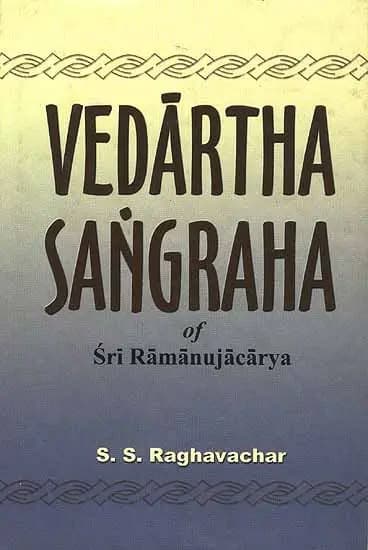
Vedarthasangraha

The Vedarthasangraha is Ramanuja's independent summary of the Upanishads' meaning, composed before his Sri Bhashya, and its distinctive method is to reconcile apparently contradictory Upanishadic passages by reading them through a Visishtadvaita framework of Brahman as the supreme self of both world and souls. Unlike a formal commentary on a single text, it ranges freely across the Upanishads to argue against Advaita and Bhedabheda rivals, establishing that the Upanishads consistently teach a theistic reality in which difference and non-difference coexist. Its central claim is that Brahman, identified as Vishnu-Narayana, is the inner self of all existence.
Key Insights
✦What is the Vedarthasangraha's distinctive function within Ramanuja's corpus?
The Vedarthasangraha is Ramanuja's only work that presents his interpretation of the Upanishads as a whole, since he wrote no direct commentary on any individual Upanishad. Swami Adidevananda described it as occupying a unique place because it takes the place of an Upanishad commentary while being an independent exposition rather than a conventional gloss . The text was composed before the Sri Bhashya and is explicitly referred to in that later work, establishing its chronological priority . Its purpose is to demonstrate that the Upanishads consistently teach Visishtadvaita, reconciling passages that affirm difference with those that affirm non-difference by reading Brahman as the inner self of both world and souls .
✦How does the Vedarthasangraha argue against Advaita and other rival schools?
The text is structured as a sustained polemic, moving through a critical review of the Advaitic interpretation of 'Tattvamasi' and a re-interpretation of Advaitic texts generally, before a metaphysical examination of the Advaitic position . Ramanuja also engages the Prabhakara Mimamsakas, arguing against their view that language only denotes things to be done (karya) and that the Veda can therefore only bear on action, not on an independently existing reality . He further examines the positions of Bhaskara and Yadava-prakasha, representatives of Bhedabheda and other rival Vedantic readings . The cumulative argument aims to show that only Visishtadvaita can coherently account for the Upanishads' teaching on Brahman, world, and self.
✦How has Western scholarship assessed the Vedarthasangraha's place in Ramanuja's thought?
Scholarship has generally recognized it as Ramanuja's philosophical debut and a key to his system. Van Buitenen's 1956 edition and translation for Deccan College was the foundational Western presentation of the text, providing the Sanskrit text alongside English translation and introduction . More recent scholarship has approached it as a 'scholastic' text, with one study arguing that because it is not a commentary on a single text, Ramanuja was relatively free to shape its sequence and deploy source texts against opponents—particularly Prabhakara Mimamsakas, Bhedabheda Vedantins, and Advaitins—in a self-consciously structured way . The text is also valued for going further than the Sri Bhashya in its treatment of certain concepts, such as sesa (accessory-hood) .
✦What is the most common misreading of the Vedarthasangraha?
A persistent misreading treats the text as a mere preliminary sketch or abbreviated version of the Sri Bhashya, valuable only as a stepping stone to Ramanuja's magnum opus. This underestimates its independent argumentative structure. Because Ramanuja was not bound by the sequence of Brahma Sutras, he organized the Vedarthasangraha to marshal Upanishadic passages against rivals in a deliberate order, making it a self-contained case for Visishtadvaita rather than a digest . The text also contains treatments that go beyond the Sri Bhashya's corresponding sections, particularly on the relation of principal and accessory. Reading it only as a precursor misses its distinctive contribution as Ramanuja's most concentrated direct engagement with the Upanishads as a unified canon.
✦What is the textual history and translation situation of the Vedarthasangraha?
The Sanskrit text survives in multiple manuscripts and has been edited several times. Van Buitenen's 1956 edition, published as Deccan College Monograph Series 16, remains the standard scholarly presentation with English translation . S. S. Raghavachar also produced an English translation, published in 1956 and reprinted in 1973 with an extensive introduction analyzing the text's structure . A traditional commentary, the Tatparyadipika by Sudarsana Bhatta (also known as Sutaprakasikacharya), was published in the Sri Vaishnava Sampradaya Granthamala series in 1953 . According to the commentator, Ramanuja delivered the substance of the work as a lecture before the deity Srinivasa at Tirumalai .
Wealthy Psyche is an intellectual archive. We do not host, distribute, or sell book copies — physical or digital. We provide structured knowledge to help you think better, faster.