



Śūnyatāsaptati (Seventy Verses on Emptiness)
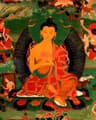
The Śūnyatāsaptati is a compact verse treatise in which Nāgārjuna extends the Madhyamaka critique of inherent existence beyond the Mūlamadhyamakakārikā's dialectic. Its distinctive contribution is a sustained refutation of svabhāva applied to the categories most resistant to emptiness—causality, the aggregates, and the very concept of emptiness itself—arguing that dependent origination and emptiness are coextensive. The text survives in full only in Tibetan translation, and its seventy-three verses (despite the title's 'seventy') serve as a condensed appendix to Nāgārjuna's magnum opus.
Key Insights
✦What is the Śūnyatāsaptati's distinctive place within Nāgārjuna's corpus?
Candrakīrti, the great Madhyamaka commentator, characterized the Śūnyatāsaptati and the Vigrahavyāvartanī as 'appendices' to the Mūlamadhyamakakārikā . This is not a dismissal but a precise description of function: the Seventy Verses does not introduce new doctrinal territory but compresses and reinforces the central argument of the larger work. Its seventy-three verses (the title's round number notwithstanding) drive relentlessly at the notion of svabhāva, showing that nothing—not causes, not aggregates, not even emptiness itself—possesses independent existence. The text's compression makes it a useful pedagogical summary, but its density demands familiarity with the broader Madhyamaka project.
✦Does any Sanskrit original of the Śūnyatāsaptati survive?
No. The Sanskrit original is lost, and the text survives in full only in Tibetan translation . Candrakīrti's commentary on the Śūnyatāsaptati also exists only in Tibetan . Modern attempts to restore the Sanskrit, such as the Central Institute of Higher Tibetan Studies edition, are back-translations from Tibetan rather than recoveries of an extant manuscript . This textual situation means that every modern translation, including the 1987 English rendering by Geshe Sonam Rinchen, Tenzin Dorjee, and David Ross Komito, is mediated through the Tibetan Buddhist scholarly tradition that preserved, transmitted, and commented upon the text.
✦How does the Śūnyatāsaptati argue against the reality of causation?
The text's treatment of causation is a concentrated version of the Madhyamaka critique: if things arise from causes and conditions, they lack independent existence; if they lack independent existence, they are empty; if they are empty, they neither truly arise nor truly cease. Christian Lindtner summarizes Nāgārjuna's method across his works as demonstrating that empirically all phenomena are dependently originated and therefore lack own-being, while logically nothing can be conceived as a unitary entity independent of its correlates . The Seventy Verses applies this double-edged argument to the causal relation itself, showing that the very notion of a cause producing an effect presupposes entities that the analysis dissolves.
✦What is the relationship between the Śūnyatāsaptati and the Mūlamadhyamakakārikā?
The relationship is one of compression and reinforcement rather than independent development. Lindtner notes that the Mūlamadhyamakakārikā may be called Nāgārjuna's magnum opus because nowhere else does he treat emptiness with such consistency and thoroughness, while the Śūnyatāsaptati and Vigrahavyāvartanī serve as supplementary works . The Seventy Verses does not cover the full range of categories examined in the twenty-seven chapters of the Middle Way; instead, it hones in on the core refutation of svabhāva and the identification of dependent origination with emptiness. Reading it in isolation gives a concentrated dose of Madhyamaka argumentation, but the fuller context of the larger treatise is presupposed.
✦How faithful is the standard English translation of the Śūnyatāsaptati?
The 1987 Snow Lion edition, titled Nagarjuna's Seventy Stanzas: A Buddhist Psychology of Emptiness, remains the standard English access to the text . It was produced by a collaborative team: Geshe Sonam Rinchen provided the Tibetan scholarly expertise, Tenzin Dorjee assisted with translation, and David Ross Komito provided the framing and commentary. The title's 'psychology of emptiness' signals an interpretive emphasis on the text's soteriological and cognitive dimensions. Because the translation works from the Tibetan rather than a lost Sanskrit original, its rendering of technical terms reflects Tibetan scholastic conventions. For readers seeking precision on specific verses, consulting the Tibetan text alongside the translation is advisable.
✦What is the most common misunderstanding of the Śūnyatāsaptati's title?
The title 'Seventy Verses' is a conventional designation, but the text actually contains seventy-three verses in its extant Tibetan form . This discrepancy is not unique in Buddhist literature—titles often use round numbers for mnemonic or traditional reasons—but it has led some readers to assume that verses have been lost or added. There is no evidence of textual corruption on this point; the seventy-three-verse count is consistent across the Tibetan tradition and its commentaries. The title should be understood as a traditional label rather than a precise verse count, and the extra three verses do not represent a separate textual layer but are integral to the argument's completion.
Wealthy Psyche is an intellectual archive. We do not host, distribute, or sell book copies — physical or digital. We provide structured knowledge to help you think better, faster.