


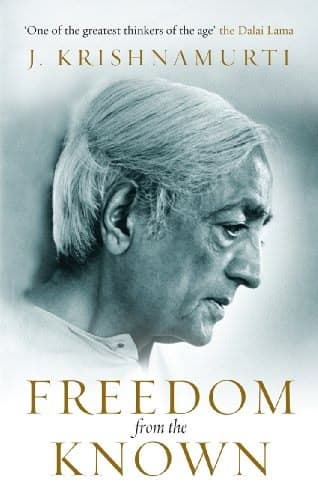
Freedom from the Known

Krishnamurti's central argument is that psychological freedom is not a matter of accumulating new knowledge, beliefs, or techniques, but of seeing clearly how the mind is trapped in the 'known'—the accumulated residue of past conditioning, memories, and ideals. This seeing is not an intellectual exercise but an act of choiceless awareness in which the observer and the observed dissolve into a single movement. The book insists that only when the mind is free from the burden of the past can there be love, intelligence, and a radical transformation of society.
Key Insights
✦What is the central claim of Freedom from the Known, and what does it reject?
Krishnamurti argues that psychological freedom cannot be achieved through the accumulation of knowledge, beliefs, or techniques. The 'known' is the entire content of the mind—memories, conditioning, traditions, ideals—and it is precisely this burden that prevents clear seeing. The book rejects all methods, disciplines, and authorities that promise liberation, because any effort to become free is itself a movement of the known, a reaction of conditioning. Freedom is not a goal to be reached; it is the immediate, choiceless awareness of how the mind is trapped, and in that seeing, without any effort to change what is seen, the trap dissolves .
✦What is the distinction between 'learning about yourself' and 'accumulating knowledge about yourself'?
Krishnamurti draws a sharp distinction between learning about oneself and accumulating knowledge about oneself. Knowledge is always of the past—it is the residue of experience, memory, and conclusion. To accumulate knowledge about yourself is to look at the present through the lens of the past, which prevents direct perception. Learning, by contrast, is a constant movement in the present, without the burden of accumulated conclusion. As the book states, 'learning is a constant movement without the past' . This distinction is central to the book's argument: freedom requires the cessation of the accumulative process, not the addition of more self-knowledge.
✦How does the book treat the relationship between the individual and society?
Krishnamurti argues that the individual is not separate from society; the social structure is the outward expression of the individual's inward psychological state. The book insists that 'the individual is the human who is all mankind' and that each person is responsible for the whole state of the world . Therefore, the transformation of society cannot be brought about by external reforms, revolutions, or ideologies, which have 'failed completely to change the basic nature of man' . Only a radical change in the individual consciousness—a freedom from the known—can bring about a different world. The book rejects the assumption that political or social action can solve the human problem without a prior psychological transformation.
✦What role does fear play in the book's analysis of the mind?
Fear is one of the central themes of Freedom from the Known. Krishnamurti argues that we are afraid of the known and afraid of the unknown: we fear the loss of what we have, and we fear what lies beyond our control . This fear sustains the entire structure of conditioning, as the mind seeks security in the known—in beliefs, relationships, and identities—even as those very securities breed conflict and suffering. The book suggests that fear cannot be overcome by will or by cultivating courage; it can only be understood through direct observation. When the mind sees fear as it actually is, without naming, judging, or trying to escape it, the fear loses its grip.
✦How was the book edited, and what is its textual status?
Freedom from the Known was edited by Mary Lutyens, a close associate and biographer of Krishnamurti, and was first published in 1969 by Harper & Row in the United States and Gollancz in the United Kingdom . Like many of Krishnamurti's books, it is a compilation drawn from his talks and writings rather than a single continuous treatise. Lutyens's editorial hand shaped the material into a coherent sequence of chapters, but the book retains the conversational, probing quality of the spoken word. Readers should be aware that the text is a curated presentation of Krishnamurti's teachings, not a verbatim transcript, and that its unity is editorial as much as authorial.
✦What is a common misreading of the book's rejection of effort and discipline?
A common misreading takes Krishnamurti's rejection of effort and discipline as a counsel of passivity or quietism—as if he were saying that one should simply accept one's conditioning and make no attempt to change. This misses the intensity of the attention he describes. Choiceless awareness is not indifference; it is a state of alert, passive observation in which the mind watches its own movements without condemnation or justification. Krishnamurti insists that this observation requires no method, but it does require an extraordinary honesty and sensitivity. The rejection of effort is not a rejection of rigor; it is a rejection of the assumption that a technique can produce the insight that alone brings freedom.
Wealthy Psyche is an intellectual archive. We do not host, distribute, or sell book copies — physical or digital. We provide structured knowledge to help you think better, faster.