


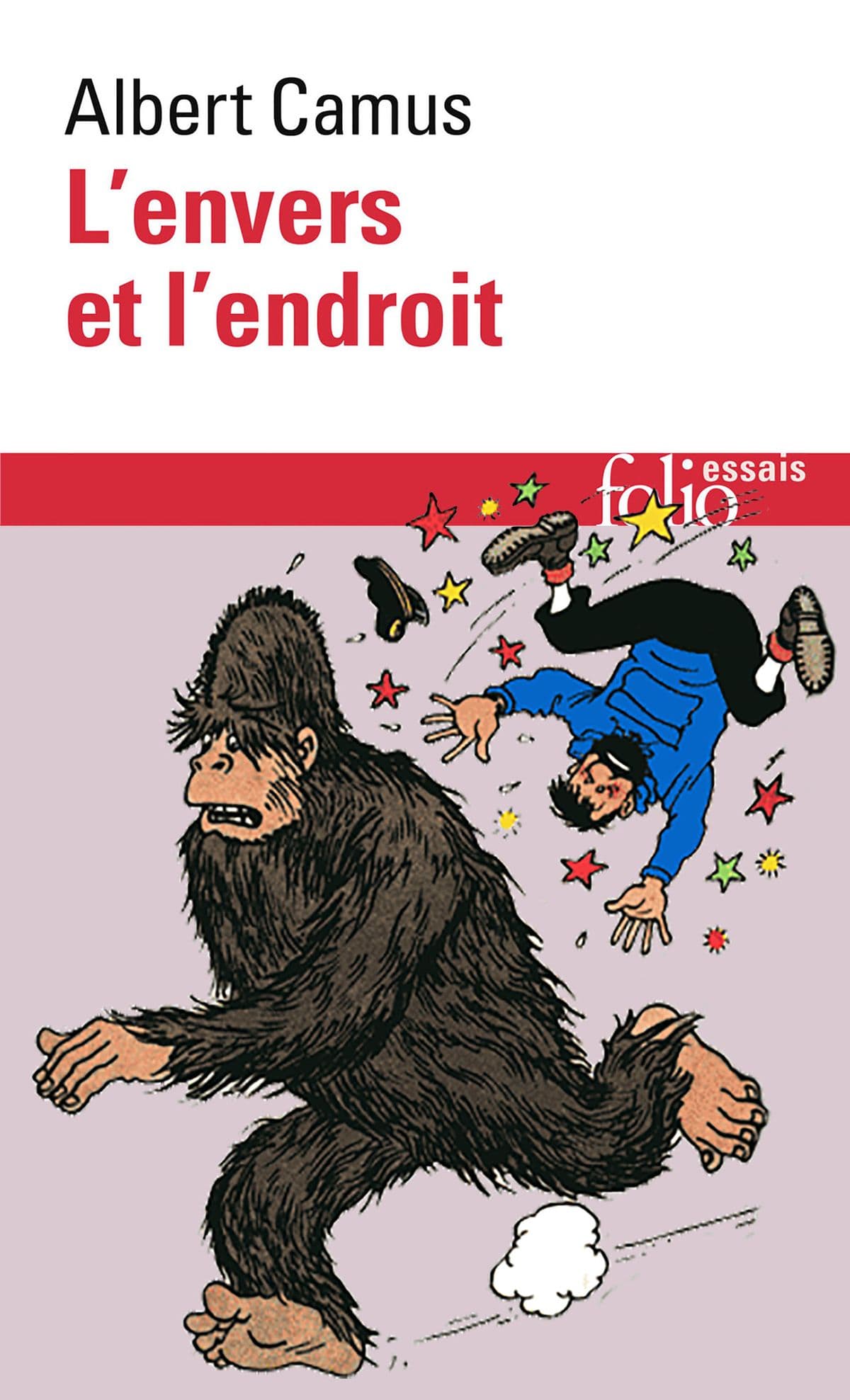
Betwixt and Between (L'Envers et l'endroit)
Camus's first published book, a collection of five lyrical essays written in his early twenties, is organized around the opposition named in its title: the 'wrong side' of poverty, silence, and the deadening routines of Belcourt, set against the 'right side' of sunlight, sea, and the bare happiness of existence. The collection's distinctive mechanism is not argument but juxtaposition—Camus places scenes of his mother's silence and his grandmother's harshness alongside Mediterranean luminosity, refusing to resolve the tension between misery and sunlight into either resentment or consolation. Twenty years later, Camus identified this unresolved double vision as the secret source of everything he wrote.
Key Insights
✦What is the central tension of Betwixt and Between, and why did Camus refuse to resolve it?
The collection is built on the opposition between what Camus calls the 'wrong side'—poverty, the silence of his illiterate mother, the oppressive routines of his grandmother's household in Belcourt—and the 'right side' of Mediterranean sunlight, sea, and the bare sensation of being alive . Camus does not treat these as a problem to be solved. He refuses to let the light redeem the poverty or the poverty sour the light, and he explicitly warns against the two dangers that threaten every artist: resentment and satisfaction . This refusal to resolve is the collection's method, and it anticipates the absurdist insistence on holding contradictions without appeal that would define his mature work.
✦Why did Camus wait two decades to authorize a new edition, and what does his 1958 preface reveal?
The original 1937 edition, published by Edmond Charlot in Algiers in a print run of only 350 copies, barely circulated and was further obscured by the war . Camus long resisted reissuing it because he judged the prose maladroit and in places unnecessarily high-flown . When he finally agreed to a new edition in 1958, his preface performed a different function: rather than defending the essays' style, he identified them as the secret source of his entire body of work. He wrote that his source lay in this world of poverty and light, and that its memory preserved him from resentment and satisfaction . The preface transformed a neglected youthful experiment into a foundational document.
✦How does Betwixt and Between relate to The First Man, the novel Camus was writing when he died?
In the 1958 preface, Camus confessed that if he failed to rewrite L'Envers et l'endroit, he would have achieved nothing . Scholarly comparison of the two works argues that The First Man, the unfinished autobiographical novel left at his death, can be read as that promised rewriting . Both return to the same material: the silent mother, the Belcourt neighborhood, the poverty that is not merely deprivation but a formative structure of feeling. The difference is scale and retrospect. Where the early essays are fragments of lyrical testimony, The First Man attempts a sustained narrative reconstruction of the world that produced them. The continuity suggests that Camus's career was, in his own view, a long detour back to the images of his childhood.
✦How has the collection's status changed within Camus's oeuvre since the 1958 reissue?
Before the reissue, Betwixt and Between was a bibliographical curiosity, known mainly to specialists and collectors. The 1958 Gallimard edition, with its substantial preface, repositioned it as a key to understanding Camus's development, and subsequent scholarship has largely accepted this framing. Cambridge criticism now treats it alongside Nuptials as containing some of Camus's best writing, with its central theme identified as the contrast between Mediterranean natural pleasures and the dark realities of poverty and death . The collection is no longer read as juvenilia to be surpassed but as the seedbed of the themes—light, poverty, silence, the refusal of consolation—that Camus would spend his career developing.
✦What is the most common misreading of the collection's lyricism?
The common misreading treats the essays as straightforwardly celebratory nature writing, a youthful Mediterranean idyll before Camus turned to darker themes. This reading takes the sunlight at face value and overlooks the structural role of poverty, illness, and the grandmother's brutality. In fact, the collection's lyricism is inseparable from its harshness: the light is valuable precisely because it illuminates a world that includes the dead and the suffering, not because it offers escape from them. Camus's later preface makes this explicit by insisting that the book testifies to a childhood involving both prolonged poverty and genuine happiness, without allowing either to cancel the other . The misreading sentimentalizes a book whose force depends on its refusal of sentimentality.
✦What are the textual and translation issues surrounding this work in English?
Betwixt and Between has no stand-alone standard English translation equivalent to the Gilbert or Ward versions of Camus's novels. It has circulated primarily in English-language compilations of Camus's lyrical essays, most notably Lyrical and Critical, which gathers L'Envers et l'Endroit with Noces and L'Été . The title itself has been rendered variously as Betwixt and Between and The Wrong Side and the Right Side, and the choice matters: the French opposition is spatial and evaluative, suggesting both a physical underside and a moral inversion. Readers working in English should be aware that the essays' rhythm and concreteness are central to their effect, and that excerpted or compiled versions may present them without the structural context of the original five-essay sequence.
Wealthy Psyche is an intellectual archive. We do not host, distribute, or sell book copies — physical or digital. We provide structured knowledge to help you think better, faster.