


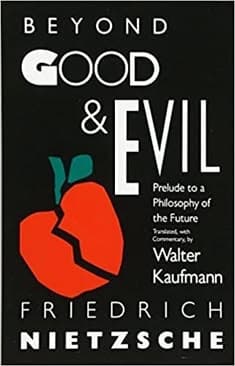
Beyond Good and Evil
Nietzsche's 1886 'prelude to a philosophy of the future' attacks the dogmatic foundations of Western philosophy—Platonism, Christianity, and the faith in opposite values—and proposes that philosophers recognize themselves as creators of values rather than discoverers of truth. Its distinctive mechanism is the aphorism as philosophical instrument: rather than building a system, Nietzsche dissects the hidden drives and moral prejudices beneath philosophical claims, arguing that the will to power, not disinterested reason, explains thought and valuation alike. The book's title names not a rejection of morality but a demand to move past its dogmatic binary into a more honest, perspectival inquiry.
Key Insights
✦What is the central claim of Beyond Good and Evil, and what does it reject?
The book's central claim is that philosophers have uncritically accepted the faith that opposite values cannot coexist—that good is the opposite of evil, truth the opposite of falsehood, reason the opposite of instinct—and have built metaphysical systems on this unexamined premise . Nietzsche argues that these 'opposites' are often expressions of the same basic drives, and that the philosopher's task is not to discover eternal truths but to recognize himself as a creator of values. What the book rejects is dogmatism in all its forms: Platonism, Christianity as 'Platonism for the people,' and the modern scientific faith in truth at any cost. The title does not advocate immorality but a perspective that has moved past morality's dogmatic binary.
✦How was the book received at the time of its publication, and what does its initial circulation reveal?
Beyond Good and Evil sold only 114 copies in its first year, a commercial failure that sharply limited its contemporary impact . Critical reception was nonetheless more favorable than the sales figures suggest. Josef Victor Widmann, reviewing the book in the Swiss journal Der Bund, called it a 'dangerous book' and compared it to the dynamite used in constructing the Gotthard railway, noting that such explosives bore a black warning flag . Nietzsche was delighted by the review, both for commercial reasons and because it captured the book's explosive intent. His old friend Erwin Rohde, however, found something 'totally uncanny' about the Nietzsche he encountered around this time, as if he 'came from a country where no one else lived' .
✦How has the book's philosophical status been reassessed by later scholars?
For much of the twentieth century, Beyond Good and Evil was treated as a compendium of aphorisms rather than a coherent work, a convenient introduction to Nietzsche's themes rather than a sustained argument. This view has been challenged. A significant strand of recent scholarship argues that the book's apparent disorder is deliberate and that it should be read as an ordered whole with a unified intention . Robert Pippin, for instance, treats it as Nietzsche's most comprehensible and detached account of his major themes, uniting his critique of knowledge, morality, and religion with his constructive proposals about perspectivism and nobility . The book is now increasingly read as a carefully constructed diagnosis of modernity rather than as a collection of brilliant fragments.
✦What specific concept did Beyond Good and Evil introduce, and where does it appear in later thought?
The book is the first published work in which Nietzsche explicitly formulates the 'will to power' as a general principle for understanding behavior, presented as an alternative to the drive for self-preservation . It also develops his 'perspectivism,' the claim that all knowledge is conditioned by perspective and that denying the perspectival is denying 'the basic condition of all life' . The will to power would become central to Nietzsche's later work, including On the Genealogy of Morality, and it exerted a profound influence on twentieth-century thought—though often through misreadings, particularly in its appropriation by Nazi ideologues, which Nietzsche's own text does not support. Perspectivism has been equally influential in epistemology and hermeneutics.
✦How does Beyond Good and Evil relate to Thus Spoke Zarathustra and On the Genealogy of Morality?
Beyond Good and Evil draws on and expands the ideas of Thus Spoke Zarathustra but adopts a more critical and polemical approach . Nietzsche himself regarded the later Genealogy as a direct supplement to Beyond Good and Evil: the inside cover of the Genealogy bore the words 'Appended to the recently published Beyond Good and Evil as a supplement and clarification' . In letters from 1887, Nietzsche emphasized the necessary connection between the two books, asking his publisher to make this relationship clear in any announcement . The three works together form the core of his late period, with Zarathustra providing the prophetic vision, Beyond Good and Evil the diagnostic critique, and the Genealogy the historical elaboration of moral concepts.
✦What is the most common misreading of the book's title and argument?
The most persistent misreading takes 'beyond good and evil' as a declaration that morality is obsolete and that anything is permitted. This reading ignores the book's actual target, which is the dogmatic faith in opposite values, not morality as such. Nietzsche's critique is aimed at the assumption that good and evil are absolute opposites rooted in a metaphysical order; his alternative is a more honest inquiry into how moral values are created and what they express. A related error treats the book as a political program, when its concerns are primarily philosophical and psychological. The 'new philosophers' Nietzsche summons are not political leaders but thinkers capable of recognizing their own prejudices and creating values without appealing to dogmatic foundations.
✦What translation issues affect English-language editions of Beyond Good and Evil?
The first English translation, by Helen Zimmern in 1907, was the standard version for decades but has been criticized for including revisions made by Nietzsche's sister Elisabeth Förster-Nietzsche after his death . Walter Kaufmann's 1966 translation, published by Vintage, became the standard scholarly English edition and is generally considered more reliable, free of the sister's posthumous interventions . Readers should be aware that editions circulating under Kaufmann's name do not always contain his translation; some reprints misattribute the Zimmern text. The choice matters because Nietzsche's aphoristic style depends on precision and tone, and translations that smooth or moralize his provocations can distort the book's philosophical intent.
Wealthy Psyche is an intellectual archive. We do not host, distribute, or sell book copies — physical or digital. We provide structured knowledge to help you think better, faster.