


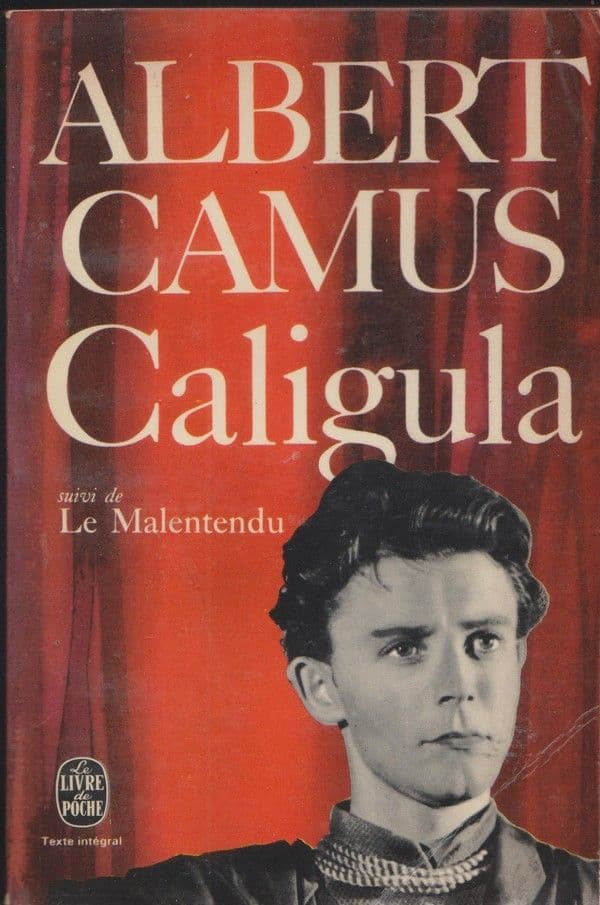
Caligula
Camus's play, begun in 1938 and published in 1944, dramatizes the Roman emperor's discovery that grief over his sister's death exposes a truth he cannot unlearn: 'Men die; and they are not happy.' Caligula's response is not despair but a systematic pursuit of an impossible freedom—he uses his absolute power to invert all values, demand the absurd, and force his subjects to confront a reality they prefer to ignore. The play's central mechanism is the emperor's role as a kind of absurd pedagogue: his cruelty is not mere madness but a demonstration, aimed at exposing the hollowness of the social fictions his subjects inhabit.
Key Insights
✦What is the central argument of Caligula, and how does it differ from The Stranger's version of the absurd?
Caligula is the absurd hero who refuses the passive lucidity of Meursault and attempts to act on his discovery. Where Meursault accepts the world's indifference and opens himself to it in the novel's final pages, Caligula tries to master it: if the world has no meaning, he will impose his own through absolute power, demanding the impossible and treating all values as interchangeable. Camus presents this as a logical extension of absurdist insight rather than a refutation of it, but the play's outcome suggests that Caligula's project fails on its own terms. His freedom is not liberation but a compulsion, and his pursuit of the impossible ends in the destruction of himself and everyone around him. The play tests whether absurd lucidity can ground action; its answer is deeply ambivalent.
✦How has Caligula been read as a political allegory of the Occupation, and what are the limits of that reading?
Scholars have argued that Caligula, written during the German Occupation, stages a critique of dictatorial power and the use of ideology to subjugate populations. A 2010 Université de Montréal thesis contends that the play, alongside Sartre's Les Mouches, parodies the political leaders of the Occupation and their deployment of religious ideology for totalitarian ends . The emperor's arbitrary cruelty and his theatrical manipulation of the patricians can be read as a portrait of authoritarian caprice. However, the allegory is not systematic: Caligula is not a stand-in for Hitler, and the play's philosophical concerns with absurdity, grief, and the limits of freedom exceed any single historical referent. The political reading illuminates the play's context without exhausting its argument.
✦What role does Caligula's relationship to his sister Drusilla play in the drama's logic?
Drusilla's death is the trigger, not the subject, of the play's central inquiry. Caligula's grief initially appears as ordinary mourning, but it quickly becomes something else: the realization that death renders all human attachments and values contingent, and that no amount of power or devotion can reverse this. His response is to pursue a kind of freedom that acknowledges this truth absolutely—a freedom that requires destroying the comforting illusions by which his subjects live. The sister's death thus functions as the occasion for a philosophical conversion rather than as the emotional core of the drama. Camus does not invite us to sympathize with Caligula's loss; he uses it to set in motion a demonstration of what happens when the absurd is not merely recognized but acted upon with unlimited authority.
✦How does Caligula relate to The Rebel's critique of revolutionary absolutism?
Caligula anticipates the argument of The Rebel in dramatic form. The emperor embodies the logic that Camus would later identify as the fatal error of revolutionary ideology: the belief that because existing values are hollow, one is entitled to destroy them without limit, and that any action is justified by the purity of one's insight into the absurd. Caligula's systematic cruelty is not arbitrary madness but a consistent application of this premise, and the play shows where it leads: to a solitude so complete that even the emperor's power becomes a prison. The Rebel theorizes the principle of limits that Caligula violates; reading the play alongside the essay clarifies why Camus insisted that authentic revolt must contain its own restraint rather than dissolving into nihilistic destruction.
✦What is the most common misreading of Caligula's character?
The most persistent misreading treats Caligula as a straightforward madman or a sadist whose cruelty requires no philosophical explanation. This reading takes the patricians' perspective at face value and dismisses the emperor's monologues as rationalizations. But Caligula insists repeatedly on the logic of his actions, and the play's structure invites the audience to follow that logic even as it recoils from the consequences. A related error is to read him as a heroic figure who has achieved a superior lucidity. Camus does not present Caligula as admirable; he presents him as a test case. The play's interest lies in the tension between the coherence of Caligula's reasoning and the horror of his conclusions, a tension that neither the 'madman' reading nor the 'hero' reading can accommodate.
✦How do the English translations of Caligula differ, and why does it matter for interpreting the play?
Stuart Gilbert's translation, first published in 1948 and collected in the 1958 Knopf edition of Caligula and Three Other Plays, has been the standard English version for decades . It has been criticized for flattening the play's rhetorical intensity and for choices that obscure the precision of Caligula's philosophical arguments. The play's language is deliberately stark and declarative—a style that Camus associated with the absurd—and a translation that smooths or poeticizes it can make Caligula seem more conventionally rhetorical than he is. More recent translation efforts have sought to recover the directness of Camus's final versions, but Gilbert's text remains the one most English-language readers encounter. The translation matters because Caligula's logic is carried almost entirely by his speech, and tonal decisions shape how persuasive or repellent that logic appears.
Wealthy Psyche is an intellectual archive. We do not host, distribute, or sell book copies — physical or digital. We provide structured knowledge to help you think better, faster.