


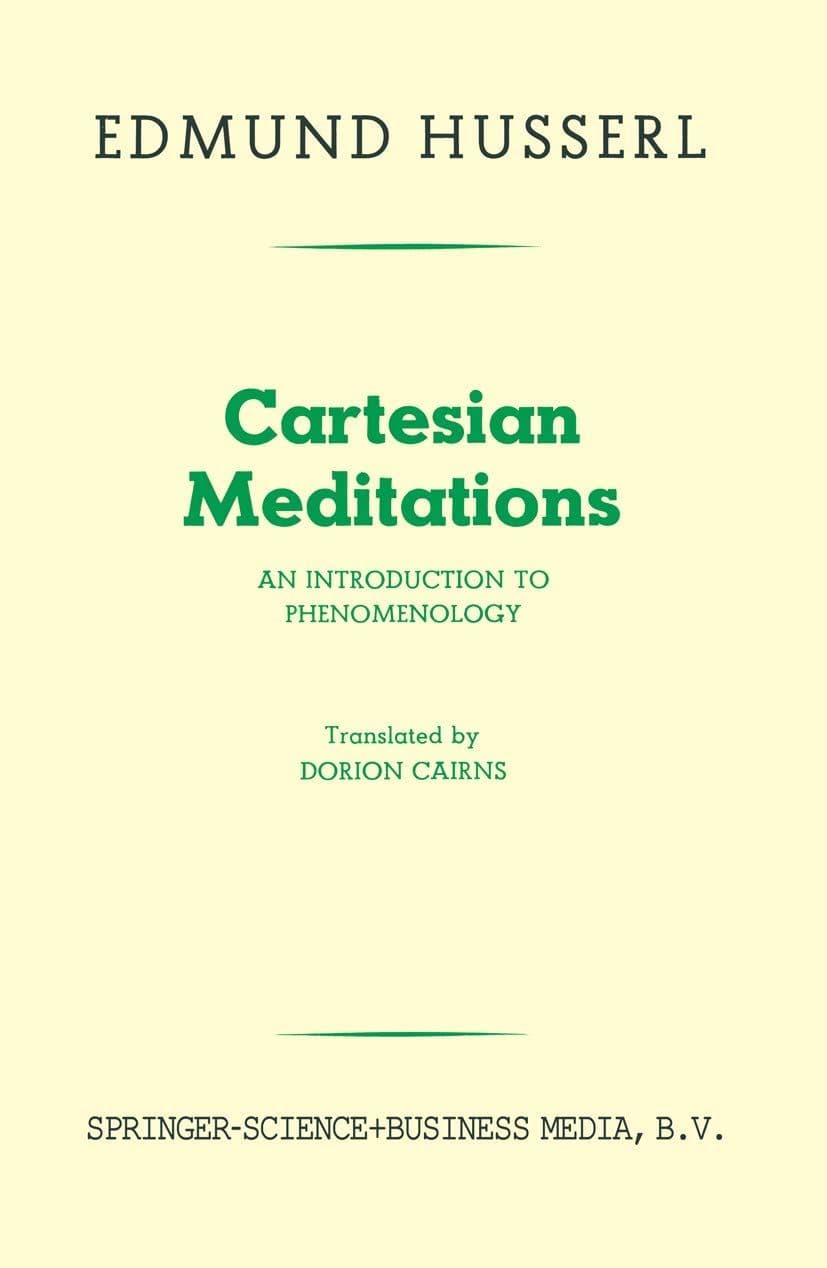
Cartesian Meditations: An Introduction to Phenomenology
Husserl's central project is to introduce transcendental phenomenology by following Descartes's path of radical doubt, but transforming it into a method that discloses the transcendental ego as the ultimate source of all meaning and validity. The five meditations move from the epoché, through the constitutional analysis of the ego and its world, to the difficult problem of intersubjectivity in the Fifth Meditation, where the transcendental ego is shown to be a monad constituted in relation to other monads. Husserl argues that phenomenology is a neo-Cartesianism that must reject nearly all of Descartes's doctrinal content.
Key Insights
✦What is the central claim of Cartesian Meditations, and what does it reject?
Husserl's central claim is that transcendental phenomenology is the fulfillment and radical transformation of Descartes's project. Following Descartes's path of doubt, Husserl argues that the epoché discloses the transcendental ego as the absolute ground of all meaning and validity. But he rejects nearly all of Descartes's doctrinal content: the substantial soul, the causal proof of God's existence, and the dualism of mind and body. Husserl writes that phenomenology might 'almost' be called a neo-Cartesianism, even though it is obliged to reject the well-known Cartesian doctrines . The meditations move from the transcendental ego's self-constitution to the constitution of the objective world, culminating in the Fifth Meditation's analysis of transcendental intersubjectivity as monadological community.
✦What is the publication history of the work, and why was it first published in French?
The Cartesian Meditations originated as four lectures Husserl delivered at the Sorbonne in February 1929. Over the next two years, he and his assistant Eugen Fink expanded and elaborated the text . The expanded version was first published in 1931 in a French translation by Gabrielle Peiffer and Emmanuel Levinas, with advice from Alexandre Koyré . The German original did not appear until 1950, as volume I of the Husserliana critical edition, edited by Stefan Strasser . Husserl never published the German text during his lifetime, which has led commentators to conclude he had become dissatisfied with the work as an introduction to transcendental phenomenology .
✦What is the significance of the Fifth Meditation, and what criticisms has it received?
The Fifth Meditation is the most discussed and contested part of the book. Husserl addresses the problem of how the transcendental ego can constitute other egos without reducing them to its own projections. His method involves a 'primordial reduction' that brackets the other's constitutive achievements, followed by an 'analogical apperception' through which the other is grasped as another psychophysical organism. Critics have argued that this approach leads to solipsism: the primordial reduction excludes the other and their achievements, leaving the ego trapped within its own sphere . Alfred Schutz, among others, argued that intersubjectivity cannot be constituted transcendentally at all and must be accepted as a given of the natural attitude. Defenders of Husserl reply that this criticism presupposes a Cartesian motive that Husserl himself transforms.
✦How does the book relate to Husserl's earlier and later work?
The Cartesian Meditations occupies a pivotal position between the Logical Investigations (1900–1901) and the Crisis of European Sciences (1936). It presents, in compact form, the mature transcendental phenomenology that Husserl had developed after his 'breakthrough' work: the epoché, the transcendental reduction, static and genetic analysis, and transcendental idealism. In the Fourth Meditation, Husserl argues explicitly that transcendental phenomenology is nothing other than transcendental idealism . The work also anticipates the Crisis in its concern with intersubjectivity and the life-world, though it treats these problems in a more systematic and less historical register. A companion to the text notes that the work is 'far from ideal' as an introduction, because Husserl uses technical terms without explaining them and alludes to aspects of his thought that receive no proper treatment .
✦How was the book received, and how does it compare to other introductions to phenomenology?
The Cartesian Meditations is Husserl's most widely read work, but its reception has been ambivalent. A scholarly companion describes it as 'a dismal failure' as an introduction, because Husserl's brevity and technical vocabulary make the text inaccessible to newcomers; the companion's author found himself obliged to refer repeatedly to Husserl's other writings to fill out the unsatisfactory presentations . Yet the work is indispensable for understanding Husserl's mature philosophy. It is the text in which he most explicitly identifies phenomenology with transcendental idealism, and the Fifth Meditation remains the canonical statement of his attempt to ground intersubjectivity in transcendental constitution. Its influence extends beyond phenomenology into social theory, particularly through the critiques of Alfred Schutz and the appropriations of Merleau-Ponty and Levinas.
✦What is a common misconception about the book's relationship to Descartes?
A frequent misconception is that Husserl is simply restating Descartes's philosophy in phenomenological terms. Husserl's relationship to Descartes is critical and transformative. He adopts Descartes's method of radical doubt and his ideal of philosophy as a universal science grounded in absolute certainty, but he rejects the substance dualism, the causal proofs of God, and the mechanistic physics that Descartes built on that foundation. The 'almost' in Husserl's formula—'one might almost call transcendental phenomenology a neo-Cartesianism'—is crucial . The work is Cartesian in its motivation but anti-Cartesian in its results: the ego disclosed by the epoché is not a thinking substance but a transcendental field of constitutive performances, and the world it constitutes is not a mechanical order but a system of intentional correlates.
Wealthy Psyche is an intellectual archive. We do not host, distribute, or sell book copies — physical or digital. We provide structured knowledge to help you think better, faster.