


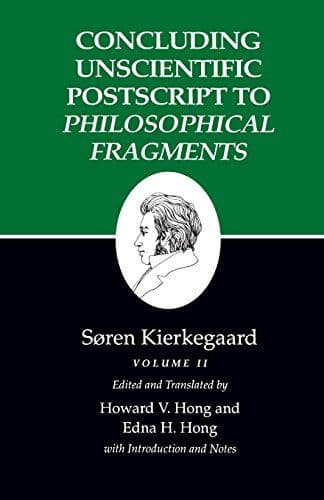
Concluding Unscientific Postscript
Kierkegaard's 1846 'afterword' to Philosophical Fragments is a massive, ironic, and deliberately unsystematic work that pivots on the thesis that 'subjectivity is truth.' Its central mechanism is the distinction between objective and subjective reflection: the objective thinker asks what Christianity is, while the subjective thinker asks how the individual can become a Christian, since an existing person's relation to an eternal truth is one of passionate appropriation rather than disinterested knowledge. The book's distinctive argument is that the only appropriate response to the absolute paradox is faith, a leap that no amount of speculation can mediate.
Key Insights
✦What is the central argument of the Postscript, and what does it reject?
The central argument is that for an existing individual, the truth that matters is not objective knowledge but subjective appropriation. Climacus rejects the Hegelian assumption that reality can be comprehended in a logical system, and he rejects the scholarly approach to Christianity that treats it as a doctrine to be examined rather than a demand to be obeyed . The book's pivotal thesis—'subjectivity is truth'—does not mean that anything one believes is true, but that the mode of the individual's relation to a truth is what matters ethically and religiously. Objective reflection is appropriate for mathematics and history, but for the question of how to exist, the appropriate medium is passionate inwardness. The Postscript's massive irony and deliberate 'unscientific' form enact this rejection of system-building.
✦What does 'subjectivity is truth' actually mean, and how has it been misread?
The thesis has been widely misread as a defense of subjectivism or relativism, as if Climacus were claiming that any sincerely held belief is true. Roe Fremstedal argues that subjective truth is better understood as an 'adverbial' theory: it concerns living truly by being wholehearted and fully committed, rather than the correspondence of propositions to reality . Climacus does not deny objective truth; he presupposes it, and he insists that there are objective formal constraints on selfhood that prevent relativism . The misreading has led many philosophers to dismiss Kierkegaard as unworthy of serious consideration, when in fact the claim is a precise intervention in epistemology about the kind of truth appropriate to existence, not a blanket denial of truth as such.
✦How does the Postscript relate to Philosophical Fragments, and why is it 'concluding' and 'unscientific'?
The Postscript was written as an afterword to the Fragments, and it takes up the question the earlier book had left open: not merely what Christianity is, but what is involved for the individual in becoming a Christian . The title's 'concluding' signals Kierkegaard's intention that it be his last word before retiring from authorship, and 'unscientific' is a polemical gesture against the pretension of Hegelian Wissenschaft. The book's full Danish title calls it a 'mimetic-pathetic-dialectic compilation,' an 'existential plea'—a description that is itself ironic and deliberately unwieldy . The form is not an accident: it enacts the argument that existence cannot be systematized, and that the thinker who tries to comprehend it objectively has already missed what matters.
✦How has the Postscript's philosophical reception been shaped by its relation to Hegel?
The book is often read as Kierkegaard's most sustained assault on Hegel, and its critique of speculative philosophy is a central part of its reception. Jon Stewart and others have cautioned that the target is not always Hegel himself but the Danish Hegelians of Kierkegaard's time, and that the book's polemic is more diffuse than a straightforward refutation. Merold Westphal's study locates the Postscript in the debate with Hegel as one of its most distinctive features, while also arguing that the book's postmodern resonances have been underestimated . The reception has shifted from treating it as a theological tract to recognizing it as a work of philosophy with a sophisticated critique of modernity's confidence in reason and system.
✦What is the significance of the 'First and Last Declaration' at the end of the Postscript?
The 'First and Last Declaration' is Climacus's—or rather Kierkegaard's—acknowledgment of his relation to the pseudonymous authors and their writings. It is a crucial document for understanding the authorship, because it reveals that the pseudonyms are not disguises but deliberate voices, each with a distinct standpoint, and that Kierkegaard himself does not identify with any of them entirely . The declaration also confirms Kierkegaard's intention that the Postscript be the conclusion of his authorial project up to that point. The fact that he continued writing after it—the 'second authorship'—makes the declaration a turning point rather than a terminus, and it has been central to scholarly debates about the unity and purpose of the authorship.
✦What are the main English translations of the Postscript, and how do they differ?
The first English translation was by David F. Swenson and Walter Lowrie, published by Princeton University Press in 1941. The standard modern translation is by Howard V. Hong and Edna H. Hong, published in two volumes by Princeton University Press in 1992 as part of Kierkegaard's Writings . Alastair Hannay's translation for Cambridge University Press, published in 2009, is also widely used and is praised for its readability and its extensive introduction . The Hong edition is generally preferred by scholars for its accuracy and its detailed historical apparatus, while Hannay's is more accessible to students. Readers should be aware that the Postscript is one of the longest and most rhetorically complex works in the Kierkegaardian corpus, and that translation choices about irony, tone, and technical vocabulary significantly shape how its argument is understood.
Wealthy Psyche is an intellectual archive. We do not host, distribute, or sell book copies — physical or digital. We provide structured knowledge to help you think better, faster.