


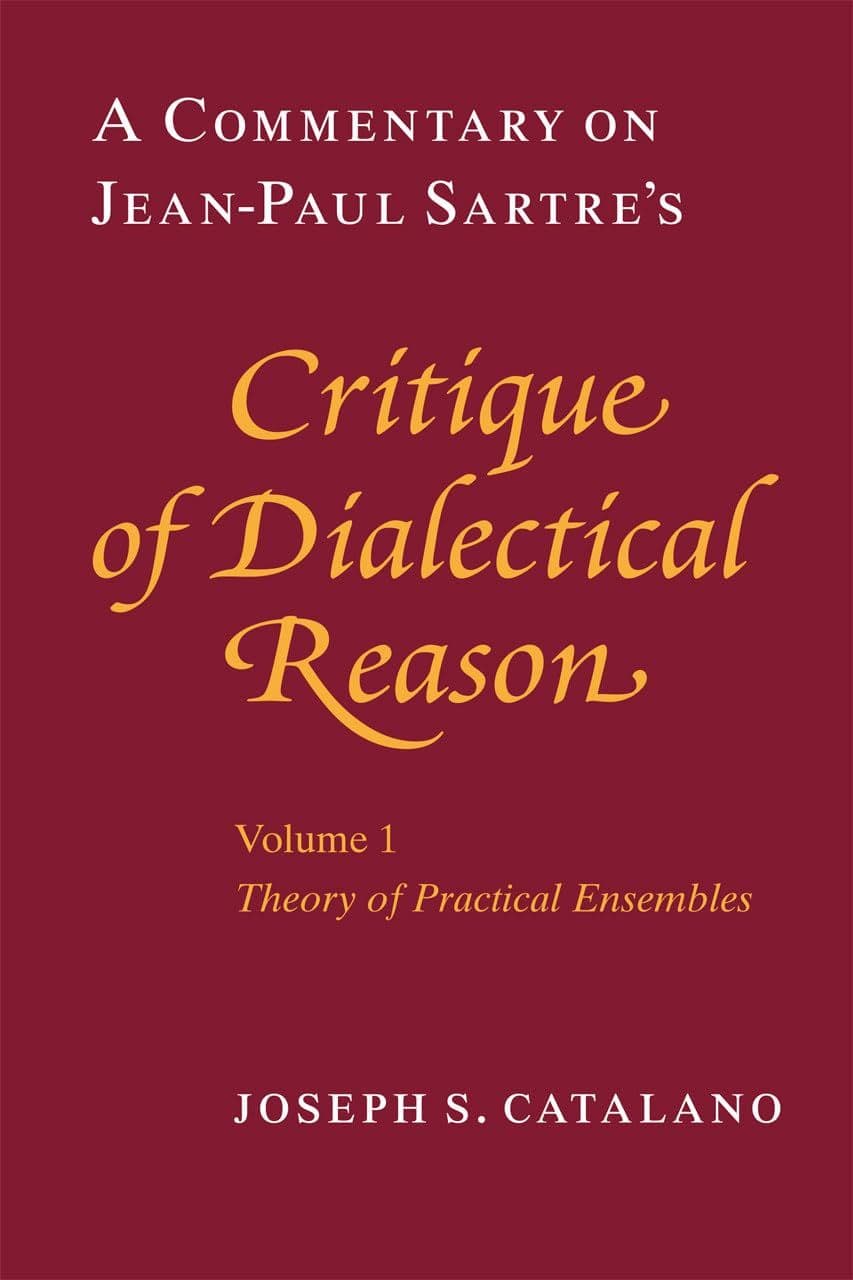
Critique of Dialectical Reason

Sartre's 1960 philosophical treatise is his attempt to reconcile existentialist freedom with Marxist historical materialism by grounding the dialectic in human praxis rather than in nature or economic laws. Its central mechanism is the analysis of how free individual action congeals into the 'practico-inert'—worked matter that returns to constrain the very freedom that produced it—and how groups form, pledge themselves, and ossify into institutions. The book's distinctive contribution is the claim that history is intelligible as a 'totalisation without a totaliser,' a dialectical process driven by scarcity and the alienating weight of material necessity.
Key Insights
✦What is the central argument of the Critique, and what does it reject?
The Critique's central argument is that the dialectic must be grounded in human praxis rather than in the laws of nature or economics. Sartre rejects both the Stalinist reduction of Marxism to a deterministic science and his own earlier existentialist insistence on individual freedom as absolute. What emerges is a theory of how free action produces the 'practico-inert'—worked matter, institutions, and social structures that then constrain the freedom that created them. The book's formal aim is to establish the dialectical intelligibility of history as a 'totalisation without a totaliser,' a process without a guiding subject or telos . Its substantive concern is the structure of class struggle and mass movements under conditions of scarcity .
✦What is the 'practico-inert,' and why is it the book's most influential concept?
The practico-inert is Sartre's term for the domain of worked matter and social structures that mediate human action and return to constrain it. A factory machine is the paradigm case: it was produced by human praxis, but it now dictates the rhythms of the worker's body, the division of labor, and the limits of possible action . Sartre's analysis of 'worked matter' occupies close to two hundred pages of the first volume, developing the idea that materiality has its own 'exigencies' that impose themselves on those who must live within them . The concept is influential because it offers a non-reductive account of alienation: the worker is not merely exploited by a capitalist class but is produced as a 'worked Thing' by the material ensemble of which they are a part .
✦How did the book's publication and translation history unfold, and what does its incompleteness reveal?
The first volume was published by Gallimard in 1960, at the height of the Algerian War . A second volume was never completed in Sartre's lifetime; it was published posthumously by Gallimard in 1985, edited by Arlette Elkaïm-Sartre, and translated into English by Quintin Hoare in 1991 . The English translation of Volume 1 by Alan Sheridan-Smith, edited by Jonathan Rée, appeared in 1976 from New Left Books . The book's incompleteness is not incidental: the second volume was to address the intelligibility of history itself, and its failure to materialize suggests the difficulty of sustaining the formal ambition of the first volume without a concrete historical referent.
✦How does the Critique relate to Being and Nothingness, and does it abandon Sartre's earlier philosophy?
The Critique does not abandon Being and Nothingness but transforms its central concepts under the pressure of historical and political experience. Sartre's earlier account of freedom as consciousness's power of negation is retained, but it is now situated within a material world that constrains and shapes it. Thomas Flynn's study notes that Sartre did not simply jettison his older views; he held onto some while recognizing that the case he had made for them had 'transformed themselves into a case for something else' . The Critique should be understood as an investigation organized 'formally,' in keeping with Sartre's philosophical intentions, rather than as an instrumental work of political ideology .
✦What is the most common misreading of the Critique's relationship to Marxism?
The most persistent misreading treats the Critique as Sartre's capitulation to Marxism, a late conversion in which he abandoned existentialism for dialectical materialism. But Sartre's relationship to Marxism was always critical and never orthodox. The book insists that Marxists must 'establish their method a priori,' which rules out simply accepting Marxism as a given and then seeing whether it can be squared with existentialism . The Critique's aim is to ground the dialectic in praxis, not to accept the dialectic as a ready-made doctrine. A related error treats the book as a political intervention in the debates of the French left, when its formal ambition—to establish the intelligibility of history—exceeds any particular political position .
✦What criticism did Merleau-Ponty make of Sartre's turn to Marxism, and how does it bear on the Critique?
Merleau-Ponty's critique, developed in Adventures of the Dialectic (1955), was that Sartre's political philosophy could not conceptualize the 'inertia' inherent in actions, institutions, and history. Sartre, he argued, dissolved the weight of facts and circumstances into the 'pure action' of the Party and its militants, ignoring the distance between the apparatus and the proletariat . This critique is directly relevant to the Critique of Dialectical Reason: the concept of the practico-inert is Sartre's belated response to Merleau-Ponty's challenge, an attempt to theorize the inertia that his earlier work had neglected. The fact that Sartre makes inertia a central concept of the 1960 book shows that the debate with Merleau-Ponty shaped his philosophical development .
Wealthy Psyche is an intellectual archive. We do not host, distribute, or sell book copies — physical or digital. We provide structured knowledge to help you think better, faster.