


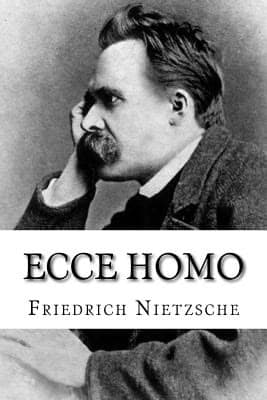
Ecce Homo
Written in 1888 but withheld until 1908, Nietzsche's self-described 'intellectual autobiography' is less a memoir than a strategic performance of self-assessment. Its central mechanism is the chapter titles themselves—'Why I Am So Wise,' 'Why I Am So Clever,' 'Why I Am a Destiny'—which deliberately provoke the reader into questioning whether the author is mad, ironic, or both. Beneath the provocation lies a serious claim: that a philosopher's life and work are inseparable, and that Nietzsche's own physiological constitution, his 'double birth' from health and decadence, is the condition that made his revaluation of values possible.
Key Insights
✦What is the central claim of Ecce Homo, and why did Nietzsche write it as an autobiography rather than a philosophical treatise?
The book's central claim is that a philosopher's philosophy cannot be separated from his life—his physiology, his health, his ancestry, his diet, even his climate. Nietzsche presents his own 'double birth' from the highest and lowest rungs of life, simultaneously decadent and beginning, as the condition that allows him to look 'from the optic of sickness towards healthier concepts' and conversely from health into decadence . This is not vanity but method: by demonstrating that his own thought arose from a specific embodied existence, he challenges the pretension of philosophers who present their systems as impersonal products of pure reason. The autobiography is philosophical because it enacts the thesis that thinking is an expression of life rather than its neutral observer.
✦How has the book's relationship to Nietzsche's madness been understood, and has that reading changed?
For most of the twentieth century, Ecce Homo was read as evidence of its author's incipient insanity, a megalomaniacal symptom rather than a philosophical work. The Deutsche Nationalbibliothek notes that the book met with a sceptical response for much of its first century of reception and was viewed as 'merely a testament to its author's incipient madness' . This reading was convenient because it allowed readers to dismiss the book's provocations without engaging them. Recent scholarship has challenged this. Thomas Brobjer argues that the book is fundamental to Nietzsche's unfinished revaluation of values and provides a 'complete corrective' to its reception as a self-referential and eccentric text of little philosophical significance . The madness narrative is now recognized as an obstacle to understanding rather than an explanation of the book.
✦What is the significance of the final line, 'Dionysus versus the crucified'?
The opposition is not between two gods but between two evaluative types. Dionysus represents the affirmation of life in its fullness, including suffering and destruction; 'the crucified' represents the Christian valuation that denies life and seeks redemption from it. Nietzsche's final formula compresses the entire argument of his late work into a single antithesis. As one philosophical commentary notes, Christ 'earns Nietzsche's respect' as a figure who became who he was, but the psychological type he represents—and the religion founded in his name—is the most momentous foe imaginable because it stripped the world of value and removed human freedom from view . The book ends not with a conclusion but with a declaration of allegiance, leaving the reader to choose between the two.
✦How does Ecce Homo relate to The Antichrist and the projected Revaluation of All Values?
Otfried Höffe's reading, drawing on the Colli-Montinari critical edition, argues that Nietzsche abandoned the plan for The Will to Power and wrote The Antichrist and Ecce Homo in its place. These two works, Höffe contends, contain the systematic philosophical content previously attributed to the phantom magnum opus . Brobjer develops this further, arguing that Ecce Homo laid the foundations for Nietzsche's planned four-volume work on values, and that the two books must be read together as complementary halves of the revaluation project—The Antichrist as the negative, prosecutorial critique of Christianity, and Ecce Homo as the constructive self-assessment that establishes the standpoint from which revaluation becomes possible .
✦What is the most common misreading of the book's megalomaniacal chapter titles and claims?
The most persistent misreading takes the titles—'Why I Am So Wise,' 'Why I Am So Clever,' 'Why I Am a Destiny'—and the claim 'I am not a man, I am dynamite' at face value, as expressions of pathological grandiosity. But Nietzsche is deliberately outrageous, and the provocation is strategic. As the Deutsche Nationalbibliothek summary notes, he 'attempts to explode one preconception after another in the Western philosophical tradition' . The titles force the reader to confront the question of how a philosopher's self-presentation relates to the truth of his thought. If the reader dismisses the book as mad, Nietzsche's challenge is evaded; if the reader engages with the claims, the question of whether a life can justify a philosophy becomes unavoidable. The megalomania is a test, not a symptom.
✦What are the main English translations of Ecce Homo, and how do they differ?
Anthony M. Ludovici produced the first English translation for the Complete Works edition in 1911, but it has been superseded. Walter Kaufmann's translation, published by Vintage and often bound with On the Genealogy of Morality, became the standard scholarly edition and is praised for its fidelity to Nietzsche's word and spirit, with comprehensive footnote commentaries . Kaufmann's edition is the one most widely used in Anglophone academia, though some readers find his editorial voice intrusive. Thomas Wayne's more recent translation claims to be 'more faithful than any other,' aiming to reproduce Nietzsche's 'hybrid, high-bred style' without scholarly excuses or 'pretentious improvements' . The choice matters because Ecce Homo is the most stylistically extreme of Nietzsche's books, and translation decisions about tone and register directly affect how the reader judges its sanity.
Wealthy Psyche is an intellectual archive. We do not host, distribute, or sell book copies — physical or digital. We provide structured knowledge to help you think better, faster.