


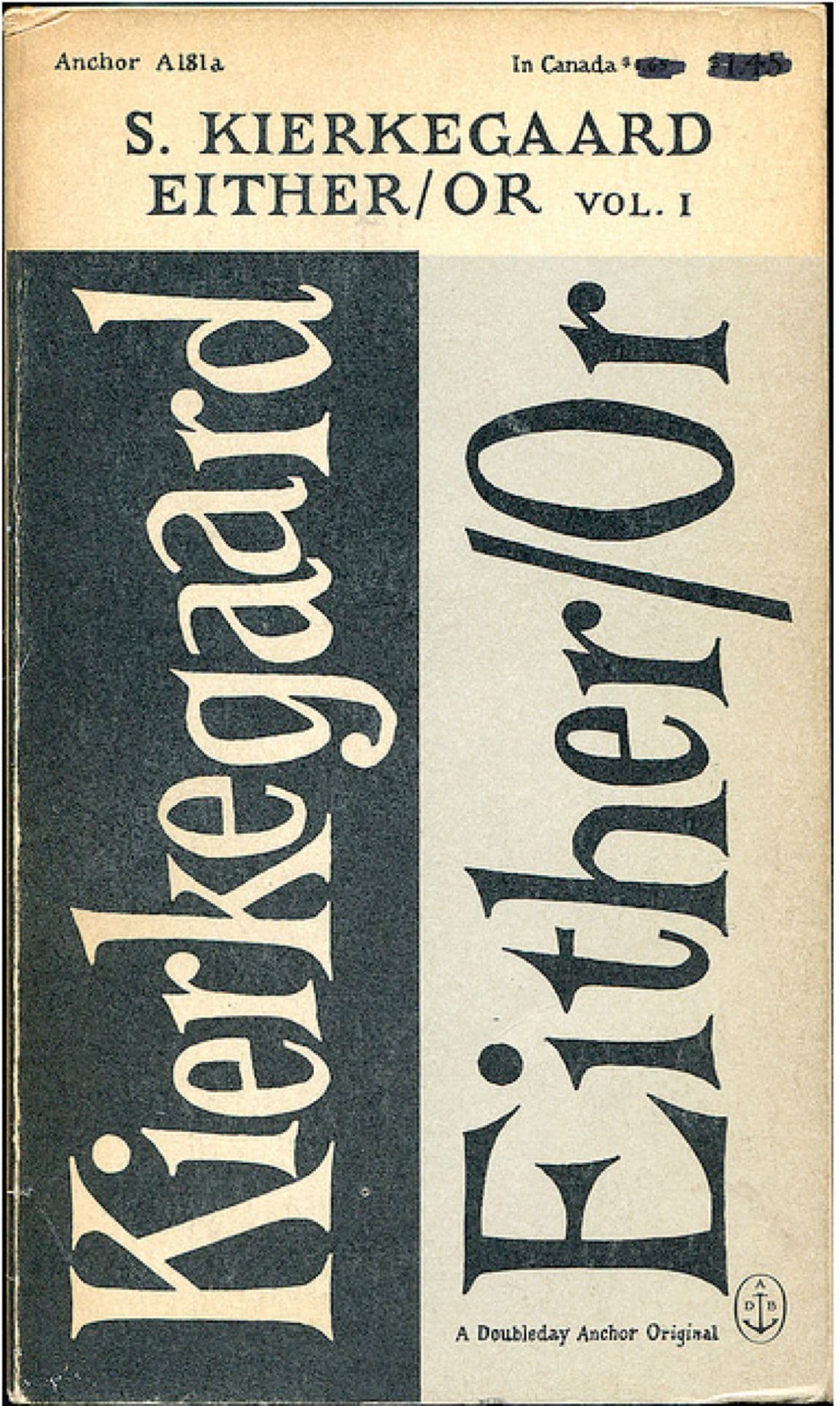
Either/Or

Kierkegaard's 1843 debut is a two-volume experiment in indirect communication, edited by the fictional Victor Eremita from papers found in a desk. Volume I presents the aesthete 'A'—aphorisms, essays on Mozart and boredom, and the notorious 'Seducer's Diary'—who lives for the interesting moment and refuses commitment. Volume II contains Judge William's earnest letters defending marriage and the ethical life of choice and continuity. The book's distinctive mechanism is that it does not adjudicate between them: no narrator harmonizes the voices, and the reader must confront the either/or as a choice to be made, not a synthesis to be achieved.
Key Insights
✦What is the central argument of Either/Or, and what does it reject?
The book does not argue for a single thesis so much as stage an irreducible opposition. Volume I presents the aesthetic life through the papers of 'A,' a nameless young man who pursues the interesting, the momentary, and the experimental, refusing the commitments that would give his life coherence. Volume II presents the ethical life through Judge William's letters, which argue that authentic selfhood requires choosing oneself, accepting one's facticity, and embracing the continuity of marriage and vocation . What the book rejects is the Hegelian assumption that these positions can be reconciled in a higher synthesis. The editor Victor Eremita does not adjudicate between them, and the title's 'either/or' names a choice that cannot be mediated by argument alone .
✦How does the book's pseudonymous structure—Victor Eremita, 'A,' Judge William—serve its philosophical purpose?
The pseudonyms are not a disguise but a method. Kierkegaard's name appears nowhere on the original title page; instead, Victor Eremita ('Victor the Hermit') claims to have found the papers in a secret compartment of a writing desk . 'A' is nameless, a detail often read as a signal that the aesthete lacks a stable self . Judge William writes in his own voice, but his letters are framed by Eremita's editorial decisions. This layering denies the reader an authoritative narrator and forces the confrontation with competing existences. As one study notes, the structure creates 'four levels': Kierkegaard, Eremita, A and B, and the further pseudonymous authors of the Seducer's Diary and the closing sermon . The reader must navigate this without guidance, which is precisely the point.
✦What is the significance of the 'Seducer's Diary,' and why has it attracted disproportionate attention?
The 'Seducer's Diary' is the final item in Volume I, ostensibly written by Johannes the Seducer and included among 'A''s papers. It recounts the calculated seduction of a young woman, Cordelia, with a coldness that has fascinated and repelled readers in equal measure. Its significance lies in what it reveals about the aesthetic life: Johannes is not driven by desire for Cordelia as a person but by the 'interesting' as a category—the strategic manipulation of situations and possibilities . The diary has attracted disproportionate attention because it is the most vivid and disturbing enactment of the aesthete's principles, but reading it in isolation from Judge William's response distorts the book's structure. The diary is a symptom, not a conclusion.
✦How did Either/Or's initial reception unfold, and what does its publication history reveal?
Either/Or was published on 20 February 1843 by C. A. Reitzel in Copenhagen, in an edition of 525 copies that sold out within two years—a literary success by the standards of the day . Kierkegaard described it as the beginning of his 'authorship,' though he had published earlier works . The reception was immediate and controversial, and the book's cultural influence extended far beyond philosophy: the title and the figures of the aesthete and the ethicist became part of Danish cultural vocabulary, inspiring artists and writers well beyond theological and philosophical circles . The pseudonym was quickly penetrated, but Kierkegaard maintained the fiction publicly, and the book's formal complexity has ensured that its reception has never settled into a single interpretation.
✦What is the most common misreading of the aesthete 'A' and Judge William's relationship?
The most persistent misreading treats the book as a straightforward moral argument in which Judge William wins and the aesthete is refuted. This reading takes the ethical sphere as the book's conclusion, when in fact the structure refuses any such resolution. Recent scholarship has emphasized that Either/Or is a 'startlingly capacious and creative philosophical work' whose internal tensions raise questions about whether William's conception of the ethical life has deeper flaws than it seems, and whether there are good reasons to take 'A''s side . The aesthete is not simply a foil; his critique of the ethical—that it is a form of self-imprisonment, that commitment is a betrayal of possibility—is never fully answered. The book's power lies in the irresolution.
✦What are the main English translations of Either/Or, and how do they differ?
The first complete English translation was by David F. Swenson and Lillian Marvin Swenson, published by Princeton University Press in 1944. The standard modern translation is by Howard V. Hong and Edna H. Hong, published by Princeton University Press in 1987 as volumes 3 and 4 of Kierkegaard's Writings . The Hong edition is generally preferred by scholars for its accuracy, its extensive historical introduction, and its inclusion of Kierkegaard's journal entries pertaining to the work . Swenson's translation remains readable and historically significant, but it predates the critical apparatus that the Hong edition provides. Readers should be aware that the book's effect depends on the distinct voices of its pseudonyms, and that translation choices about register—the aesthete's irony, the Judge's earnestness—significantly shape how the conflict between spheres is experienced.
Wealthy Psyche is an intellectual archive. We do not host, distribute, or sell book copies — physical or digital. We provide structured knowledge to help you think better, faster.