


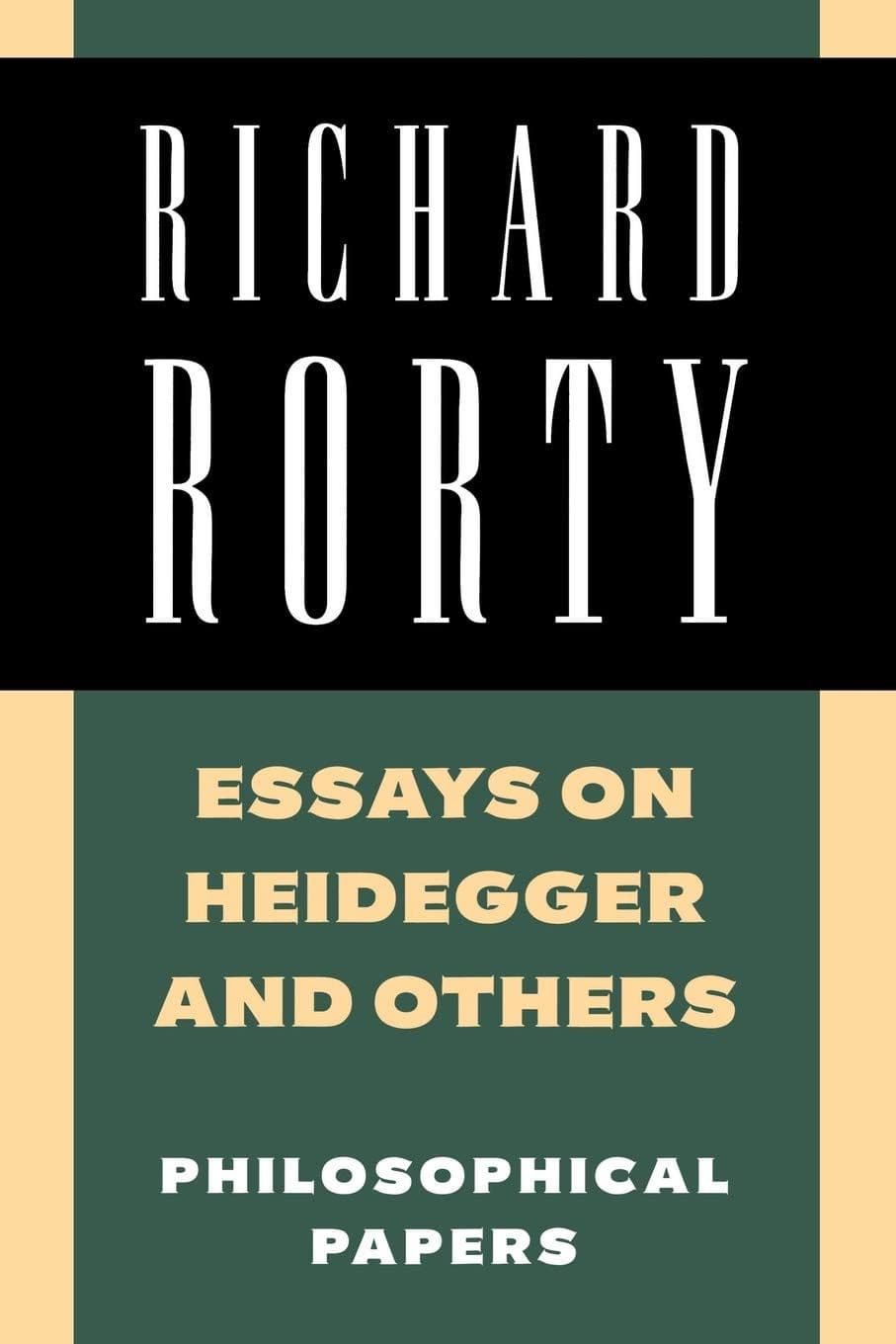
Essays on Heidegger and Others: Philosophical Papers, Volume 2
Rorty's central thesis across this volume is that the divide between analytic and continental philosophy is a professional boundary rather than a philosophical one, and that Heidegger, Derrida, and their successors can be recruited for pragmatist ends while their political conclusions are resisted. The volume's distinctive mechanism is Rorty's characteristic move of separating a thinker's anti-metaphysical insights from their politics: Heidegger's critique of the tradition is useful, but his Nazism and nostalgia for Being are not. Derrida's textual play is celebrated, while his admirers' political pretensions are deflated. Pragmatism emerges as the mediator that agrees with the continentals about truth and objectivity but disagrees about what follows politically.
Key Insights
✦What does Rorty mean by 'pragmatism and post-Nietzschean philosophy,' the volume's organizing phrase?
The phrase names Rorty's attempt to place pragmatism in a lineage that runs through Nietzsche rather than through Kant or Mill. Post-Nietzschean philosophy, for Rorty, is philosophy that has abandoned the search for ahistorical foundations and accepts that thought is shaped by history, language, and contingent practice. Heidegger and Derrida are the central figures in this lineage, and Rorty's introduction argues that pragmatism can enter into conversation with them without adopting their metaphysical or political commitments. The phrase is deliberately loose: it allows Rorty to treat Nietzsche as a shared ancestor of both the European tradition and American pragmatism, a genealogy that many Nietzsche scholars and many pragmatists would contest.
✦How does Rorty handle Heidegger's Nazism in these essays, and what does his treatment reveal?
Rorty's treatment of Heidegger is consistently bifurcated: he admires the critique of the philosophical tradition while refusing to excuse or ignore the politics. The essay 'Philosophy as Science, as Metaphor, and as Politics' engages Heidegger's thought on its own terms, but Rorty does not allow the question of Nazism to disappear. His strategy is to separate the anti-metaphysical insight from the political failure, arguing that pragmatists can take the former without the latter. Critics have charged that this separation is too clean, and that Heidegger's politics are not an accidental excrescence but are embedded in his conception of Being and history. The essay on Kundera and Dickens offers Rorty's alternative: the novel, not ontology, is the better guide to moral and political life.
✦What is Rorty's argument about Derrida, and why does he separate Derrida from his American admirers?
Rorty's Derrida essays, including 'Deconstruction and Circumvention' and 'Is Derrida a Transcendental Philosopher?,' argue that Derrida's value lies in his textual play and his refusal of systematic philosophy, not in any positive doctrine or political program. Rorty is critical of what he sees as the American appropriation of Derrida by literary critics who turn deconstruction into a method or a politics. The essay on Paul de Man and the American Cultural Left extends this critique: Rorty charges that de Man's followers have used Derridean ideas to support a cultural politics that is vague, evasive, and disconnected from practical reform. The separation of Derrida from his admirers is characteristic of Rorty's broader strategy of rescuing thinkers from their disciples.
✦How does the volume's treatment of Foucault and Habermas differ, and what does this reveal about Rorty's political alignments?
Rorty's essay on Foucault, 'Moral Identity and Private Autonomy,' treats Foucault with suspicion: he is described in one reader's summary as 'loathsome,' and Rorty's argument suggests that Foucault's private project of self-creation offers little for public politics . Habermas, by contrast, is engaged more seriously as a social theorist, even though Rorty disagrees with his appeal to universal communicative rationality. The essay on Habermas and Lyotard on postmodernity positions Rorty between them: he shares Lyotard's suspicion of grand narratives but rejects his political quietism, and he shares Habermas's commitment to liberal institutions but rejects his foundationalism. The alignment that emerges is a pragmatist liberalism that borrows from both but settles with neither.
✦How was the volume received, and what were the main criticisms?
The early reception was largely disappointing. A German handbook on Rorty notes that reviews by Richter (1993) and Gottlieb (1991) either met Rorty's arguments with counter-assertions or failed to engage them substantively, while Lichtigfeld (1994) offered a chain of quotations that shortened the essays beyond recognition . The exception was Rosenberg's 1993 review, which engaged Rorty with philosophical depth as well as humor. A recurring criticism is that Rorty uses Heidegger, Derrida, and others for his own purposes rather than interpreting them faithfully. One reader review on ThriftBooks captures this: 'Rorty once again proves himself a master of the consolidation of varying ideas... but he is using them for the purpose of propagating his own views' . Defenders reply that Rorty never claimed to be a neutral interpreter.
✦What is the relationship between this volume and Rorty's Contingency, Irony, and Solidarity, published two years earlier?
Essays on Heidegger and Others is best read as the companion volume to Contingency, Irony, and Solidarity. The 1989 book lays out the theoretical framework: the contingency of language, the liberal ironist, and the separation of private self-creation from public solidarity. The 1991 essays apply that framework to specific European thinkers, showing how Heidegger, Derrida, and Foucault can be read as ironists whose private projects have little to offer public politics. The volume thus supplies the continental genealogy that Contingency, Irony, and Solidarity had presupposed without fully arguing. Where the earlier book is systematic, the later collection is occasional and polemical, but the two together form Rorty's most sustained engagement with the European tradition.
Wealthy Psyche is an intellectual archive. We do not host, distribute, or sell book copies — physical or digital. We provide structured knowledge to help you think better, faster.