


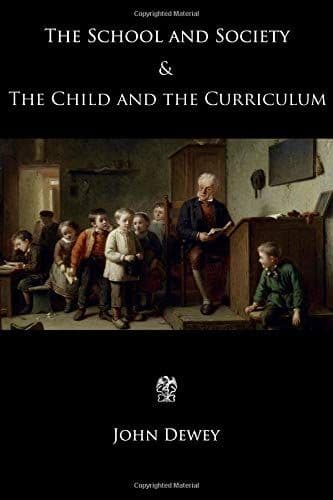
The Child and the Curriculum
Dewey's 1902 pamphlet argues that the opposition between the child's present experience and the organized subject matter of the curriculum is a false dualism. Both are necessary poles of a single process: the child's impulses and interests provide the starting point, while the curriculum's bodies of knowledge represent the funded experience of the race. The educational task is not to choose between them but to reconstruct subject matter so that it can be assimilated by the child's growing experience. Dewey uses the analogy of an explorer and a map to show how the psychological and logical ordering of knowledge are related, not opposed.
Key Insights
✦What is the central argument of The Child and the Curriculum, and what dualism does it reject?
Dewey argues that the child and the curriculum are not opposing forces but two limits defining a single process. The child's present experience and the organized bodies of knowledge that constitute the curriculum are both necessary: one provides the starting point of growth, the other the funded wisdom of the race that growth must eventually assimilate. Dewey rejects the assumption that education must choose between child-centered and subject-centered approaches. D. C. Phillips has argued that the essay contains an influential account of how dualisms arise, become entrenched in opposing sects, and can eventually be dissolved—an account Phillips traces to Hegel's dialectic . The essay's aim is not compromise but reconstruction of how we understand the relation itself.
✦What is the explorer-and-map analogy, and what does it illustrate?
Dewey uses the analogy of an explorer and a map to clarify the relation between the psychological and the logical ordering of subject matter. The explorer's actual journey is messy, contingent, and directed by immediate needs and discoveries—this corresponds to the child's psychological experience of learning. The map, by contrast, is a logical distillation of many journeys, organized for efficient reference and abstract comprehension. Neither is superior: the map would be useless to someone who had never explored, and exploration without maps risks wasting effort on already-charted ground. The educational implication is that subject matter must be psychological—rendered as experience—without losing its logical organization. Phillips notes that this analogy is central to the essay's argument and has been widely analyzed in curriculum theory .
✦How does this essay relate to Dewey's earlier The School and Society and later Democracy and Education?
The Child and the Curriculum was published in 1902, three years after The School and Society and fourteen years before Democracy and Education. It emerged from the same period of intense curricular work at the Laboratory School, which Dewey ran from 1896 to 1904 . Where The School and Society argued for connecting school activities to social life, The Child and the Curriculum focuses more narrowly on the epistemological problem of how organized knowledge relates to the child's experience. Democracy and Education later integrated both concerns into a comprehensive theory. The essay is thus a crucial middle term: it addresses the theoretical puzzle that the Laboratory School's practical reforms had exposed, and it anticipates the more systematic treatment of experience and knowledge in Dewey's mature work.
✦Why was the essay written at a moment of crisis for the Laboratory School?
By 1902, relations between the Laboratory School and the University of Chicago administration had become strained, and the school's continuation was in question . The Child and the Curriculum was one of Dewey's last writings on education while at Chicago, and it served partly as a statement of the principles the school embodied. The essay is not merely a theoretical exercise; it defends the school's approach against both traditionalists who saw it as neglecting subject matter and enthusiasts who saw it as abandoning structure. Dewey's insistence that the child and curriculum are poles of one process was a direct response to critics who accused the Laboratory School of being either too child-centered or insufficiently rigorous. The pamphlet's rhetorical context illuminates why Dewey was so concerned to reject false alternatives.
✦What is a common misreading of Dewey's position in this essay?
A persistent misreading treats Dewey as a child-centered progressive who subordinated organized knowledge to the child's whims. The essay explicitly rejects this. Dewey criticizes the "new" education as much as the "old": child-centered enthusiasts who dismiss subject matter as irrelevant are just as mistaken as traditionalists who impose it without regard for the child's experience. The essay's opening claim is that profound theoretical differences grow out of genuine problems, not gratuitous error . Dewey's point is that the child's experience is not the terminus of education but its starting point; the curriculum is not the enemy but the destination. Reading the essay as a defense of unstructured child-centeredness inverts its argument and ignores its sustained critique of that position.
✦How has the essay's argument held up in curriculum theory since its publication?
The Child and the Curriculum remains a foundational text in curriculum theory, though its reception has been selective. Phillips's centennial assessment in The Elementary School Journal noted the essay's continuing relevance for understanding how educational disputes become polarized around false dualisms . However, the essay's proposed resolution—reconstructing subject matter so that it is continuous with the child's experience—has proven easier to state than to institutionalize. Later curriculum theorists have drawn on Dewey's framework while disagreeing about its practical implications, and the tension between psychological and logical ordering of knowledge remains a live problem in curriculum design. The essay's value lies less in a settled solution than in its diagnosis of why the debate persists.
Wealthy Psyche is an intellectual archive. We do not host, distribute, or sell book copies — physical or digital. We provide structured knowledge to help you think better, faster.