


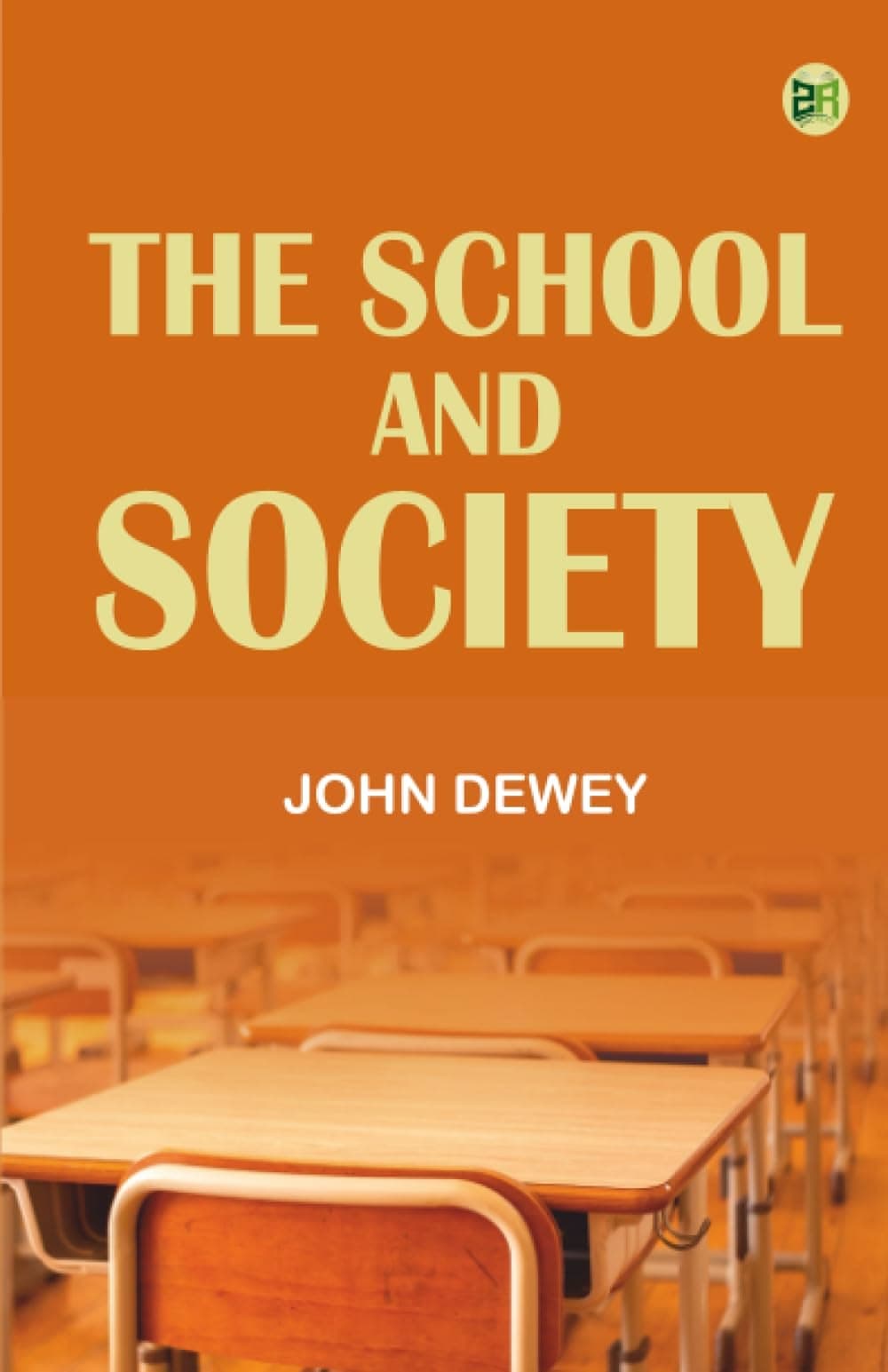
The School and Society
Based on lectures delivered at the University of Chicago Laboratory School, this 1899 book argues that the school must be reconstructed as a miniature community whose occupations—cooking, weaving, woodwork—reflect the larger life of society. Dewey's central claim is that traditional education isolates the child from the practical and social sources of learning, producing passive recipients rather than active inquirers. By connecting classroom activity to the industries and problems of everyday life, the school becomes an instrument of social reform rather than a preserve of abstract book-learning. The book is Dewey's first extended statement of education as a social process.
Key Insights
✦What is the central argument of The School and Society, and what does it reject?
Dewey argues that the school must be reconstructed as a cooperative community whose activities mirror the occupations and problems of the larger society. He rejects the traditional school's isolation from life: passive, rote learning focused on symbolic studies severs the child from the practical sources of intellectual growth . The book's four core emphases, as James Campbell summarizes them, are education for social reconstruction, the integration of the "new psychology" of sociality and problem-solving, in-school activities that reflect society, and the reduction of waste between school and out-of-school life . Dewey's claim is that when children engage in cooking, weaving, or woodwork, they are not learning menial skills but tracing the historical and social foundations of knowledge itself.
✦What was the University of Chicago Laboratory School, and how does the book relate to it?
The Laboratory School, founded by Dewey in 1896 at the University of Chicago, was the experimental setting in which his educational theories were tested and refined. The School and Society grew directly out of lectures Dewey gave to parents and supporters of the school, explaining its aims and methods . The book describes his experiences with the school and presents its underlying philosophy . This origin matters: the text is not a detached treatise but a justification of a specific institutional experiment, written for an audience already invested in its success. The Laboratory School's practices—occupations, cooperative activity, connection to community life—supply the concrete examples through which Dewey's abstract claims are illustrated.
✦How did the 1915 revised edition change the original 1899 text?
The 1915 revision substantially altered the book's structure. Dewey dropped the fourth chapter from the original edition and added five additional essays that had been published elsewhere . This means that readers encountering "The School and Society" in a combined or modern edition may be reading a text quite different from the 1899 original. The 1899 edition consisted of three lectures supplemented by a statement about the University Elementary School . The 1915 version expanded the book considerably, and later reprints have varied in which edition they follow. Scholars should specify which edition they are citing, since the added essays introduce material not present in the original lectures and alter the book's overall shape.
✦Why did Dewey think traditional education was incompatible with industrial society?
Dewey argued that the Industrial Revolution had removed practical learning from the home and neighborhood: once production moved to urban factories, children no longer had opportunities to observe and participate in the productive activities through which earlier generations had learned . The common school had merely added literacy and numeracy on top of practical abilities formed outside school. But in the industrial city, those abilities had no organic source, so the school itself had to provide opportunities for experience-based practical learning. This historical argument is central to the book's reform program. Dewey was not nostalgic for pre-industrial life; he was claiming that the school must adapt to changed social conditions by reconstructing, within its own walls, the active and cooperative character of learning that industrialism had displaced.
✦How does The School and Society relate to Dewey's later Democracy and Education?
The School and Society is Dewey's first published work of length on education and lays the foundation for his later, more systematic treatment in Democracy and Education (1916) . The earlier book is more concrete and polemical, rooted in the specific practices of the Laboratory School. Democracy and Education generalizes and deepens the argument, providing a philosophical anthropology of growth and a fuller account of the relationship between education and democratic life. Many of the themes announced in The School and Society—education as social process, the rejection of dualisms between thought and action, the connection between school and community—are developed at greater length and with more theoretical sophistication in the later work. Reading the earlier book illuminates the practical origins of Dewey's mature educational philosophy.
✦What is a common misconception about Dewey's progressivism that this book helps to correct?
A persistent misconception is that Dewey's progressive education advocated unstructured, child-centered activity in which teachers imposed no direction and students simply did as they pleased. The School and Society does not support this reading. Dewey's emphasis on occupations and practical activity is paired with a demand for intellectual continuity: the child's interests are the starting point, but the aim is to lead the child toward organized knowledge and social understanding. Campbell notes that Dewey sought to reduce "isolation and waste" in education, not to abolish structure . The Laboratory School's curriculum was carefully designed, and Dewey insisted that freedom without direction produces mere caprice. The book's argument is for a different kind of structure—one grounded in cooperative inquiry rather than mechanical recitation—not for the absence of structure altogether.
Wealthy Psyche is an intellectual archive. We do not host, distribute, or sell book copies — physical or digital. We provide structured knowledge to help you think better, faster.