


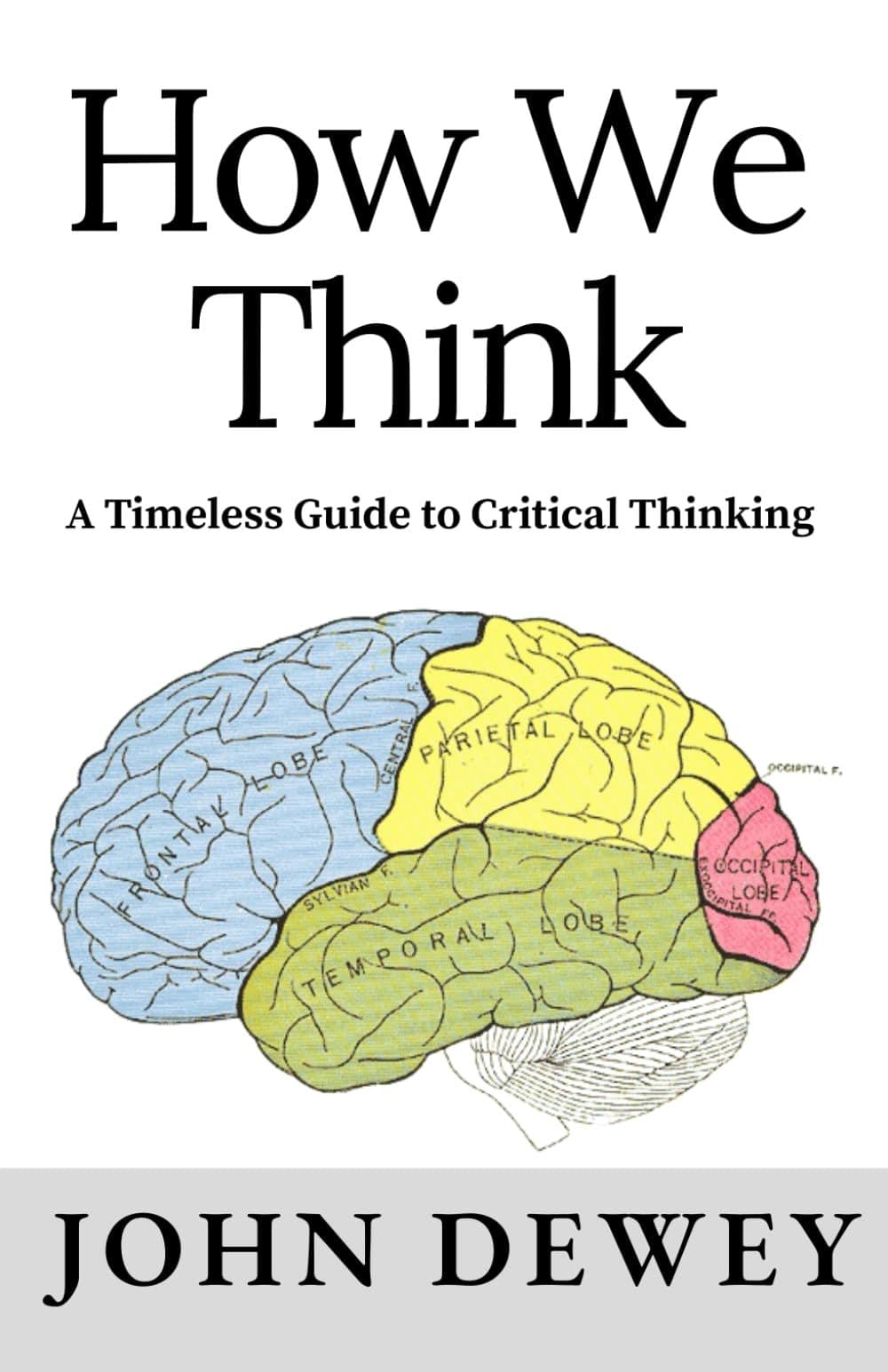
How We Think
Dewey's 1910 book argues that reflective thinking is not a natural endowment but a disciplined method that can be taught and cultivated. He defines it as the active, persistent, and careful consideration of a belief in light of the grounds that support it and the conclusions to which it leads. The book traces a five-phase pattern of inquiry—from a perplexing situation through observation, hypothesis, and testing—and applies this pattern to the educative process, insisting that schools should train habits of suspended judgment and experimental verification rather than transmit fixed conclusions.
Key Insights
✦What is Dewey's definition of reflective thinking, and what distinguishes it from ordinary thought?
Dewey defines reflective thinking as the active, persistent, and careful consideration of any belief or supposed form of knowledge in light of the grounds that support it and the further conclusions to which it tends . The key terms are "active" and "careful": ordinary thinking is passive, a stream of suggestions that happen to us, while reflective thinking involves taking control of the conditions under which inquiry occurs. Dewey argues that the transition from natural to reflective thinking requires overcoming "the inertia that inclines one to accept suggestions at their face value" . The essence of the method is suspended judgment—holding a conclusion in abeyance while evidence is gathered and tested—rather than jumping to the first available answer.
✦What are the five phases of reflective thinking that Dewey identifies?
Dewey's account of inquiry proceeds through five phases, though he insists they are not a rigid sequence. First, a perplexing situation or problem is encountered. Second, the problem is located and defined through observation of the facts. Third, suggestions or hypotheses emerge as possible solutions. Fourth, the implications of these hypotheses are reasoned out. Fifth, the hypotheses are tested through further observation or experiment, leading to acceptance or rejection . Dewey's model was influential in shaping later phase models of critical thinking, and it underlies his account of the "scientific method" as a pattern of complete thinking rather than a set of fixed procedures. The phases describe a logic of inquiry, not a recipe that guarantees correct answers.
✦How does the 1933 revised edition differ from the original 1910 text, and why does this matter?
Dewey substantially revised How We Think in 1933, retitling it A Restatement of the Relation of Reflective Thinking to the Educative Process . The most significant lexical change is that Dewey largely replaced the term "critical" with "reflective" in the revised edition, a shift that some scholars argue obscures an operative notion of criticality present in the 1910 text . The 1933 edition also reflects Dewey's intervening work in logic and his more mature pragmatism. Readers should be aware that citations to "Dewey's How We Think" may refer to either edition, and the two are not identical in emphasis. The 1910 edition's vocabulary of "critical" thinking has been argued to carry normative and operative dimensions that the later term "reflective" does not fully capture.
✦How does Richard Rorty's critique of Dewey's experimental method relate to How We Think?
Rorty argued that Dewey's appeal to the "experimental method" was a residual scientism that pragmatism should discard. Recent scholarship has challenged this reading by returning to How We Think, where Dewey's account of method is most fully developed in an educational context . The argument is that Rorty's dismissal would have been either nuanced or radically different had he seriously considered the importance of education for Dewey's philosophy. In How We Think, method is not a fixed algorithm but a disciplined habit of inquiry tied to growth and experience. The text thus shows the relevant connections between pragmatism, evolutionism, and method that Rorty's reconstruction overlooks. This debate illustrates how a pedagogical text can bear on central questions of pragmatist epistemology.
✦What is a common misconception about Dewey's account of thinking that this book is meant to correct?
A frequent misconception is that Dewey believed thinking could be taught directly as a subject matter, or that his five phases constitute an infallible method for arriving at correct solutions. Neither is accurate. Dewey held that thinking cannot be taught in the sense of transferring a technique; it can only be positively influenced by creating conditions that provoke and sustain inquiry . The phases describe the logic of complete thinking, not a guarantee of success. Dewey explicitly warned that no infallible method of reflective thinking has been devised or is likely to be, and that different inquirers following the method may reach different conclusions based on evidence and reasoning. The method suggests a rational approach, not a mechanical procedure for generating truth.
✦How has How We Think shaped later educational practice and teacher education?
The book's influence on teacher education has been extensive, particularly through the concept of reflective practice. Dewey's definition of reflective thinking as active, persistent, and careful consideration of beliefs became foundational for later models of teacher reflection, including Donald Schön's work on reflection-in-action and reflection-on-action . However, scholars have noted that the term "reflection" has become so widely used that it has lost precision: one researcher laments that in becoming everything to everybody, reflective thinking "has lost its ability to be seen" . Dewey's own text remains valuable precisely because it specifies what reflection is—suspended judgment grounded in evidence—rather than treating it as a vague attitude of thoughtfulness.
Wealthy Psyche is an intellectual archive. We do not host, distribute, or sell book copies — physical or digital. We provide structured knowledge to help you think better, faster.