


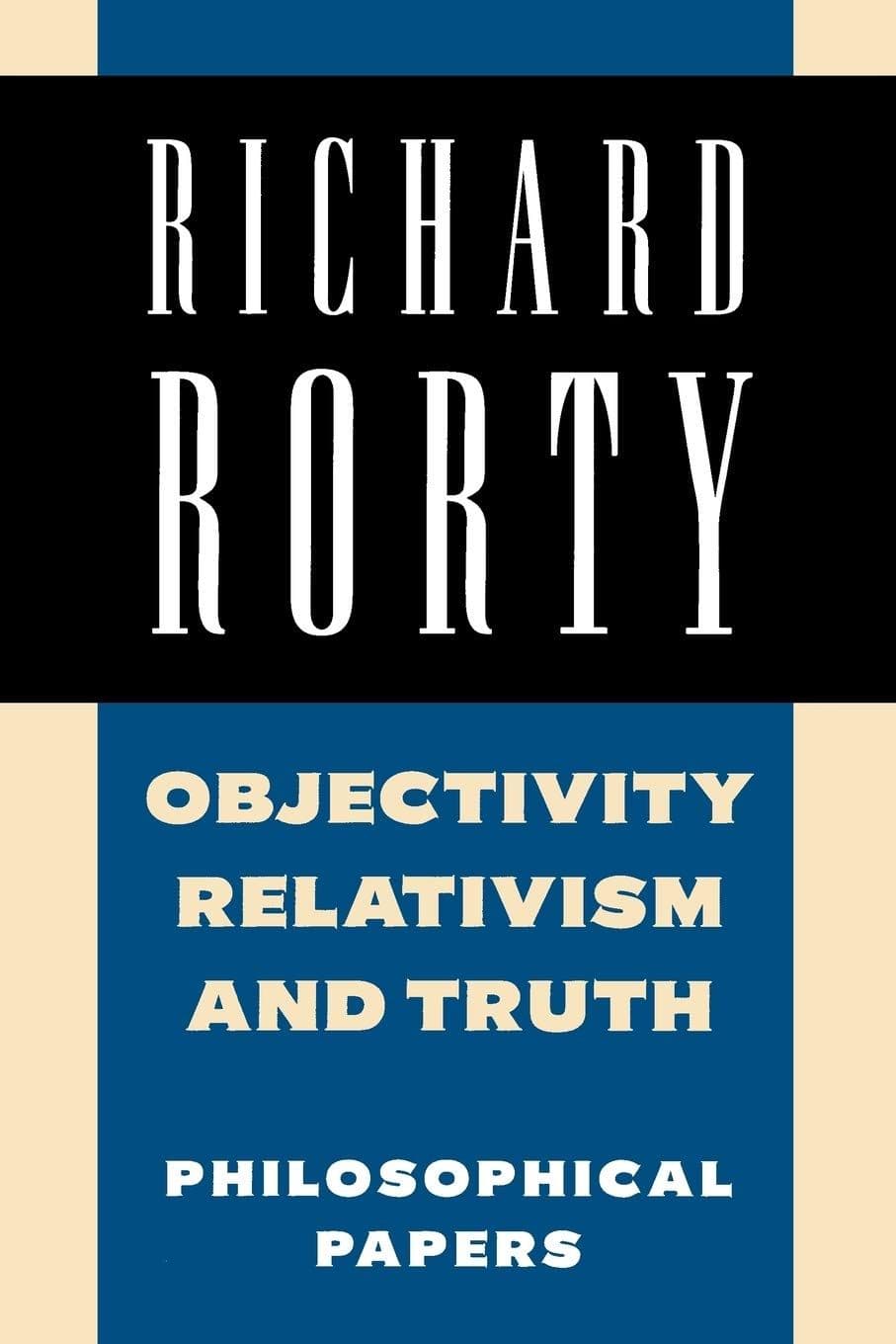
Objectivity, Relativism, and Truth: Philosophical Papers, Volume 1
Rorty's central thesis across these essays is that objectivity should be redefined as intersubjectivity—agreement within a community—rather than correspondence to a mind-independent reality. The volume's distinctive mechanism is its Deweyan recasting of the natural sciences as exemplary not because of a special method but because of the moral virtues of scientific communities: openness, tolerance, and free inquiry. Rorty navigates between analytic and continental philosophy by agreeing with the latter's critique of traditional objectivity while rejecting its political quietism, concluding with reflections on the priority of democracy to philosophy.
Key Insights
✦What does Rorty mean by 'objectivity as intersubjectivity,' and what does it reject?
Rorty's Deweyan proposal is that objectivity should be understood not as correspondence to a mind-independent reality but as agreement among inquirers within a community. Cambridge University Press summarizes the volume's central move: Rorty offers 'a Deweyan account of objectivity as intersubjectivity, one that drops claims about universal validity and instead focuses on utility for the purposes of a community' . What this rejects is the traditional epistemological picture in which beliefs are objective insofar as they accurately represent a world that exists independently of our descriptions. Rorty does not deny that there is a world; he denies that the notion of 'correspondence' does any useful work in explaining why some beliefs are better than others. Better beliefs are those that survive free and open inquiry, not those that mirror reality.
✦Why does Rorty say the natural sciences are exemplary, and how does this differ from traditional philosophy of science?
Rorty argues that the natural sciences are exemplary for inquiry not because they employ a special scientific method that gets at objective reality, but because scientific communities exhibit certain moral virtues: openness to criticism, tolerance of disagreement, and commitment to free inquiry . This is a significant departure from traditional philosophy of science, which seeks to identify the distinctive logic or method that makes science superior to other forms of inquiry. For Rorty, science has no special epistemological privilege; it is simply one practice among others that has developed habits of coping with the world effectively. The lesson to draw from science's success is political and moral, not methodological: communities that permit free and open encounters produce better beliefs than those that do not.
✦What does Rorty mean by 'ethnocentrism,' and why does he defend it against charges of relativism?
Rorty's ethnocentrism is the view that we can only justify our beliefs by reference to the standards and practices of our own community, not by appealing to a neutral, universal standpoint that transcends all communities. The essay 'On Ethnocentrism: A Reply to Clifford Geertz' defends this position against Geertz's charge that it leaves no room for critical engagement with other cultures . Rorty's response is that ethnocentrism is not relativism: it does not claim that all communities are equally good, only that our judgments about which communities are better must themselves be made from within some community's standards. The alternative—appealing to a view from nowhere—is not a genuine option, and pretending it is merely obscures the fact that our commitments are grounded in historical and cultural practice.
✦How does the volume's final section, 'The Priority of Democracy to Philosophy,' summarize Rorty's political position?
The section title states the thesis directly: democracy does not need philosophical foundations, and the attempt to provide them has been a distraction from the practical task of sustaining free and open institutions. The essays 'Postmodernist bourgeois liberalism' and 'Cosmopolitanism without emancipation' argue that liberal democracy can survive without the metaphysical and epistemological doctrines that philosophers have historically offered in its defense. Rorty's target is not only foundationalist philosophers but also leftist critics who demand that liberalism justify itself by reference to universal principles. His claim is that such demands are themselves a legacy of the representationalist picture he has been dismantling throughout the volume. Democracy is prior to philosophy because the practices of free inquiry and toleration can be defended without appeal to any philosophical theory.
✦How does this volume relate to Rorty's other Philosophical Papers collections?
Objectivity, Relativism, and Truth is Volume 1 of Rorty's Philosophical Papers, followed by Essays on Heidegger and Others (Volume 2) and Truth and Progress (Volume 3). Cambridge University Press describes the two volumes published in 1991 as taking up 'some of the issues which divide Anglo-Saxon analytic philosophers and contemporary French and German philosophers' and offering 'something of a compromise' . Volume 1 focuses primarily on analytic interlocutors—Davidson, Hesse, Geertz, Lyotard—while Volume 2 turns to continental figures like Heidegger and Derrida. The collection thus establishes the pragmatist position that the later volumes develop and apply in different registers. Readers seeking the fullest statement of Rorty's engagement with Davidson, in particular, will find it here in the essays on truth and metaphor.
✦What is the significance of Rorty's engagement with Donald Davidson in this volume?
Rorty treats Davidson as the contemporary philosopher who offers the best account of objectivity and truth . The essays 'Pragmatism, Davidson and truth' and 'Unfamiliar noises: Hesse and Davidson on metaphor' argue that Davidson's work supports a pragmatist view in which truth is not a substantive property to be analyzed but a term we use to endorse beliefs that have survived inquiry. Davidson's coherence theory of truth and his rejection of the scheme-content distinction are, for Rorty, important resources for dismantling the representationalist picture. At the same time, Rorty's reading of Davidson has been contested by Davidson scholars who argue that Davidson was not the pragmatist Rorty made him out to be. The volume's Davidson essays are therefore central both to Rorty's project and to debates about its fidelity to its sources.
Wealthy Psyche is an intellectual archive. We do not host, distribute, or sell book copies — physical or digital. We provide structured knowledge to help you think better, faster.