


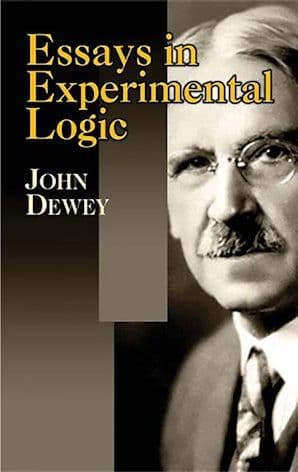
Essays in Experimental Logic
Dewey's central thesis is that there is no such thing as 'pure' thinking or logic überhaupt: thought always originates in a concrete problematic situation and aims at its resolution, so logical forms are instruments generated within inquiry rather than a priori structures standing above it. The collection's distinctive mechanism is the application of a behavioristic psychology to logical theory—treating ideas as plans of action whose validity is tested by their success in transforming indeterminate situations. Dewey's introduction, written specifically for the volume, frames the essays as a unified statement of instrumentalism against both idealist and presentative realist accounts of knowledge.
Key Insights
✦What is the central claim of Essays in Experimental Logic, and what does it reject?
The central claim is that thinking is always situated: it arises from a specific difficulty, operates on concrete data, and terminates in a specific resolution, so there can be no 'pure' logic that prescribes forms independent of actual inquiry. A contemporary review in The School Review put the point directly: 'There is no thinking überhaupt, and no pure logic' . What Dewey rejects is the traditional conception of logic as a normative science of thought's abstract forms, along with the spectator theory of knowledge that treats cognition as a relation between a subject and an independent object. The essays instead treat logical principles as instruments refined within inquiry and generalized for future use.
✦How does this collection relate to Dewey's earlier Studies in Logical Theory?
Essays in Experimental Logic is partly a reprint and partly a reconstruction of the earlier volume. Dewey's prefatory note explains that Studies in Logical Theory (1903) had gone out of print, and the University of Chicago Press suggested reprinting his own contributions together with other essays in the same field. Chapters two through five represent, with editorial revisions mostly consisting of omissions, the essays taken from the old volume. The first and introductory chapter was written especially for the new collection, and the remaining essays were partly reprinted and partly rewritten from periodical contributions . James Scott Johnston's study of Dewey's earlier logic treats the 1916 volume as a distinct stage in the development of instrumentalism, not a mere reissue .
✦What does Dewey mean by describing his psychology as 'behavioristic' in this volume?
In the prefatory note dated April 1916, Dewey writes that the essays in their psychological phases are written from the standpoint of what was then termed a behavioristic psychology, though some of them antedate the use of that term . The commitment is methodological rather than doctrinal: conscious states are treated as modes of behavior by which an organism adjusts to a situation of conflict, and psychology's task is to provide a natural history of the conditions under which a behavioral mode emerges. Andrew Backe's dissertation argues, however, that an underlying metaphysical intuition inherited from Dewey's absolute idealism prevents a fully behavioristic reading of his psychology, since Dewey refused to treat psychological phenomena as composed of separate existences .
✦How was the book received by Dewey's contemporaries?
The reception was serious and divided. The School Review's 1916 notice called the volume 'the voice of evolution in the temple of logic' and insisted that no teacher satisfied with a perfunctory logic course could afford to neglect it, while noting that readers might disagree with Dewey's conception of thinking . The 2007 critical edition edited by D. Micah Hester and Robert B. Talisse reprints five critical essays by Dewey's contemporaries—Bertrand Russell, Wendell T. Bush, R. F. Alfred Hoernlé, H. T. Costello, and C. S. Peirce—alongside the original texts, making the contemporary controversy accessible in one volume . Russell's objections in particular anticipated the charge that Dewey's logic collapses normativity into psychology.
✦Is Essays in Experimental Logic a unified book or a collection of occasional papers?
It is genuinely both, and the tension matters for reading it. Dewey wrote a new introduction specifically to frame the collected essays as a coherent statement, and the volume's chapters range across the relationship of thought to its subject-matter, the antecedents of thinking, data and meanings, the objects of thought, and the logic of judgments of practice . But the essays were composed over more than fifteen years and for different occasions; the prefatory note acknowledges that 'Some Stages of Logical Thought' antedates the Studies essays, having been published in 1900 . The 2007 critical edition's textual notes map each chapter to its location in the Collected Works, making the composite history visible to scholars.
✦What is the relationship between this book and Dewey's 1938 Logic: The Theory of Inquiry?
Essays in Experimental Logic is the crucial intermediate stage between the 1903 Studies and the 1938 Logic, which is usually treated as Dewey's definitive statement. The 1916 volume lays the groundwork for the mature theory: it develops the account of inquiry as the transformation of a problematic situation, the instrumental status of logical forms, and the critique of epistemological realism that the 1938 book would systematize. The 2007 critical edition's editors describe the Essays as marking the point at which Dewey critically engages idealistic and intuitionist theorists and lays the groundwork for his mature theory of inquiry . Tom Burke's introduction to that edition places the Essays in precisely this developmental context.
Wealthy Psyche is an intellectual archive. We do not host, distribute, or sell book copies — physical or digital. We provide structured knowledge to help you think better, faster.