


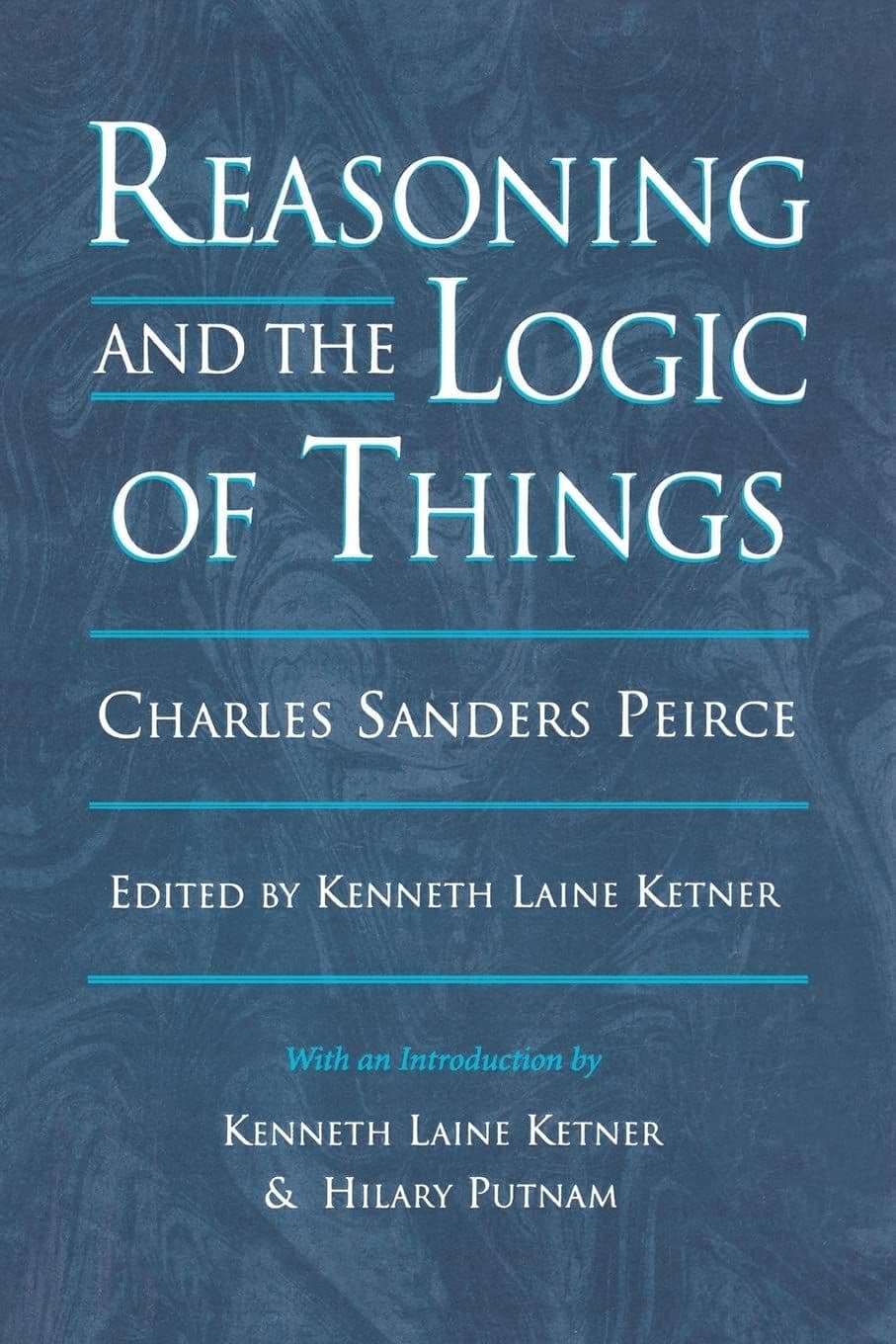
Reasoning and the Logic of Things: The Cambridge Conferences Lectures of 1898
Delivered as the Cambridge Conferences Lectures of 1898 and first published in full in 1992, these eight lectures present Peirce's most accessible and coherent account of his mature system. The argument moves from the nature of philosophy and the three types of reasoning—deduction, induction, and retroduction—to the logic of relatives, the first rule of logic, and the classification of the sciences. It culminates in an evolutionary cosmology that explains the reality of laws through continuity and habit. Peirce, at William James's urging, deliberately avoided technical mathematics to address a general audience, making this the clearest single-volume introduction to his thought.
Key Insights
✦What is the central argument of Reasoning and the Logic of Things, and why is it considered Peirce's most coherent statement?
The lectures argue that metaphysics must draw its principles from logic, and logic from mathematics, and they proceed to demonstrate this hierarchy across eight connected lectures. Peirce begins with the conduct of life, moves through the three types of reasoning (deduction, induction, retroduction), the logic of relatives, and the first rule of logic, and concludes with an evolutionary cosmology that explains the reality of laws through continuity and habit. Harvard University Press describes the volume as Peirce's "only known, complete, and coherent account of his own work" . The coherence lies in the sequence: each lecture builds on the previous one, moving from the foundations of reasoning to the metaphysical conclusions that reasoning, properly understood, requires.
✦Why were these lectures not published until 1992, and what does the editorial reconstruction involve?
The lectures were delivered in 1898 at a private home near Harvard Yard, after Harvard's corporation denied Peirce permission to lecture on campus . Extracts from drafts and delivered lectures appeared piecemeal in the Collected Papers, but the full set was not assembled until Kenneth Laine Ketner reconstructed it from manuscripts in the Charles S. Peirce Papers and the William James Papers at Houghton Library . The 1992 Harvard edition includes an introduction by Ketner and Hilary Putnam, extensive comments by Putnam, and a study edition apparatus. Jaime Nubiola's review in The Philosophical Quarterly notes that the piecemeal presentation in the Collected Papers had made "any proper understanding difficult until now" .
✦What role did William James play in shaping these lectures?
James was instrumental in arranging the lectures and in shaping their accessible style. At James's urging, Peirce made an uncharacteristic effort to present his ideas in terms intelligible to a general audience, avoiding advanced mathematics and technical logic . James also asked the Harvard Corporation to allow Peirce to lecture on campus, though permission was denied, and the lectures were held in a private home instead . This context matters for interpreting the text: the lectures are not a technical treatise but a deliberate attempt at public philosophy, which is why they remain the most accessible entry point into Peirce's mature thought. The volume is dedicated to Walker Percy, whose prophecy about Peirce—that most people had never heard of him, but would—is recorded in the introduction .
✦How does the account of reasoning in these lectures differ from Peirce's earlier published essays?
The earlier essays of the 1870s, particularly "The Fixation of Belief" and "How to Make Our Ideas Clear," presented the pragmatic maxim as a method for clarifying concepts, with inquiry understood as the settlement of belief. The 1898 lectures incorporate two decades of subsequent work and present a far more systematic framework. The clearest formulation of the three types of reasoning—deduction, induction, and retroduction (abduction)—appears here, with retroduction given a central role in explaining how novel hypotheses are generated . The lectures also integrate Peirce's logical work on relatives and his evolutionary cosmology into a single narrative, whereas the earlier essays were isolated interventions. The 1898 lectures thus represent the mature Peirce looking back on and reorganizing his entire philosophical project.
✦What is the significance of the lectures' conclusion on "the logic of continuity"?
The eighth and final lecture, "The Logic of Continuity," turns from reasoning to the "logic of things"—that is, from the norms of inquiry to the structure of reality itself. Peirce calls for an evolutionary cosmology to explain the reality of laws, arguing that laws are not eternal fixtures but products of growth and habit-formation. Ketner and Putnam's introduction identifies continuity in Peirce with "the notion of inexhaustible and creative possibility" . This conclusion ties the lectures' logical investigations to Peirce's synechism, the doctrine that continuity governs all reality. The move from logic to cosmology is the lectures' most ambitious gesture: it claims that the same principles that govern valid reasoning also govern the development of the universe.
✦How does Hilary Putnam's commentary shape the reader's encounter with these lectures?
Putnam's contribution is substantial: he provides fifty pages of comments designed as "a guide to background materials not conveniently available" and as a suggestion of "real connections between Peirce's efforts and contemporary discussions" . Putnam highlights, among other things, the contrast between Peirce's and Frege's attitudes toward logic: the two inventors of predicate calculus disagreed fundamentally on whether logic is empirical, with Peirce treating logical reasoning as involving "mental experimentation with diagrams" . This editorial mediation is significant because Putnam reads Peirce through the lens of twentieth-century analytic philosophy, making the lectures speak to contemporary debates while also imposing a particular interpretive frame. Readers should treat Putnam's comments as a valuable but distinct layer of the volume, not as Peirce's own voice.
Wealthy Psyche is an intellectual archive. We do not host, distribute, or sell book copies — physical or digital. We provide structured knowledge to help you think better, faster.