


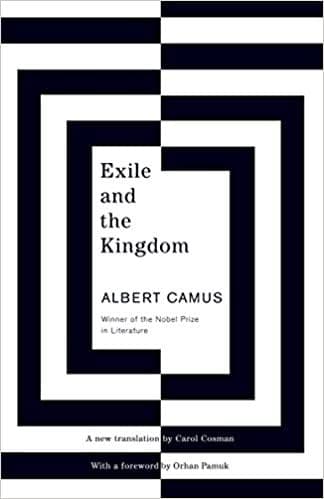
Exile and the Kingdom

This 1957 collection of six stories is organized around a single conceptual pair: exile as the experience of separation from self, community, or meaning, and the kingdom as the elusive condition of belonging or reconciliation that may or may not follow. Unlike Camus's novels, which build sustained arguments, these stories dramatize the pair through discrete figures—a dissatisfied colonial wife, a broken laborer, a conflicted schoolteacher—whose endings remain deliberately unresolved. The book's distinctive contribution is its refusal to specify what the kingdom consists of, treating it instead as a limit-concept against which the varieties of exile are measured and judged.
Key Insights
✦What does the title opposition of exile and kingdom actually organize in this collection?
The title is not a thesis but a diagnostic frame. Each story presents a character in a condition of exile—from a spouse, a community, a political cause, or a sense of purpose—and each ending withholds or complicates any arrival in a kingdom. English Showalter Jr. argues that the stories should be read as a unified sequence in which the final story, 'The Growing Stone,' offers the collection's most sustained image of reconciliation, though even there the resolution is bodily and ambiguous rather than doctrinal . The kingdom, in other words, functions less as a promised destination than as a standard against which the adequacy of each character's response to exile is judged.
✦How does this collection relate to Camus's earlier novels and to The Fall?
Exile and the Kingdom extends the ethical turn visible in The Fall while dispersing it across six distinct situations. Where The Fall concentrates duplicity in a single performing voice, these stories distribute the problem of judgment across colonial wives, laborers, a schoolteacher, and an artist. EBSCO's critical summary notes that the collection makes explicit the theme of living for others who cannot live fully, a theme that runs through Camus's later work . Bernard Murchland, reviewing the collection in Catholic World, observed that Camus was stressing 'penance and expiation' in both The Fall and these stories, a shift that some admirers of his earlier nihilistic register did not welcome .
✦Why has Exile and the Kingdom been comparatively neglected next to The Stranger and The Plague?
Showalter attributes the neglect partly to the collection's form: six independent stories cannot produce the unified impact of a novel, and early reviewers tended to single out individual stories for praise or blame rather than assess the book as a whole . He also notes that the first major Camus biography, Herbert Lottman's 1979 life, barely mentions the collection across more than seven hundred pages . The result is that the book remains one of Camus's most widely anthologized works in American classrooms—'The Guest' has appeared in at least seventeen English-language anthologies—while receiving far less sustained critical treatment than his novels .
✦How does the Algerian context of 1957 shape the stories, particularly 'The Guest'?
'The Guest' is the collection's most direct engagement with the colonial dilemma Camus faced as a pied-noir who sympathized with Algerian aspirations while fearing for the French settler community. The story places a French schoolteacher, Daru, in an impossible position: a policeman leaves an Arab prisoner with him, and Daru must choose between delivering the man to authorities or setting him free. Camus's own position, as documented in his 1957 Nobel speech and earlier writings, combined opposition to French colonial abuses with refusal to endorse FLN violence, a stance that drew accusations of 'incapacitated colonial sensibility' from Edward Said . The story does not resolve this tension; it dramatizes the moral paralysis it produced.
✦What is the most common misreading of the collection's endings?
The most persistent misreading takes the stories' unresolved endings as failures of craft or as signs that Camus had no position. Showalter argues the opposite: the obscurity is deliberate, designed to force the reader to extend the text's perplexity into real-world judgment . Each ending poses a difficulty that is 'murky, insoluble, and real,' and the reader is invited to formulate what the character cannot. A related error is to treat the stories as illustrations of a pre-existing existentialist doctrine, when they are better read as experiments that test whether any doctrine of exile and belonging can survive the specific pressures of colonial Algeria, labor displacement, and artistic compromise.
✦How do the standard English translations handle Camus's prose in this collection?
Justin O'Brien's 1958 translation was the standard English version for decades, and it remains the text most widely anthologized and cited . A later translation by Carol Cosman, published around the fiftieth anniversary of the French edition, sought to recover qualities of Camus's prose that O'Brien's version had smoothed . The collection poses particular translation challenges because several stories depend on shifts in register—the clinical detachment of 'The Adulterous Woman,' the fractured intensity of 'The Renegade'—and small tonal choices can significantly alter how sympathetic or judgmental the narration appears. Readers comparing translations will find that the stories' ambiguities are partly a function of the prose surface itself.
Wealthy Psyche is an intellectual archive. We do not host, distribute, or sell book copies — physical or digital. We provide structured knowledge to help you think better, faster.