


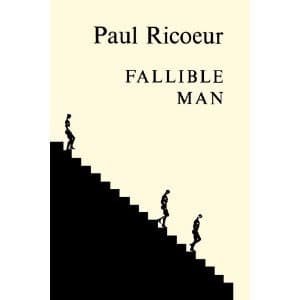
Fallible Man

Ricœur's central claim is that human fallibility—the capacity for evil—is rooted in a constitutive disproportion within the human person. This disproportion is not a defect but the very structure of human existence: reason and desire, the infinite and the finite, the transcendental and the empirical meet in a fragile synthesis that can break down. Evil is therefore not a foreign intrusion but a possibility inscribed in the constitution of a being who must continually mediate between incompatible poles. The book is a philosophical anthropology that prepares the ground for a phenomenology of guilt and transcendence.
Key Insights
✦What is the central claim of Fallible Man, and what does it reject?
The central claim is that human fallibility—the capacity for evil—is rooted in a constitutive disproportion within the human person. This disproportion is not a defect to be overcome but the very structure of human existence: reason and desire, the infinite and the finite, the transcendental and the empirical meet in a fragile synthesis that can break down . Ricœur rejects both the naturalistic reduction of evil to a defect in human nature and the moralistic view that evil is a simple failure of will. Evil is not a foreign intrusion but a possibility inscribed in the constitution of a being who must continually mediate between incompatible poles. The book is a philosophical anthropology that prepares the ground for the phenomenology of guilt and transcendence in The Symbolism of Evil .
✦What is the significance of the concept of 'disproportion' in Ricœur's argument?
Disproportion is the central concept of Fallible Man. Ricœur argues that the human person is constituted by a series of disproportions: between reason and desire, between the infinite and the finite, between the transcendental and the empirical. These proportions are not a harmony but a fragile synthesis, always liable to break down. The 'fault' (faute) of human fallibility is not a moral failing that could be corrected but the fragility of a being who must mediate between poles that cannot be fully reconciled . The concept is deliberately philosophical rather than theological: Ricœur is describing the structure of human existence, not its sinfulness. This is why the book is subtitled 'Philosophy of the Will' rather than 'Theology of Sin.'
✦How does Fallible Man relate to The Symbolism of Evil?
Fallible Man is the philosophical anthropology that prepares the way for The Symbolism of Evil, which Ricœur published the same year. The earlier book (Freedom and Nature, 1950) had described the voluntary and involuntary structure of the will; Fallible Man analyzes the disproportion that makes the will liable to fault; The Symbolism of Evil examines the myths and symbols through which cultures have expressed the experience of fault . The three books together form a trilogy on the philosophy of the will, with Fallible Man occupying the pivotal position: it shows why evil is possible for a being constituted as a fragile synthesis, thereby grounding the subsequent investigation of how evil is experienced and symbolized. A 2023 edition by Cambridge University Press has made the book available to new generations of readers .
✦What is the publication and translation history of the work?
Fallible Man was first published in French as L'Homme faillible by Aubier-Montaigne in Paris in 1960, as part of Ricœur's Philosophie de la volonté . The English translation by Charles Kelbley was published by Henry Regnery Company in Chicago in 1965 . A revised edition of the translation was published by Fordham University Press in 1986 . A new edition appeared from Cambridge University Press in 2023, with an introduction by Adam Graves . The original French subtitle is Philosophie de la volonté, and the book is the second part of a trilogy that began with Freedom and Nature (1950) and continued with The Symbolism of Evil (1960).
✦How was the book received, and what is its place in Ricœur's oeuvre?
Reception was positive, particularly in Catholic and phenomenological circles, though the book was overshadowed by the simultaneous publication of The Symbolism of Evil, which attracted more attention. It has since been recognized as a crucial bridge in Ricœur's development from the phenomenology of the will to his later hermeneutics. One of the tasks Ricœur set himself, in books such as Fallible Man and The Symbolism of Evil, was to clear a passage between pure description and confessional theology, respecting the secular character of his profession while drawing on religious traditions . The book's analysis of disproportion has been cited in discussions of philosophical anthropology, the problem of evil, and the relation between reason and desire .
✦What is a common misconception about the book's relationship to theology?
A frequent misconception is that Fallible Man is a theological work, given its concern with evil and fault. Ricœur insists that the book is philosophical anthropology, not theology. He deliberately brackets the question of original sin and the theological doctrines of the fall, analyzing the possibility of evil in terms of the constitution of the human person rather than in terms of sin or grace . The book is subtitled 'Philosophy of the Will,' and its method is descriptive and phenomenological. Ricœur writes as a philosopher, not as a believer, though his philosophical work is informed by his deep engagement with the Christian tradition. This bracketing of theology is itself a methodological choice, designed to show that the possibility of evil is inscribed in the structure of human existence as such, not just in the history of salvation.
Wealthy Psyche is an intellectual archive. We do not host, distribute, or sell book copies — physical or digital. We provide structured knowledge to help you think better, faster.