


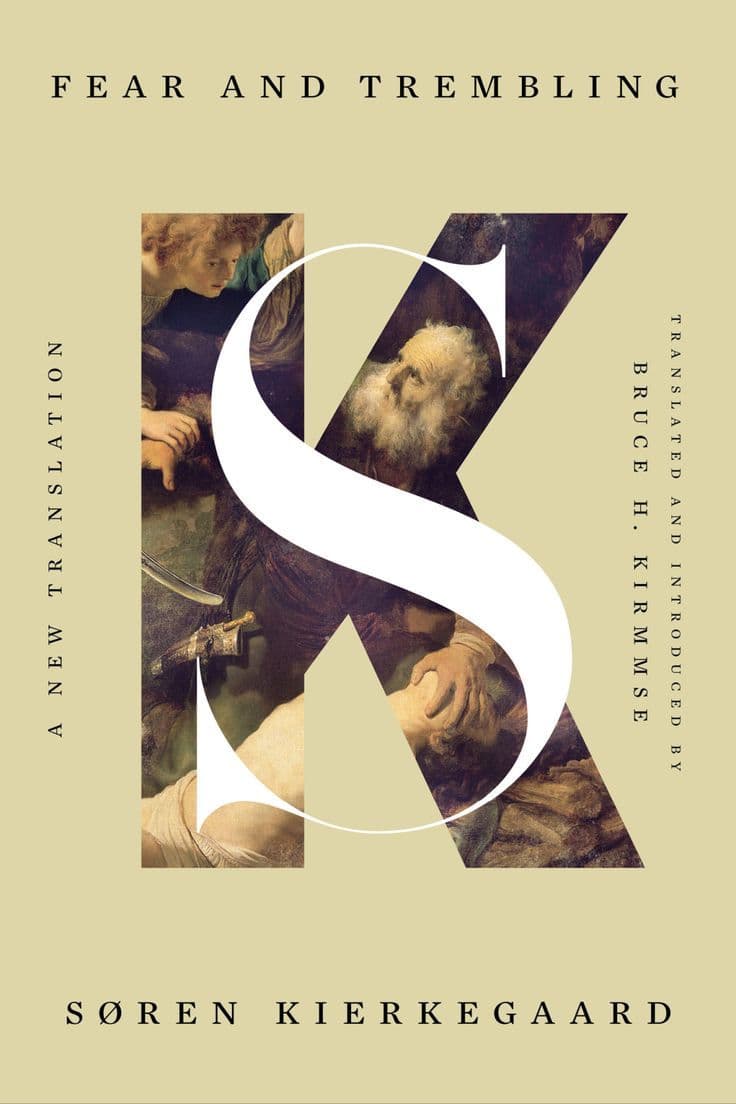
Fear and Trembling
Published in 1843 under the pseudonym Johannes de Silentio, this book takes the biblical story of Abraham's near-sacrifice of Isaac as the occasion for a radical inquiry into faith. Its central mechanism is the distinction between the ethical—the universal law that Abraham would have violated—and the religious, a sphere in which the individual stands in an absolute relation to the absolute that suspends the ethical. The book's distinctive argument is that faith cannot be mediated by reason or explained by philosophy; it is a paradox that Abraham embodies but cannot articulate, and the reader is left to decide whether Abraham is a knight of faith or a murderer.
Key Insights
✦What is the central argument of Fear and Trembling, and what does it reject?
The central argument is that faith is a paradox that cannot be mediated by reason or subsumed under the ethical universal. Using the story of Abraham's near-sacrifice of Isaac, Johannes de Silentio argues that Abraham's willingness to kill his son would be murder under the ethical law, but that faith posits a 'teleological suspension of the ethical'—a relation to the absolute that overrides the universal . What the book rejects is the Hegelian assumption that faith can be reconciled with reason, that the individual's relation to God can be understood as a moment within a rational system. Faith, for Silentio, is not a preliminary stage to be surpassed by philosophy; it is a permanent paradox that philosophy cannot comprehend.
✦What is the 'teleological suspension of the ethical,' and why has it been so controversial?
The teleological suspension of the ethical is the claim that the individual, in an absolute relation to God, may suspend the universal ethical law for a higher purpose—as Abraham does when he prepares to sacrifice Isaac. The phrase is controversial because it appears to license the violation of morality in the name of religious obedience, and it has been read as a defense of religious terrorism or fanaticism. Defenders argue that the suspension is teleological, not arbitrary: it is ordered toward a telos, and Abraham's faith is defined by the anguish and isolation of a decision that he cannot justify to others . The controversy is central to the book's reception, and it is not resolved by the text, which presents the suspension as a paradox rather than a doctrine.
✦Who is Johannes de Silentio, and why does the pseudonym matter?
Johannes de Silentio—'John of Silence'—is the pseudonymous author of Fear and Trembling, and his name signals his relation to the book's subject. He is not a knight of faith; he describes himself as a poet and a dialectician who admires faith from the outside but cannot make the movement himself . The pseudonym matters because it prevents the reader from identifying the argument with Kierkegaard's own position. Silentio speaks of faith as a paradox that he cannot comprehend, and his admiration is mixed with a sense of his own exclusion. Kierkegaard's name appears only as the editor, and the book's meaning is inseparable from the distance between the author and his creation.
✦How does the book relate to Either/Or, and what does it add to Kierkegaard's authorship?
Fear and Trembling was published in the same year as Either/Or, and the two works are complementary. Either/Or had mapped the aesthetic and ethical spheres; Fear and Trembling adds the religious sphere, or rather, it dramatizes what the transition to the religious might look like. But it does not present the religious as a stable resolution. Where Judge William's ethical life offered coherence and continuity, Silentio's faith offers paradox, isolation, and the impossibility of justification. The book thus deepens the either/or: the choice is not merely between the aesthetic and the ethical, but between the ethical and a religious sphere that lies beyond it, inaccessible to reason and available only through a leap of faith.
✦What is the most common misreading of the book's treatment of Abraham?
The most persistent misreading treats Abraham as a hero or a model to be emulated, as if the book were recommending that individuals follow his example. But Silentio repeatedly says that he cannot understand Abraham, and that he is not a knight of faith. The book does not present Abraham's action as a template; it presents it as an exception that resists generalization . A related error treats the teleological suspension as a license for religious violence. Silentio emphasizes the anguish of Abraham's decision, his inability to speak, and the isolation that separates him from the universal. The suspension is not a justification; it is a paradox that the book refuses to resolve, leaving the reader to decide whether Abraham is a knight of faith or a murderer.
✦What are the main English translations of Fear and Trembling, and how do they differ?
The first English translation was by Robert Payne, published by Oxford University Press in 1939. The standard modern translation is by Howard V. Hong and Edna H. Hong, published by Princeton University Press in 1983 as part of Kierkegaard's Writings. Alastair Hannay's translation for Penguin, first published in 1985 and reissued in 2003, is widely used in classrooms and is praised for its readability . The Hong edition is generally preferred by scholars for its accuracy, its historical introduction, and its notes. Readers should be aware that the book's effect depends on the distinct voice of Silentio—his irony, his admiration, and his confessed incomprehension—and that translation choices about tone and register significantly shape how the reader is positioned in relation to the paradox of faith.
Wealthy Psyche is an intellectual archive. We do not host, distribute, or sell book copies — physical or digital. We provide structured knowledge to help you think better, faster.