


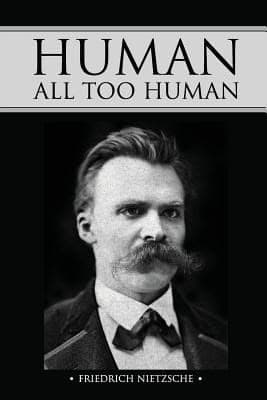
Human, All Too Human
Nietzsche's 1878 book marks a decisive break with his earlier romanticism and with Wagner, inaugurating the aphoristic style that would dominate his mature work. Its central method is a relentless debunking of 'higher' ideals—metaphysics, art, religion, morality—by tracing them to their human, all-too-human origins in drives, vanity, and social utility. The book does not yet announce a constructive philosophy; it clears the ground by exposing the unwarranted assumptions beneath inherited values, and in doing so it establishes the free spirit as a type: the thinker who has detached himself from the convictions of his time and experiments with new ways of living.
Key Insights
✦What is the central argument of Human, All Too Human, and what does it reject?
The book's central argument is that the 'higher' things—metaphysics, religion, art, morality—have human, all-too-human origins that their adherents prefer to ignore. Nietzsche's method is debunking rather than system-building: he traces ideals to drives, vanity, habit, and social utility, showing that what appears sublime is often a refinement of something base . What the book rejects is the metaphysical faith that values require transcendent grounding, along with the romantic idealism of his earlier work and the Wagnerian aesthetic he had recently embraced. The book does not yet offer a constructive philosophy; it clears the ground, establishing the free spirit as the type who has detached himself from inherited convictions and begun to experiment with new ways of living.
✦Why was the book's reception so hostile among Nietzsche's former admirers, and what does that reveal about the break it represented?
The hostility was intense and personal because the book was read as a betrayal. Julian Young records that Wagner claimed to have read only a few pages, 'in order not to upset the delightful impression left by [Nietzsche's] earlier works,' and then published a mocking counterblast in the Bayreuther Blätter . Erich Heller describes Erwin Rohde's response as like being chased from a warm Roman bath into an icy plunge—'a rather shocking experience'—while another devoted friend wrote that 'something has died within me' . The shock was not merely stylistic. Nietzsche had dedicated the first edition to Voltaire and adopted a positivist slant that seemed to renounce the metaphysical and artistic ambitions of The Birth of Tragedy. For readers who had admired the earlier Nietzsche, the book announced that the author they valued no longer existed.
✦What is the significance of the 'free spirit' in this book, and how does it relate to Nietzsche's later philosophy?
The free spirit is the book's central figure, defined in aphorism 225 as someone who 'thinks differently from what we expect of him on the basis of his origin, environment, his social rank and position, or on the basis of the prevailing views of the time' . This figure is not yet the Übermensch or the prophet of Zarathustra; he is an experimental type, engaged in 'a continual process of engaging and challenging the world around them' while refraining from any attempt to guide or transform it . Paul Franco argues that Human, All Too Human, Daybreak, and The Gay Science share the goal of erecting 'a new image and ideal of the free spirit,' and that this middle-period Nietzsche is more rational, moderate, and committed to Enlightenment values than the popular image of him suggests .
✦How does Human, All Too Human relate to The Birth of Tragedy, and what does the break between them consist in?
The break is both stylistic and philosophical. The Birth of Tragedy had argued for the metaphysical consolation of tragic art and placed Wagner at the center of a cultural renewal. Human, All Too Human abandons that project: it adopts the aphorism rather than the treatise, cultivates a cool, analytic tone rather than prophetic fervor, and treats art itself as one of the 'higher' illusions to be debunked. Nietzsche later described the book as an exercise in self-discipline through which he rid himself of the 'higher swindle' of idealism and romantic sentiment . Yet the relationship is not simply one of repudiation. Erich Heller argues that Nietzsche reversed Schopenhauer's nay-saying without fully abandoning the metaphysical framework it presupposed, and that the later doctrine of will to power adds 'power' to Schopenhauer's Will rather than replacing it .
✦What is the most common misreading of the book's aphoristic form and its philosophical ambitions?
The most persistent misreading treats the aphorisms as disconnected fragments, brilliant observations without a unifying purpose, and therefore as evidence that Nietzsche had abandoned philosophy for literature or psychology. But the aphoristic form is itself a philosophical choice: it enacts the free spirit's refusal to build systems, its preference for experiment over doctrine, and its suspicion of the grand architectural ambitions of metaphysical philosophy. A related error assumes that because the book is negative and debunking, it lacks constructive content. In fact, the free spirit is a positive ideal, and the book's critiques of art, religion, and morality are undertaken in the service of a specific vision of intellectual independence and honesty. Reading the aphorisms in isolation misses the cumulative argument they build.
✦What are the main English translations of Human, All Too Human, and how do they differ?
The first English translation was Helen Zimmern's version of volume one (with Paul V. Cohn translating volume two), published by T. N. Foulis in 1910–1911 . This remained the standard for decades but has been superseded. R. J. Hollingdale's translation, published by Cambridge University Press in 1986 and revised in 1996, is the most widely used scholarly edition and is generally preferred for accuracy and readability . The Cambridge edition includes the later additions—Assorted Opinions and Maxims and The Wanderer and His Shadow—that Nietzsche published as parts two and three of the work, along with the 1886 prefaces he added when republishing the material in two volumes. Readers should be aware that the book's identity is composite: the 1878 original is not the same text as the two-volume 1886 edition, and the additions substantially alter its scope.
Wealthy Psyche is an intellectual archive. We do not host, distribute, or sell book copies — physical or digital. We provide structured knowledge to help you think better, faster.