


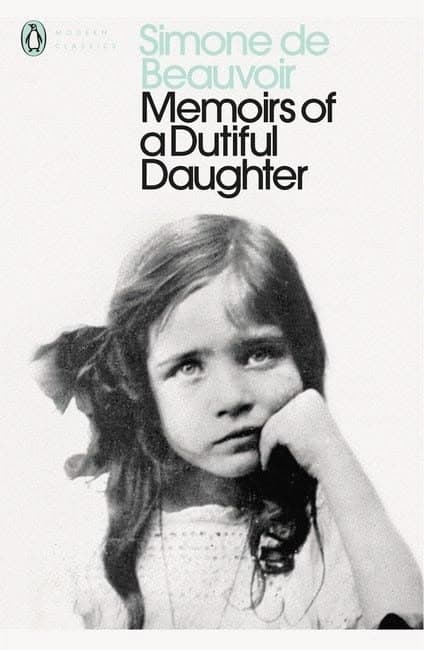
Memoirs of a Dutiful Daughter

The first volume of Beauvoir's autobiography traces her childhood and adolescence in a bourgeois Parisian family, from the certainties of a Catholic upbringing to the progressive loss of faith, the collapse of her family's finances, and her emergence as an independent intellectual. Its distinctive mechanism is the retrospective reconstruction of a self that did not yet exist: the young Simone believes herself a dutiful daughter even as her reading and friendships are quietly dismantling the beliefs that make duty possible. The book's central claim is that freedom is achieved not by a single act of rebellion but by a long, often unconscious process of disengagement from the roles one has been assigned.
Key Insights
✦What is the central argument of Memoirs of a Dutiful Daughter, and what does it reject?
The book's central argument is that the self is not given but constructed through a slow, often imperceptible process of disengagement from the roles one has been assigned. Beauvoir traces her childhood as a 'dutiful daughter'—pious, studious, eager to please—and shows how this identity eroded not through dramatic rebellion but through reading, friendship, and the gradual recognition that the beliefs sustaining her obedience were untenable. What the book rejects is the conventional narrative of self-discovery, in which a protagonist finds their true self beneath social conditioning. Beauvoir insists that there was no true self waiting to be uncovered; there was only a series of choices, many of them made without full awareness, that gradually produced the woman who could write the memoir.
✦Why did the book become a model for women's autobiography, and what did it offer that earlier memoirs did not?
The book was immediately influential because it demonstrated that a woman's intellectual and emotional development could be the subject of serious autobiography, not merely a domestic chronicle or a confession of scandal. Beauvoir's account of her childhood is detailed and unsentimental: she does not idealize her family, nor does she present her younger self as a heroine. The book's innovation is its honesty about the ambiguity of intellectual awakening—the mixture of excitement and guilt, ambition and fear—and its refusal to resolve the story into a single moment of liberation. For later women writers, it provided a model for narrating a life in which the public and the private, the intellectual and the emotional, are not separate spheres but aspects of a single, ongoing negotiation with the conditions of one's existence.
✦How did the book's portrait of Beauvoir's family and education shape its reception?
The book's portrait of a bourgeois Catholic family in decline—her father's disappointment at not having a son, her mother's piety, the financial reverses that forced the family to move—was read with great interest in France, where the Beauvoir family was known and where the details of her upbringing could be compared with the autobiographical fragments she had published elsewhere. The reception was generally positive, and the book was praised for its lucidity and its refusal of self-pity. But some readers were struck by the coldness of the portrait, particularly of her mother, and by the sense that Beauvoir was always observing rather than participating. This observation has since become a point of scholarly interest: the book's detachment is itself a feature of the self it describes, a self formed by the habit of looking at itself from the outside.
✦How does the book relate to The Second Sex, and does it provide an experiential basis for the later theory?
The book is often read as the experiential basis for The Second Sex, and Beauvoir herself suggested as much: the memoir describes the childhood and adolescence that the treatise analyzes in structural terms. But the relationship is not one of simple illustration. The Second Sex argues that women are made, not born, and the memoir shows the process of making in concrete detail—the lessons in femininity, the restrictions on movement and desire, the subtle encouragements to please rather than to act. What the memoir adds to the theory is a sense of how the process feels from the inside, and how a girl can be complicit in her own formation even as she resists it. The book thus enriches the theory without merely confirming it.
✦What is the most common misreading of the book's account of Beauvoir's loss of faith?
The most persistent misreading treats the loss of faith as a single dramatic event, a moment of illumination in which the young Simone sees through the illusions of religion. But Beauvoir describes a gradual erosion: doubts accumulate, practices become empty, and the beliefs that once sustained her simply lose their hold. The memoir is careful to show that the process was not purely intellectual; it was bound up with her growing sense of herself as a separate person, with her relationships, and with the changing circumstances of her family. A related error assumes that Beauvoir's loss of faith was liberating in a straightforward way. The memoir suggests something more complicated: the loss of faith was also a loss of certainty, and the freedom it brought was accompanied by anxiety and a sense of exposure.
✦What are the translation and publication issues surrounding Memoirs of a Dutiful Daughter in English?
The English translation is by James Kirkup, first published in 1959 by the World Publishing Company . The French original, Mémoires d'une jeune fille rangée, was published by Gallimard in 1958 . Kirkup's translation has been the standard English version for over six decades and has been reissued in multiple editions, including Penguin and Harper Perennial editions. The translation has been praised for its readability but criticized for occasional infelicities and for a tendency to smooth out Beauvoir's prose, which in the French has a certain austerity and precision that Kirkup's version sometimes loses. Readers should be aware that the memoir is the first of four volumes, and that its portrait of a vanished bourgeois world is as much a social document as a personal confession.
Wealthy Psyche is an intellectual archive. We do not host, distribute, or sell book copies — physical or digital. We provide structured knowledge to help you think better, faster.