


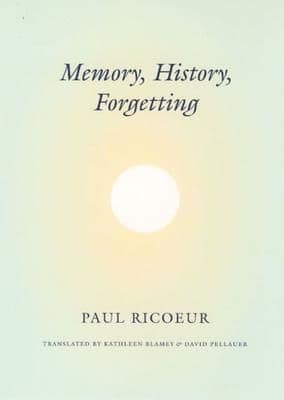
Memory, History, Forgetting
Ricœur's central thesis is that memory and forgetting are not opposites but mutually conditioning dimensions of our relation to the past, and that history as a discipline mediates between them. The book proceeds through three registers—a phenomenology of memory, an epistemology of historical knowledge, and a hermeneutics of forgetting—arguing that the historian's craft neither simply continues nor fully breaks with living memory, and that a 'happy forgetting' remains an ethical horizon alongside the duty to remember.
Key Insights
✦What is the central claim of Memory, History, Forgetting, and what does it reject?
Ricœur argues that memory and forgetting are not simple antagonists but mutually conditioning dimensions of our relation to the past. The book rejects two reductions: the claim that history is merely a more rigorous continuation of living memory, and the claim that historical knowledge breaks completely with memory. History mediates between memory and forgetting, drawing on the testimonies of memory while subjecting them to critical procedures that memory alone cannot provide. Yet history never fully escapes its debt to memory, and forgetting is not simply a failure to be overcome—it is a condition of the possibility of remembering, and a 'happy forgetting' remains an ethical horizon alongside the duty to remember.
✦What are the three parts of the book, and how do they relate?
The book is divided into three closely related studies: a phenomenology of memory, an epistemology of historical knowledge, and a hermeneutics of forgetting . The first part asks how a memory of the present can be of something absent—the past—and examines the mnemonic devices through which memory is cultivated. The second part turns to the historian's craft, asking whether historical writing can break with all dependence on memory. The third part meditates on forgetting as a condition for remembering, and asks whether there can be a forgetting that is not merely a failure but a form of wisdom. The three parts are not a deductive system but a course traversed, and their unity lies in the question of how the past is rendered present without being simply reproduced.
✦How does the book relate to Ricœur's earlier Time and Narrative and Oneself as Another?
The University of Chicago Press describes Memory, History, Forgetting as providing the crucial link between Time and Narrative and Oneself as Another and Ricœur's later reflections on ethics and responsibility . The earlier work on narrative had shown how emplotment configures temporal experience; the present book turns to memory as the faculty through which the past is retained and attested, and to history as the discipline that transforms memory into knowledge. The concern with selfhood and imputability developed in Oneself as Another returns in the book's final sections on forgiveness, where the capable self is confronted with the unforgivable and the possibility of a forgiveness that exceeds the self's capacities.
✦How faithful is the English translation by Blamey and Pellauer, and what is the book's textual history?
The French original, La mémoire, l'histoire, l'oubli, was published by Éditions du Seuil in 2000 . Kathleen Blamey and David Pellauer's English translation appeared in 2004 from the University of Chicago Press . The translation is generally regarded as careful and scholarly, though Ricœur's late prose is dense and the book's three-part structure makes significant demands on readers. Blamey had previously translated Oneself as Another, and Pellauer had translated Time and Narrative and later The Course of Recognition, so the translation team was already deeply familiar with Ricœur's vocabulary. No major textual controversy surrounds the edition, but readers working on specific terms—such as 'attestation,' 'imputability,' and 'happy forgetting'—should consult the French where precision matters.
✦What does 'happy forgetting' mean, and why does it matter to the argument?
Happy forgetting is Ricœur's term for a forgetting that is not a failure or a repression but a pacified relation to the past, a letting-go that makes coexistence possible without demanding amnesia. It is paired with the 'work of memory' and the 'work of mourning,' and it is linked to the question of forgiveness that occupies the book's epilogue. The concept matters because it prevents the book from collapsing into a simple ethics of remembrance. If the duty to remember were absolute, the past would become an unending burden, and the present would be held hostage by commemoration. Happy forgetting names the possibility of a forgetting that is a statement in a pacified mood, not a silence—an enunciation to be understood not as a commandment but as a wish .
✦How does Ricœur's treatment of memory differ from the sociological tradition of Maurice Halbwachs?
Ricœur engages Halbwachs closely, and the book's careful readings of Halbwachs and Pierre Nora are among its most cited features . Halbwachs had argued that memory is always collective, sustained by social frameworks, and Ricœur grants the force of this claim. But he insists that collective memory cannot be understood without the individual act of remembering, which is attested in first-person experience and remains irreducible to social frameworks. The phenomenology of memory in the book's first part is precisely an attempt to describe this first-person dimension without denying its social mediation. The difference is not a rejection of Halbwachs but a supplementation: Ricœur wants to show how the social and the singular are intertwined in the act of remembering, rather than dissolving one into the other.
✦What is a common misreading of the book's treatment of forgetting?
A common misreading treats forgetting as the enemy of memory, as if the book recommended a duty to forget alongside the duty to remember. Ricœur's argument is more subtle. Forgetting is not simply a failure or a threat; it is a condition of the possibility of remembering, since a memory that could not be forgotten would be an absolute burden. The book distinguishes between destructive forgetting—the forgetting that erases traces and denies the past—and a forgetting that is a form of wisdom, a pacified relation to what has been. The misreading flattens this distinction and turns Ricœur into an advocate of amnesia. His position is closer to the opposite: the work of memory and the work of mourning are necessary precisely because forgetting is unavoidable, and the ethical task is to distinguish between forgettings that liberate and forgettings that conceal.
Wealthy Psyche is an intellectual archive. We do not host, distribute, or sell book copies — physical or digital. We provide structured knowledge to help you think better, faster.