


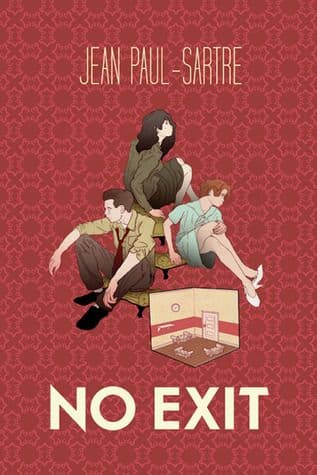
No Exit (Huis clos)

Sartre's 1944 one-act play, written and first performed in occupied Paris, places three deceased strangers in a Second Empire drawing room that is their hell. The play's distinctive mechanism is the absence of any external torturer: the valet is polite, the room is comfortable, and the punishment consists entirely in being locked together forever, forced to see and judge one another without respite. Garcin, Inez, and Estelle each need something from the others—validation, desire, recognition—that the others cannot or will not give. The famous line 'hell is other people' names this structure: the gaze of the other fixes us as objects, and no exit from that judgment exists.
Key Insights
✦What is the central mechanism of No Exit's hell, and why is it more than a clever premise?
The play's hell has no torturers, no fire, and no physical pain. The valet is courteous, the sofas are comfortable, and the lights never go out—but the door is locked from outside and there is no mirror. The punishment is the permanent presence of the other two, each of whom demands something the others cannot provide: Garcin wants to be told he is not a coward, Estelle wants to be desired as a woman, and Inez wants Estelle's attention. Each attempt to secure validation from the others fails or is turned into a new form of torment. The mechanism is Sartre's theory of the gaze made dramatic: to be seen is to be fixed as an object, and no amount of confession or cruelty can escape that objectification .
✦How has 'hell is other people' been misread, and what did Sartre himself say about the misunderstanding?
The line is commonly taken as a misanthropic declaration that other people are unbearable and solitude is preferable. Sartre explicitly rejected this reading, explaining that the phrase means something entirely different: when relations with another person are twisted or vitiated, that person becomes hell, because we come to know ourselves through the judgments and categories that others impose on us . The play dramatizes this precisely: none of the three characters can access a stable sense of self without the others, and the others' perceptions are inevitably distorting. The misreading treats the line as a verdict on sociability; Sartre intended it as a description of a structural condition in which self-knowledge is mediated by the alienating gaze of others.
✦What was the play's original context of production, and how did the Occupation shape its staging and reception?
Huis clos was first performed on 27 May 1944 at the Théâtre du Vieux-Colombier in Paris, during the German Occupation . The production history is marked by the political pressures of the period: an early plan involving Albert Camus as director and performer was disrupted, partly by the Gestapo's arrest of one of the actresses . The play's claustrophobic setting—a sealed room from which there is no exit—has been read as an allegory of occupied Paris, a city under surveillance where the gaze of the occupier and the occupied mutually defined one another. Sartre did not present the play as a resistance allegory, but the conditions of its first performance gave its meditation on inescapable scrutiny a particular resonance.
✦How does the play differ from Sartre's philosophical account of the gaze in Being and Nothingness?
Being and Nothingness develops the theory of the Look abstractly: the other's gaze objectifies me, and my attempts to recover my subjectivity through love, sadism, or indifference are doomed to failure. No Exit tests this theory in a concrete situation with three characters who embody different strategies for dealing with the other's gaze. Garcin seeks recognition as a hero, Estelle seeks to be desired as an object, and Inez seeks to dominate through the gaze itself. The play's contribution is to show that these strategies do not merely fail individually; they combine into a closed system in which each character's attempt to escape the others' judgment produces new forms of dependency. The famous line compresses this system into a single formulation that the play has earned dramatically .
✦What is the most common critical objection to the play, and how have defenders responded?
The most persistent objection is that the play is too schematic: the three characters are arranged as a neat triangle of bad faith, and the dialogue sometimes sounds like philosophical illustration rather than dramatic speech. Defenders respond that the schematic quality is deliberate. The play is a 'theater of situations' in Sartre's sense: it places characters in an extreme situation and observes what they do, without psychological depth or backstory serving as explanation. The economy of the one-act form enforces a concentration that a longer play might dissipate. The characters are not meant to be realistic individuals but positions in a structure—the coward, the lesbian, the murderer—whose interactions demonstrate the logic of the gaze .
✦How do the English translations and titles differ, and does the choice matter?
Stuart Gilbert's English versions were published in Britain in 1946 under the title In Camera and in the United States in 1947 as No Exit, bound with The Flies . The French title Huis clos is a legal phrase meaning 'behind closed doors' or 'in camera,' suggesting a proceeding conducted without public access. No Exit emphasizes the spatial trap; In Camera emphasizes the juridical and theatrical dimension of being watched. Gilbert's translation has been the standard English version for decades, though some readers find its idiom dated. The title choice matters because the play is equally about confinement and about judgment: the characters are both trapped in a room and subjected to a trial without end.
Wealthy Psyche is an intellectual archive. We do not host, distribute, or sell book copies — physical or digital. We provide structured knowledge to help you think better, faster.