


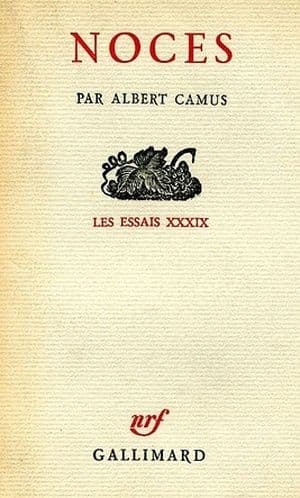
Nuptials (Noces)
Camus's 1938 collection of four lyrical essays is built around a single, emphatic affirmation: the marriage of a young man to the sun, sea, and landscape of his Algerian homeland. The 'nuptials' are not metaphorical—they describe a sensual, pagan union with the natural world that Camus presents as sufficient in itself, requiring no transcendent justification. The collection's distinctive mechanism is the way this celebration carries an implicit limit: the union is with a world that will pass, and the joy it produces is inseparable from the awareness of death. The essays enact a meditation on present-tense existence rather than arguing for it.
Key Insights
✦What is the central argument of Noces, and how does it relate to Camus's later concept of the absurd?
The essays do not yet articulate the absurd as a philosophical position, but they enact a sensibility from which that position would later be constructed. Camus describes a 'solar paganism fraught with melancholy'—a devotion to sun, landscape, and sea that finds in these sensations a form of sufficiency, while remaining aware that the world offering them is indifferent and mortal . The 'nuptials' are the union of a young man with this world, and the joy they produce is not the joy of overcoming death but of existing fully in its shadow. As John Weightman noted in a 1968 review, the absurd is 'not worked up explicitly' in these essays, but 'it might easily have been' . The collection is the experiential ground of the later theory.
✦What specific structure does the collection follow, and what does its framing suggest about Camus's intentions?
Noces consists of four essays whose sequence has been read as an initiatory trajectory rather than a loose gathering. A 2016 study in the Classical Receptions Journal argues that the opening essay, 'Nuptials at Tipasa,' and the closing essay, 'The Desert,' are framed by references to the Eleusinian mysteries, and that the four essays together suggest a seasonal progression—spring at Tipasa, summer at Algiers, autumn in Florence . On this reading, the collection is designed to enact the very union its title names: a sacred marriage of the human with nature, culminating in an initiation that reframes the earlier celebration as insufficient on its own . The structure is deliberate and philosophical, not merely aesthetic.
✦How has Noces been received critically, and what has been its status within Camus's oeuvre?
Noces has generally been treated as a key to Camus's sensibility rather than as a major work in its own right. The New York Times review of the first complete English translation in 1968 described the lyrical essays as illuminating 'new facets of his usual subject matter,' identifying the collection's value as contextual and biographical . More recent scholarship has taken the essays more seriously as objects of philosophical and literary analysis. James Brown's 2021 study, for instance, reads Noces through the lens of meditative practice, treating the text as an exercise in bare awareness rather than as a preliminary to the later novels . The collection's reputation has shifted from juvenilia to a foundational text.
✦What is the most common misreading of Noces's paganism?
The common misreading treats the collection's celebration of sun and sea as a straightforward hedonism or a naive vitalism, a youthful enthusiasm that Camus would later correct with the darker themes of The Stranger and The Plague. But the 'solar paganism' Weightman identifies is explicitly 'fraught with melancholy' . The joy in Noces is not the denial of death but a way of inhabiting a world that includes it; the union with nature is valuable precisely because it is temporary and unredeemed. Camus does not present the Mediterranean as a refuge from mortality but as the arena in which mortality is most intensely felt. The misreading sentimentalizes a collection whose force depends on the tension between sensual affirmation and the awareness of ending.
✦How does Noces relate to Betwixt and Between (L'Envers et l'endroit), Camus's first book?
The two collections are closely linked in composition and sensibility. Betwixt and Between appeared in 1937, a year before Noces, and both draw on Camus's experiences in Algeria and his travels in Europe. The earlier collection holds poverty and sunlight in unresolved tension, while Noces leans more decisively toward the sunlight. In the 1958 preface to Betwixt and Between, Camus identified the earlier book as the source of everything he wrote, and Noces can be read as the first extension of that source into a more sustained lyrical register. Together they form the autobiographical and stylistic foundation on which the 'cycle of the absurd'—The Stranger, Caligula, and The Myth of Sisyphus—would later be built.
✦What are the translation and editorial issues surrounding Noces in English?
Noces has no stand-alone standard English translation. It first appeared in complete English form in Philip Thody's 1968 edition, Lyrical and Critical Essays, translated by Ellen Conroy Kennedy and published by Knopf . That volume gathers Noces alongside Betwixt and Between and Summer, and it remains the primary route by which English-language readers encounter the collection. The translation has been praised for its readability but has not been subjected to the same scrutiny as the standard translations of Camus's novels. Readers should be aware that the essays' effects depend heavily on rhythm and sensory concreteness, and that the French text, published initially in a small Algiers print run in 1938 and reissued by Charlot in the 1940s before passing to Gallimard, has its own complex publication history .
Wealthy Psyche is an intellectual archive. We do not host, distribute, or sell book copies — physical or digital. We provide structured knowledge to help you think better, faster.