


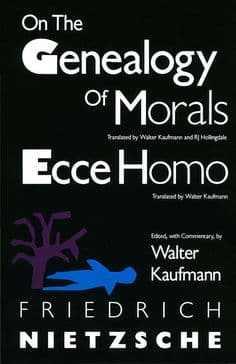
On the Genealogy of Morality
Nietzsche's 1887 'polemic' is his most sustained attempt to explain how moral concepts acquired their present authority. Rather than asking whether moral judgments are true, it asks where they came from and what they express: the first essay traces the slave revolt in morality that inverted noble valuations, the second reconstructs the origin of guilt and bad conscience from the internalization of cruelty, and the third diagnoses the ascetic ideal as a self-defeating cure for suffering. The book's method is genealogical—it treats morality as a historical artifact whose value is not given in advance.
Key Insights
✦What is the central argument of On the Genealogy of Morality, and what does it reject?
The book's central argument is that moral values are historical productions whose authority cannot be taken for granted. Nietzsche rejects the assumption that moral judgments are self-evident or divinely grounded, and instead asks what they express and how they came to dominate. The first essay traces the transition from the noble valuation of 'good and bad' to the slave revolt that produced 'good and evil,' attributing the latter to ressentiment—the creative reversal by which the powerless declare the powerful evil and themselves good . The second essay reconstructs how guilt and bad conscience emerged from the internalization of cruelty when humans were deprived of outward discharge. The third essay diagnoses the ascetic ideal as a self-defeating remedy for suffering, one that numbs pain by intensifying the sickness it claims to cure .
✦Why is the Genealogy considered Nietzsche's most treatise-like work, and what does that form accomplish?
Lawrence Hatab notes that of all Nietzsche's writings after The Birth of Tragedy, the Genealogy most resembles a treatise, with extended discussions of organized themes and a historical orientation, in contrast to Nietzsche's typical aphoristic or literary styles . This form offers advantages for systematic critique: the three essays can develop sustained arguments across multiple sections rather than delivering isolated provocations. Yet Hatab cautions that it is hardly a typical academic treatise—Nietzsche calls it a 'polemic,' and it is loaded with hyperbole, ambiguity, misdirection, provocation, and his own vigorous persona . The form is therefore instrumental rather than conventional: it provides enough structure to sustain a genealogical investigation while remaining rhetorically forceful enough to unsettle the reader's inherited moral assumptions.
✦How has the book's relationship to Beyond Good and Evil been understood?
Nietzsche himself presented the Genealogy as a direct supplement to Beyond Good and Evil. The inside cover of the Genealogy bore the words 'Appended to the recently published Beyond Good and Evil as a supplement and clarification,' and in letters from 1887 he emphasized the necessary connection between the two books, asking his publisher to make this relationship clear . The relationship is not merely chronological. Beyond Good and Evil diagnoses the dogmatic faith in opposite values and the hidden drives beneath philosophical claims; the Genealogy supplies the historical reconstruction that the earlier book gestures toward but does not deliver. The first essay's account of the slave revolt in morality, for instance, elaborates what Beyond Good and Evil describes more aphoristically. Reading the two together reveals a division of labor between diagnosis and genealogy.
✦What are the major English translations of the Genealogy, and which should readers choose?
David Owen identifies five easily available English editions, of which four are suitable for serious study: the Kaufmann/Hollingdale translation (Random House, 1967), the Diethe translation edited by Ansell-Pearson (Cambridge, 1994), the Clark/Swenson translation (Hackett, 1998), and the Douglas Smith translation (Oxford, 1998) . The exception is the Dover edition, which reproduces H. B. Samuel's 1913 translation and should be avoided for scholarly purposes . Owen generally favors the Cambridge Texts in the History of Philosophy series for quality and consistency . The Hackett edition, translated by a Germanist and a philosopher, has been praised for communicating both Nietzsche's style and his meaning, and for its superb notes . The choice matters because the Genealogy's rhetorical force and terminological precision are central to its argument.
✦What is the most common misreading of the Genealogy's critique of morality?
The most persistent misreading takes the book as a refutation of morality, as if Nietzsche had demonstrated that moral values are 'merely' products of ressentiment and therefore ought to be discarded. But Nietzsche's method is diagnostic rather than refutational. As the Stanford Encyclopedia notes, his account of the ascetic ideal places it in an unattractive light, but the ascetic conception of morality is by no means refuted by these considerations . Nietzsche's concern is to diagnose evaluative commitments as symptoms of psychological and cultural conditions, not to prove them false. A related error treats the slave revolt as a conspiracy or a conscious strategy, when Nietzsche describes it as an 'imaginary' revolt—a creative revaluation that occurs unconsciously among those incapable of direct action . The Genealogy asks what our values cost us, not whether they correspond to reality.
✦How does the Genealogy relate to The Antichrist and Nietzsche's later critique of Christianity?
The Genealogy's three studies are offered as examples of Nietzschean skepticism about conventional moral ideas, and The Antichrist extends these criticisms specifically to the Christian psychological, cognitive, and evaluative foundations for morality . The relationship is one of scope and intensity rather than doctrinal difference. Where the Genealogy reconstructs the historical emergence of guilt, bad conscience, and the ascetic ideal, The Antichrist prosecutes Christianity as a unified pathological phenomenon. The Genealogy provides the diagnostic framework; The Antichrist applies it with a ferocity that the earlier book deliberately avoids. Reading the Genealogy first clarifies that The Antichrist's polemic is not an outburst but the culmination of an argument about how moral concepts acquire their hold on us and what that hold costs.
Wealthy Psyche is an intellectual archive. We do not host, distribute, or sell book copies — physical or digital. We provide structured knowledge to help you think better, faster.