


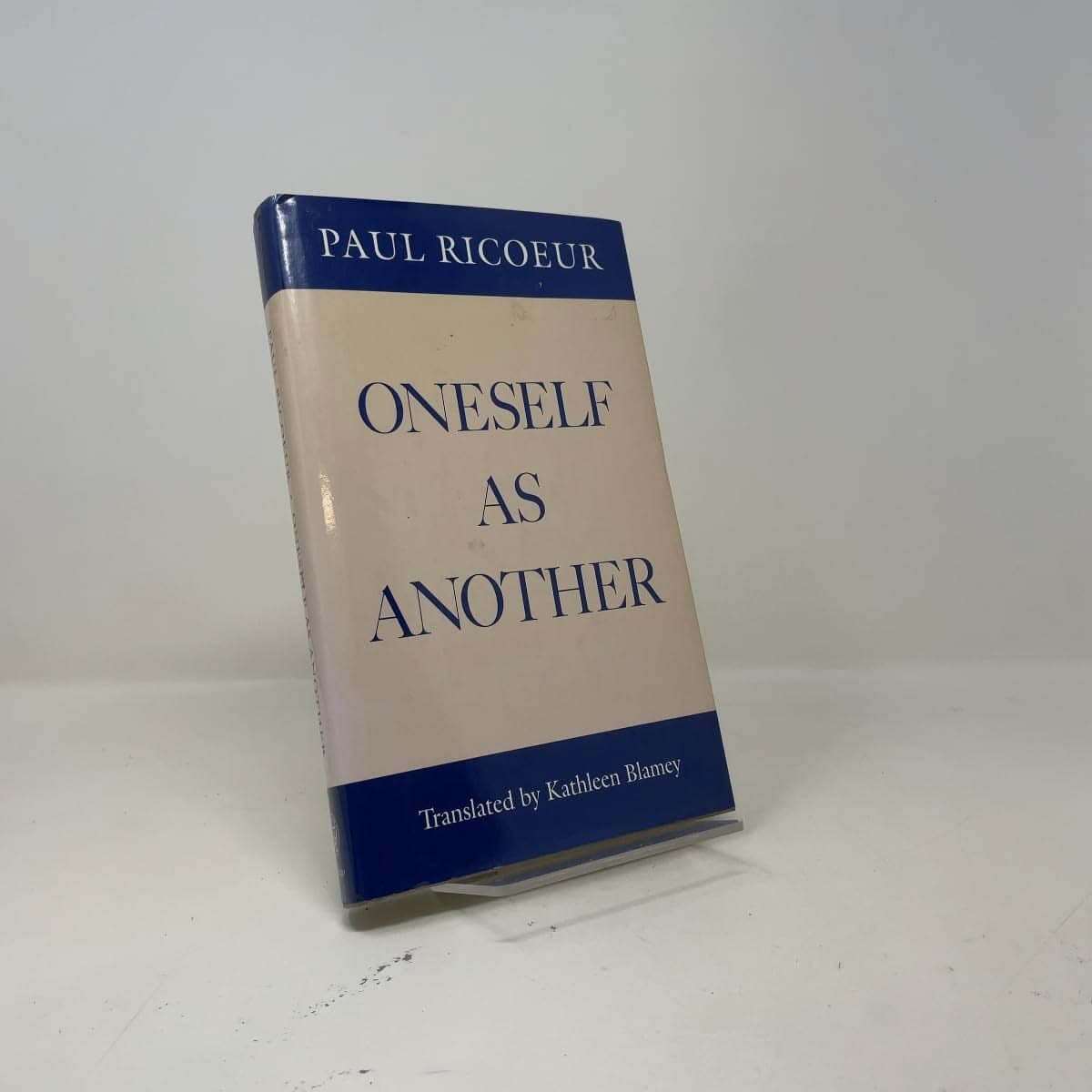
Oneself as Another

Ricœur's central thesis is that personal identity is not a given substance but a hermeneutic achievement, articulated through the dialectic of idem (sameness) and ipse (selfhood). The self is reached only by a detour through linguistic, practical, and narrative analyses, and it is constituted in relation to otherness—so that 'oneself as another' names an ontological structure, not a comparison. The book develops a 'little ethics' of solicitude and justice grounded in this fragile, attested self.
Key Insights
✦What is the central claim of Oneself as Another, and what does it reject?
Ricœur argues that the self is not given immediately to reflection but is recovered only through a long detour of analysis—linguistic, practical, narrative, and ethical. The book rejects two opposite positions: the Cartesian exaltation of the cogito as a foundational certainty, and the structuralist or Nietzschean 'shattered cogito' that dissolves the subject into linguistic or unconscious systems. Against both, Ricœur positions his hermeneutics of the self at an equal distance from apology and overthrow . The self that emerges is 'capable'—able to speak, act, narrate, and impute actions to itself—but also fragile, attested rather than proven, and constituted in relation to otherness.
✦What is the distinction between idem-identity and ipse-identity, and why does it matter?
Idem-identity is sameness: the continuity of a thing through time, measurable by reidentification. Ipse-identity is selfhood: the self's maintenance of itself through fidelity to promises, a constancy that is not a mere persistence of substance. Ricœur argues that personal identity cannot be reduced to either pole alone. Character belongs largely to idem, while promise-keeping exemplifies ipse at its most demanding. The distinction matters because it allows Ricœur to defend a robust sense of selfhood without recourse to an unchanging substratum, and it grounds his claim that narrative identity mediates between the two: a life story configures sameness and selfhood into a fragile unity that is always open to revision.
✦How does Oneself as Another relate to Ricœur's earlier Time and Narrative?
The book extends the analysis of narrative from the philosophy of history to the question of personal identity. In Time and Narrative, Ricœur showed how emplotment configures temporal experience; in Oneself as Another, he applies that framework to the self, arguing that narrative identity is the mediating stage between a theory of action and an ethical response to the other . The narrative self is not the author of a stable life story but a character in stories that are always entangled with the stories of others. This turn to ethics marks a new phase: the narrative identity developed here becomes the basis for the 'little ethics' of solicitude and justice that occupies the book's later studies.
✦How faithful is Kathleen Blamey's English translation, and what does it change?
Kathleen Blamey's translation, published by the University of Chicago Press in 1992, is the standard English edition and is generally regarded as careful and scholarly . The principal difficulty is terminological: Ricœur's idem and ipse are rendered as 'sameness' and 'selfhood,' a choice that loses some of the Latin pair's grammatical precision. The French 'attestation' becomes 'attestation,' a neologism that English readers must learn. Blamey also translates 'soi-même comme un autre' as 'oneself as another,' which preserves the ambiguity of the French: the 'as' can mean both 'in the mode of' and 'in comparison with.' No major textual controversy surrounds the edition, but close readers should consult the French for the precise play of idem, ipse, and soi.
✦What is a common misreading of the book's ethics of solicitude?
A common misreading treats solicitude as the whole of Ricœur's ethics, as if the book recommended a purely interpersonal care that leaves institutions and justice aside. This overlooks the movement of the argument. Solicitude is indeed central to the ethical aim—living a good life with and for others—but Ricœur quickly passes from the face-to-face relation to the question of justice and just institutions . The 'little ethics' is tripartite: the teleological aim of the good life, the deontological norm of obligation, and the phronetic wisdom of application. Solicitude without justice becomes a partial ethic, confined to those we can know or meet; the book's wager is that the self's relation to the other is always already mediated by institutions that demand justice, not merely care.
✦How has the book's account of narrative identity been challenged?
The most persistent challenge comes from sociological and dialogical quarters. Pierre Bourdieu's earlier critique of the 'biographical illusion' had already questioned whether a life can be coherently narrated as a unified story; later sociologists who adopted Ricœur's narrative identity have had to reckon with Bourdieu's objection that the narrative unity of a life is an imposition rather than a given . A dialogical challenge, drawing on Gadamer, argues that narrative identity is too monological: it privileges the story a self tells about itself over the open-ended dialogue through which identities are actually negotiated. Ricœur's defenders respond that narrative identity is always entangled with the narratives of others and that the book's ethics of solicitude already acknowledges this dependence.
✦What does 'attestation' mean, and why is it central to the argument?
Attestation is Ricœur's term for the kind of certainty proper to selfhood—not the epistemic certainty of the cogito, but a confidence or credence that the self can act, speak, and keep its promises. It is fragile and can be lost; it is attested rather than demonstrated. The concept is central because it names the mode in which the self is known: through a trust that is risked in action and confirmed or betrayed in practice. Attestation also links the book's epistemology to its ethics: the self that attests to itself is the same self that is accountable to others and capable of solicitude. Without attestation, the hermeneutics of the self would collapse into either skepticism or dogmatism.
Wealthy Psyche is an intellectual archive. We do not host, distribute, or sell book copies — physical or digital. We provide structured knowledge to help you think better, faster.