


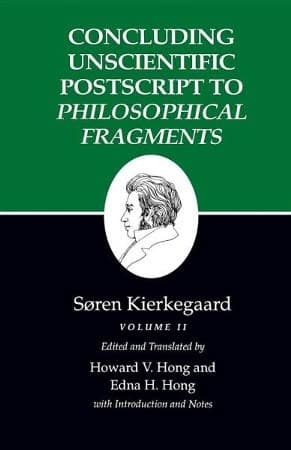
Philosophical Fragments
Kierkegaard's 1844 work, published under the pseudonym Johannes Climacus, is a thought-experiment that asks what would follow if the Socratic premise of recollection were false and the truth had to be given from outside. Its central mechanism is the construction of an alternative hypothesis: a Teacher who is not a midwife but a savior, a Moment that is not an occasion but a transformation, and a Paradox that thought cannot master but can only believe or reject. The book's distinctive argument is that Christianity's demand on the individual is intelligible only when contrasted with the philosophical assumption it contradicts.
Key Insights
✦What is the central thought-experiment of Philosophical Fragments, and what does it reject?
The book's central thought-experiment is to ask what would follow if the Socratic assumption were false—if truth were not already possessed by the learner and recovered through recollection, but had to be brought from outside by a Teacher who also provides the condition for understanding it . Kierkegaard, through Climacus, rejects the Socratic model of the teacher as midwife, which assumes that the learner already possesses the truth and needs only to be reminded of it. The alternative hypothesis generates a different account of the Moment (not an occasion but a transformation), the Teacher (not a midwife but a savior), and the Paradox (not something thought can master but something that must be believed or rejected) . The book does not argue that the Christian hypothesis is true; it constructs it as a coherent alternative whose intelligibility depends on the contrast with the Socratic premise it denies.
✦What is the 'absolute paradox,' and why is it central to the book's argument?
The absolute paradox is the claim that the eternal has entered into time—the incarnation—and it functions as the limit of philosophical thought . Climacus presents the paradox not as a contradiction to be resolved by dialectical mediation but as an offense to reason that can only be believed or rejected. It is 'absolute' because it cannot be relativized or integrated into a higher synthesis; it is a permanent stumbling block to speculative philosophy. The paradox is central because it marks the point at which the Socratic assumption breaks down completely: if the truth is external and the learner is in error, then the encounter with truth takes the form of a paradox that reason cannot master. The book's argument is that Christianity's demand on the individual is intelligible only when this paradoxical structure is acknowledged rather than dissolved.
✦How does Philosophical Fragments relate to the Concluding Unscientific Postscript, and did Kierkegaard intend a sequel?
The Concluding Unscientific Postscript was written as an afterword to the Fragments, and Kierkegaard intended it as his concluding work as an author . It takes up where the Fragments left off, moving from the construction of the Christian hypothesis to the question of what is involved for the individual in becoming a Christian. The Postscript is also where Climacus criticizes a review of the Fragments that he believed overlooked essential aspects of the book—a sign that Kierkegaard regarded the Fragments as a text requiring careful interpretation rather than a self-contained statement . The relationship is therefore not merely chronological: the Postscript supplies the subjective, existential elaboration that the Fragments had left implicit, and together they form a single project under the Climacus pseudonym.
✦Why did Kierkegaard publish the book under a pseudonym, and what does 'Johannes Climacus' signify?
The pseudonym Johannes Climacus is a deliberate philosophical strategy, not an authorial disguise. 'Climacus' echoes the name of John Climacus, the seventh-century author of The Ladder of Divine Ascent, and the pseudonym suggests a thinker who is climbing toward faith without having yet arrived . The Fragments were not originally planned to appear under Climacus, but the pseudonym allowed Kierkegaard to present the argument as a thought-experiment rather than a confession of faith, maintaining a distance between the author and the position constructed in the text . The result is a book that explores the Christian hypothesis without asserting it as the author's own belief, leaving the reader to confront the choice between the Socratic and Christian alternatives without the comfort of an authoritative voice.
✦How has Philosophical Fragments been read in relation to Kierkegaard's critique of Hegel?
The book is often read as a critique of Hegelian systematic philosophy, and the title itself—'a fragment of philosophy'—can be taken as an ironic challenge to the pretension of the system . But Jon Stewart's study cautions that Hegel's name appears directly only three times in the text, twice in footnotes and once adjectivally, and that many of the apparent references to 'the system' may be directed at contemporary Danish Hegelians such as Martensen and Grundtvig rather than at Hegel himself . This caution does not diminish the book's critical force, but it complicates the standard reading: Kierkegaard's target is less Hegel's philosophy as such than the assumption, shared by his Danish contemporaries, that existence can be comprehended within a systematic framework.
✦What are the main English translations of Philosophical Fragments, and how do they differ?
The first English translation was by David F. Swenson, published by Princeton University Press in 1936 . The standard modern translation is by Howard V. Hong and Edna H. Hong, published by Princeton University Press in 1985 as part of their complete Kierkegaard's Writings series . The Hong edition includes the related text 'Johannes Climacus' as well as extensive historical introduction and notes, making it the preferred scholarly version. Swenson's translation remains readable and historically significant, but it predates the critical apparatus that the Hong edition provides. Readers should be aware that the book's effect depends on the precise construction of its thought-experiment, and that translation choices about key terms—the Moment, the Paradox, the Condition—significantly shape how the argument is understood.
Wealthy Psyche is an intellectual archive. We do not host, distribute, or sell book copies — physical or digital. We provide structured knowledge to help you think better, faster.