


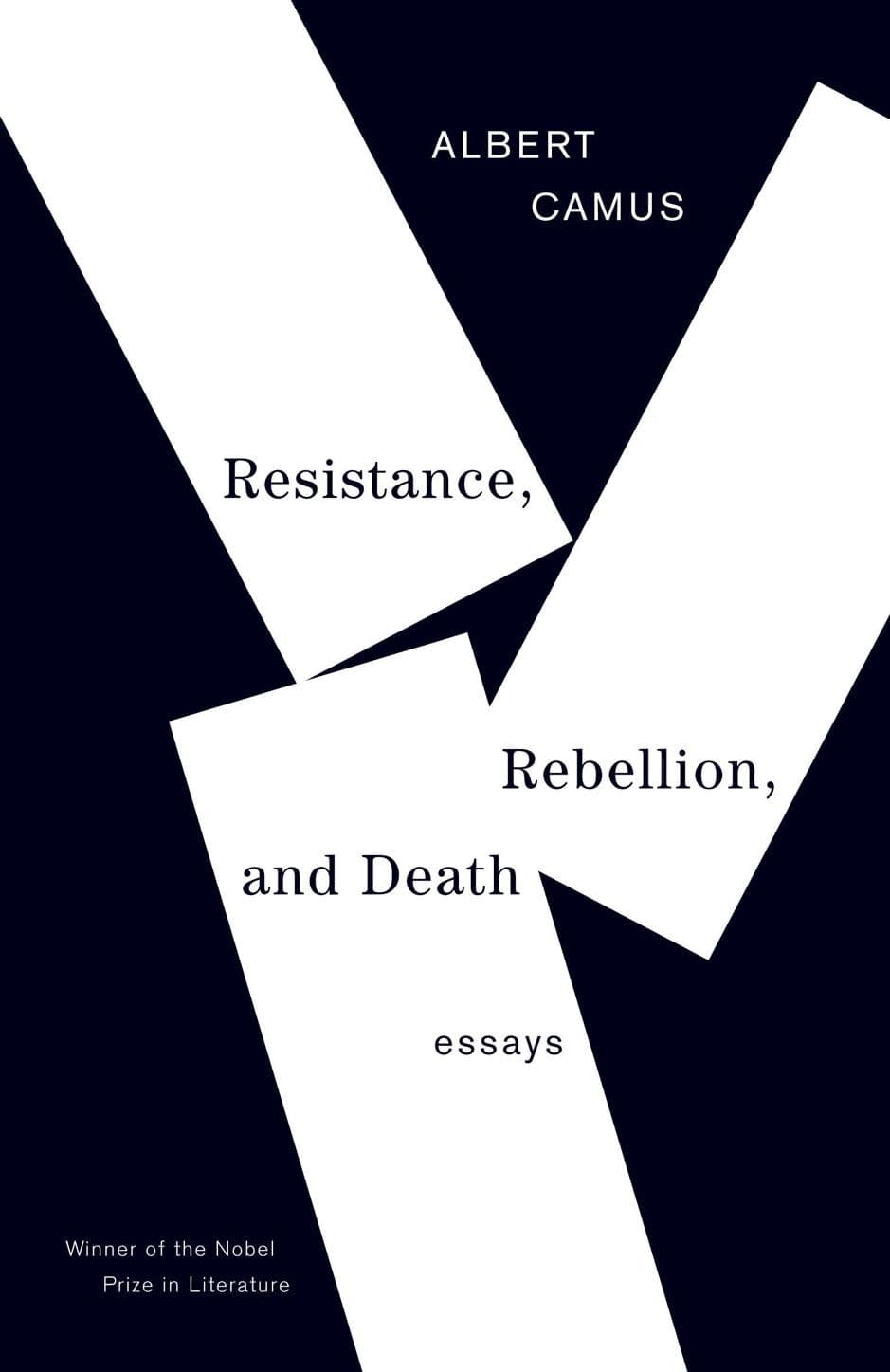
Resistance, Rebellion, and Death
This collection, assembled by Camus himself from his Actuelles and other occasional writings, is not a systematic treatise but a record of a moral intelligence under political pressure. Its unifying thread is the question of what intellectual integrity requires when history demands action: how to oppose tyranny without adopting its methods, how to refuse capital punishment without excusing murder, and how to speak for the condemned without claiming to speak for history. The essays on Algeria and the 'Letters to a German Friend' are the collection's sharpest tests of this position, where Camus's commitment to limits collides with the intractable demands of colonial violence and total war.
Key Insights
✦What holds this collection together, given that the essays span two decades and several distinct political crises?
The collection is unified less by a single thesis than by a persistent method: Camus tests abstract moral commitments against concrete historical emergencies and refuses to let either term cancel the other. The essays on capital punishment argue against state killing without denying the reality of murder; the 'Letters to a German Friend' define resistance without sanctifying violence; the Algeria writings attempt to hold French and Arab suffering in view simultaneously while rejecting both colonial repression and FLN terror. This method produces what one contemporary reviewer in Dissent called a 'disconcerting sameness of tone'—a moral register applied with equal intensity to unequal situations . The coherence is ethical rather than doctrinal.
✦How did Camus's position on Algeria, as articulated in these essays, draw criticism from Sartre and postcolonial critics?
Sartre attacked Camus's call for economic and social reform before political independence, sarcastically labeling him 'our tender-hearted realist' who placed the economy first . For Sartre, Algerian poverty was a direct effect of colonialism, and reforms that left colonial structures intact merely perpetuated the injustice. Conor Cruise O'Brien, in his 1970 study of Camus, went further, arguing that Camus's Mediterranean cultural ideal masked a preference for European over Arab culture and that his abstract commitments to freedom and justice coexisted with a partisan blindness to Algerian claims . Defenders counter that Camus was among the first in his circle to condemn French colonialism and that his opposition to both FLN and state terror reflected a consistent ethics of limits rather than colonial sympathy.
✦Why did Camus insist on opposing the death penalty with such unusual intensity, and how does that argument sit within this collection?
Camus's 'Reflections on the Guillotine' is the collection's emotional and argumentative climax, and its intensity reflects a lifelong preoccupation rather than a passing political stance. His objection is not primarily utilitarian but metaphysical: capital punishment, he argues, is a ritual of absolute judgment that pretends to a certainty no human institution can possess, and it degrades the society that performs it by making killing a matter of administrative procedure. The essay extends the logic of The Rebel into a specific institutional practice, testing whether the principle of limits can be applied not only to revolutionary violence but to the state's own violence. The essay's force lies in its refusal to separate the question of murder from the question of who claims the right to judge.
✦How does this collection relate to The Rebel, and does it resolve the tensions that book left open?
Resistance, Rebellion, and Death applies the framework of The Rebel to concrete episodes—the Resistance, the Hungarian uprising, the Algerian War—without resolving the central tension The Rebel identified between revolt and murder. If anything, the collection demonstrates the difficulty of sustaining that framework under pressure. The Algeria essays in particular show Camus struggling to apply a politics of limits to a situation in which both sides regarded limits as a form of betrayal. A reviewer writing in Dissent in 1961 observed that Camus's journalism revealed him to be 'not really a political man,' driven to intervene when silence became unbearable but unable to translate moral clarity into political program . The collection is valuable precisely for documenting this impasse rather than concealing it.
✦What is the most common misconception about this book's status within Camus's oeuvre?
The common misconception treats it as a minor appendix to Camus's novels and philosophical essays, valuable only as biographical context. In fact, Camus selected these pieces himself, and their arrangement is deliberate: the sequence moves from wartime resistance through capital punishment to Algeria and finally to the responsibilities of the artist, constructing a narrative of escalating moral pressure. The collection also contains some of Camus's most direct and least mediated prose, unencumbered by the irony of The Fall or the abstraction of The Rebel. Readers who dismiss it as occasional journalism miss the fact that these essays were the primary arena in which Camus tested whether the absurdist ethics of his earlier work could guide action in the world.
✦How does the editorial history of this collection affect how it should be read?
The book is not a single unified work but a selection made by Camus from his Actuelles volumes and other occasional writings, translated by Justin O'Brien under Camus's supervision and published in English in 1960, the year of his death . The French originals appeared in different contexts and at different moments, and the English collection reshapes them into a single volume with a retrospective coherence that the original publications did not possess. Readers should keep in mind that the juxtaposition of essays on Hungary and Algeria, for instance, is an editorial decision rather than an argument Camus made explicitly. O'Brien's translation has been the standard English version since its publication, and no major rival translation has displaced it.
Wealthy Psyche is an intellectual archive. We do not host, distribute, or sell book copies — physical or digital. We provide structured knowledge to help you think better, faster.