


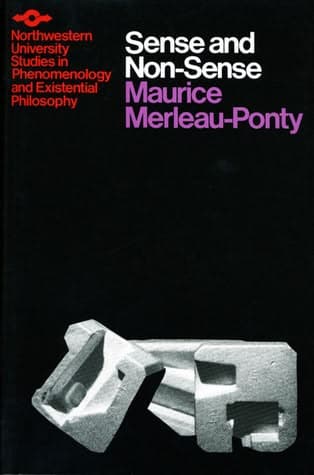
Sense and Non-Sense

Merleau-Ponty's central claim is that the world of perception is already laden with meaning before any explicit theorizing, and that philosophy's task is to recover this primordial sense from the layers of objectivist abstraction that obscure it. The essays collected here—on art, politics, and psychology—argue that sense and non-sense are not opposites but interwoven: meaning emerges from ambiguity, and the absurd arises only when reason's demands outstrip the world's generosity. The book extends the phenomenology of perception into aesthetics, history, and political critique, defending a situated rationality against both dogmatism and scepticism.
Key Insights
✦What is the central claim of Sense and Non-Sense, and what does it reject?
The central claim is that the world of perception is already laden with meaning before any explicit theorizing, and that philosophy's task is to recover this primordial sense from the layers of objectivist abstraction that obscure it. The essays argue that sense and non-sense are not opposites but interwoven: meaning emerges from ambiguity, and the absurd arises only when reason's demands outstrip the world's generosity . Merleau-Ponty rejects the Cartesian and intellectualist assumption that meaning is imposed on a meaningless sensory manifold by a constituting consciousness. He also rejects the empiricist view that perception is a passive reception of discrete data. The book defends a situated rationality that acknowledges ambiguity without collapsing into irrationalism, extending the phenomenology of perception into aesthetics, history, and politics.
✦How does the essay on Cézanne exemplify the book's argument about art and meaning?
The essay 'Cézanne's Doubt' is one of Merleau-Ponty's most celebrated pieces and a key illustration of the book's thesis. Merleau-Ponty argues that Cézanne's painting does not copy appearances but interrogates them, seeking to render the very texture of the visible world as it is given to perception before any conventional representation. Cézanne's doubt—his difficulty in completing his work—is not a psychological failing but the expression of the impossible task of capturing the world's nascent meaning . The artist's expression is not a translation of pre-existing thought but a creative act that brings meaning into being. The essay thus shows how art, like perception itself, is a mode of access to the world rather than a secondary representation of it.
✦How does the book treat politics, and how does this relate to Merleau-Ponty's later political thought?
The political essays in Sense and Non-Sense, including 'The War Has Taken Place' and 'Faith and Good Faith,' reflect Merleau-Ponty's engagement with the ambiguities of political action in the immediate postwar period. He rejects both the dogmatic certainties of orthodox Marxism and the moralism of liberal anti-communism, insisting that political judgment must acknowledge the indeterminacy of history and the irreducible plurality of perspectives . These essays anticipate the more sustained critique of revolutionary Marxism in Adventures of the Dialectic (1955). The book's political thought is continuous with its broader argument: just as perception is ambiguous and meaning emerges from indeterminacy, so political action operates in a field of ambiguity where no absolute guarantee of rightness is available.
✦What is the publication and translation history of the work?
Sense and Non-Sense was first published in French as Sens et non-sens by Les Éditions Nagel in Paris in 1948 . It collects essays and articles Merleau-Ponty had published between 1945 and 1947, including 'Cézanne's Doubt' and 'The War Has Taken Place' . The English translation by Hubert L. Dreyfus and Patricia Allen Dreyfus was published by Northwestern University Press in Evanston in 1964, as part of the Studies in Phenomenology and Existential Philosophy series . The translation runs 193 pages and includes an introduction by the translators. A second edition of the translation appeared in 1996 . The volume was the first collection of Merleau-Ponty's essays to appear in English, making his work on art and politics accessible to Anglophone readers.
✦How was the book received, and what is its place in Merleau-Ponty's oeuvre?
The book was well received as a lucid and accessible introduction to Merleau-Ponty's thought in its early phase. A review in The Journal of Philosophy praised the essays for their 'clarity and insight' and noted that they provide 'an excellent introduction to the phenomenological approach' . Later scholarship has recognised Sense and Non-Sense as a crucial transitional work: it develops the phenomenology of perception into the domains of art and politics while anticipating the more systematic treatments in Signs (1960) and Adventures of the Dialectic (1955). The essay on Cézanne has been particularly influential and is widely anthologised in aesthetics courses. The book remains a standard entry point to Merleau-Ponty's early philosophy.
✦What is a common misconception about the book's title?
A frequent misconception is that 'sense and non-sense' names a simple opposition, as if the book were defending sense against non-sense or celebrating the irrational. In fact, the title signals their intertwining: sense emerges from non-sense, and the two are never wholly separable. Merleau-Ponty argues that meaning is never given in pure form but always emerges against a background of ambiguity and indeterminacy. The absurd, he suggests, arises only when reason demands a clarity that the world cannot provide; the world is not absurd but ambiguous, and ambiguity is the condition of meaning rather than its failure . The book's title thus encapsulates its central philosophical claim rather than naming a thematic binary.
Wealthy Psyche is an intellectual archive. We do not host, distribute, or sell book copies — physical or digital. We provide structured knowledge to help you think better, faster.