


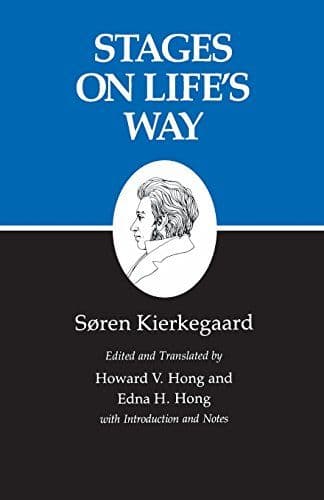
Stages on Life's Way
Kierkegaard's 1845 work is a sequel to Either/Or that extends his map of existence from the aesthetic and ethical spheres into the religious. Its distinctive mechanism is a three-part structure of pseudonymous documents—a banquet on love modeled on Plato's Symposium, a defense of marriage by Judge William, and the diary of a young man who breaks his engagement—framed by the conceit of a bookbinder who found them by chance. The book's central claim is that the stages of life are not chronological phases but competing ways of existing, and that the transition between them requires irony and humor rather than argument.
Key Insights
✦What is the central argument of Stages on Life's Way, and what does it reject?
The book argues that existence is structured by distinct spheres—the aesthetic, the ethical, and the religious—that are not chronological stages a person passes through automatically, but competing ways of interpreting oneself and one's world. What it rejects is the Hegelian assumption that these stages can be reconciled in a higher synthesis or that movement between them is a matter of logical deduction. Kierkegaard presents each sphere through a distinct pseudonymous voice, and the transitions between them are effected by irony (from aesthetic to ethical) and humor (from ethical to religious), not by argument . The book's three-part structure enacts this claim rather than stating it: the reader must move between incompatible perspectives without a narrator to harmonize them.
✦How does the book's structure—three documents found by a bookbinder—serve its philosophical purpose?
The framing device of 'Hilarius Bookbinder' who discovers a bundle of documents and prepares them for printing is a characteristic Kierkegaardian mystification . It serves a precise philosophical function: by denying the reader a single authoritative narrator, the structure forces the reader to confront the documents as competing claims on existence rather than as parts of a system. The first section, 'In Vino Veritas,' stages a banquet where speakers take turns declaring that love is ludicrous; the second is Judge William's earnest defense of marriage; the third is the diary of a young man who broke his engagement and suffers in a religious register . The bookbinder does not adjudicate between them, and the reader is left to do the work of judgment.
✦How does Stages on Life's Way relate to Either/Or, and what does it add to Kierkegaard's authorship?
The book is the direct sequel to Either/Or, and Kierkegaard described it as supplying a missing piece: Either/Or had stopped with the ethical, and Stages adds the religious dimension that the earlier work lacked . But the relationship is not one of simple completion. Walter Lowrie noted that Kierkegaard wrote a 'repetition of Either/Or' because it had stopped with the ethical, and the addition of Quidam's diary—the 'Guilty?/Not Guilty?' section—was intended to lead the reader toward the religious stage . The book thus repeats characters and themes from the earlier work while redirecting them toward a destination that Either/Or had not reached. It points forward to Concluding Unscientific Postscript, where the religious stage receives its full philosophical treatment .
✦What role does Judge William's defense of marriage play, and how does it relate to the aesthetic critique of love?
Judge William's discourse, 'Some Reflections on Marriage in Answer to Objections,' is the book's ethical center. He defends marriage against the aesthetic view that love is a game or a style, arguing that marriage is 'the most positive of all' resolutions and that faith—not understanding or sophistication—is what makes a married man lovable . The placement of this defense after the banquet scene is deliberate: the aesthetes have declared love ludicrous, and Judge William responds not by refuting them on their own terms but by demonstrating a different way of inhabiting love altogether. The ethical sphere does not win an argument; it shows itself as a coherent alternative. And yet the book does not end with Judge William, suggesting that the ethical, too, is incomplete.
✦What is the most common misreading of the 'stages' or 'spheres' of existence?
The most persistent misreading treats the stages as a developmental sequence that individuals pass through in order, as if the aesthetic were childhood, the ethical adulthood, and the religious maturity. But Kierkegaard's pseudonyms are not stages in a single life; they are positions that can be occupied simultaneously, and the movement between them is not guaranteed by time or growth. A related error assumes that the religious stage is simply 'higher' in a straightforwardly evaluative sense. The book's ending does not deliver a triumphant religious synthesis; Quidam's diary is 'a story of suffering' and an 'imaginary psychological construction' , and his willingness to repent does not yet constitute faith. The stages are diagnostic categories for understanding how one exists, not rungs on a ladder.
✦What are the English translations of Stages on Life's Way, and how do they differ?
The first English translation was by Walter Lowrie, published by Princeton University Press in 1940 and reprinted several times . Lowrie's version remained standard for decades. The authoritative modern translation is by Howard V. Hong and Edna H. Hong, published by Princeton University Press in 1988 as part of their complete Kierkegaard's Writings series . The Hong translation is generally preferred by scholars for its accuracy, its extensive notes, and its fidelity to Kierkegaard's pseudonymous complexity. Readers should be aware that the book's effect depends on the distinct voices of its pseudonyms—the worldly aesthetes, the earnest judge, the suffering diarist—and that translation choices about register and tone significantly shape how the reader experiences the conflicts between spheres.
Wealthy Psyche is an intellectual archive. We do not host, distribute, or sell book copies — physical or digital. We provide structured knowledge to help you think better, faster.