


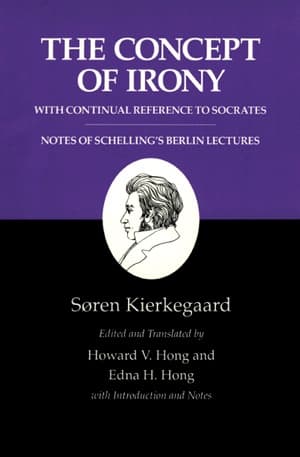
The Concept of Irony

Kierkegaard's 1841 dissertation, published in 1841 but defended in 1841, is a philosophical analysis of Socratic irony that doubles as a critique of Hegel and German Romanticism. Its central mechanism is the distinction between irony as an infinite, absolute negativity—a stance that negates the given actuality without possessing the new—and 'mastered' irony, which is brought under control and made a controlled element in an ethical life. The book's distinctive argument is that Socratic irony was a necessary transitional stage in the development of subjectivity, and that modern Romantic irony, which remains trapped in endless negativity, misunderstands and betrays it.
Key Insights
✦What is the central argument of The Concept of Irony, and what does it reject?
The central argument is that Socratic irony is a necessary transitional stage in the development of subjectivity, but that irony must be 'mastered'—brought under control and limited—to become productive rather than destructive. Kierkegaard defines irony as 'infinite, absolute negativity': the ironist negates the whole of existence and stands in complete superiority over it, yet simultaneously has not embraced any positive content . What the book rejects is the German Romantic irony of Friedrich Schlegel, which Kierkegaard regards as a subjective, unlimited negativity that becomes an end in itself, a nihilistic play with possibility rather than a preparation for ethical commitment . Socratic irony, by contrast, was a divine mission that dissolved the existing order to prepare for something new.
✦What does Kierkegaard mean by 'mastered irony,' and why is it central to the book's conclusion?
Mastered irony is irony that has been brought under control and made a controlled element in an ethical life, rather than a stance of pure, infinite negativity. Brad Frazier's study of the dissertation argues that after extensively critiquing pure irony, Kierkegaard attempts to recover the 'truth of irony' in a brief but suggestive conclusion: irony, when mastered, is an indispensable component in an ethical way of life . Kierkegaard draws an analogy between poets who skillfully use irony in their work and persons who employ it in their 'individual existence,' suggesting that irony becomes beneficial when it is mastered through moral commitment . The conclusion is central because it prevents the book from being a simple rejection of irony: the point is not to dispense with irony, as Hegel does, but to limit and deploy it.
✦Why did Kierkegaard write his dissertation in Danish rather than Latin, and what does this reveal?
Kierkegaard had to petition the King for permission to write his dissertation in Danish rather than the customary Latin—his was only the third case of this happening . The principal reason he offered was that the subject-matter belonged pre-eminently to modernity, despite much of the thesis being concerned with ancient philosophy, 'only insofar as the modern age has its beginning therein' . This choice reveals that Kierkegaard was already thinking of his work as addressing a contemporary audience and contemporary problems, not merely as an academic exercise in classical scholarship. The dissertation's style was sufficiently radical to cause 'concern bordering on consternation' among his examiners, and the methodological parallels between Kierkegaard's defense and Socrates' Apology suggest that the dissertation was itself an ironic performance .
✦How does the book relate to Hegel's account of Socrates, and what is Kierkegaard's principal criticism?
Kierkegaard's dissertation engages extensively with Hegel's interpretation of Socrates, and his principal criticism is that Hegel fails to see the fundamental significance of the Socratic daimon—the divine sign that guided Socrates—as a determination of subjectivity . For Hegel, irony was merely a 'vanishing point in the system,' a negative moment in the development of the Idea; for Kierkegaard, Socratic irony signified the emergence of personal existence and subjective concern, which speculative philosophy cannot comprehend. Kierkegaard also departs from Hegel by insisting that Aristophanes, not Plato or Xenophon, provides the most reliable portrait of Socrates, because Aristophanes correctly grasped the negativity of Socrates' standpoint . The polemic against Hegel is therefore both interpretive and philosophical: it concerns both what Socrates was and what philosophy can know about individual life.
✦How has scholarship reassessed the dissertation's importance to Kierkegaard's later work?
For a long time the dissertation was treated as a semi-canonical academic exercise, peripheral to the pseudonymous works that made Kierkegaard famous. This has changed. K. Brian Soderquist's study The Isolated Self argues that The Concept of Irony is a foundational text that established some of Kierkegaard's most important ideas on the self, and that Kierkegaard would return to the ideas developed there throughout his entire career . Soderquist uncovers in the dissertation the most comprehensive account of the 'double movement' that is crucial to the later works—the movement from an immediate, unreflective life toward a self-developed worldview . The dissertation is now recognized not as juvenilia but as the laboratory in which Kierkegaard worked out the concepts of subjectivity, negativity, and commitment that would define his authorship.
✦What are the main English translations of The Concept of Irony, and how do they differ?
The first English translation was by Lee M. Capel, published by Harper & Row in 1965 and reprinted by Indiana University Press in 1968 . This version remained the standard for decades and is still cited in scholarship. The standard modern translation is by Howard V. Hong and Edna H. Hong, published by Princeton University Press in 1989 as part of their complete Kierkegaard's Writings series. The Hong edition includes extensive historical introduction, notes, and supplementary material, making it the preferred scholarly version. The dissertation's title is sometimes rendered as On the Concept of Irony with Continual Reference to Socrates, and the full title signals the book's method: a sustained engagement with a single figure (Socrates) through whom the concept is examined. Translation choices matter because Kierkegaard's Danish exploits the resources of irony and ambiguity that the dissertation is analyzing.
Wealthy Psyche is an intellectual archive. We do not host, distribute, or sell book copies — physical or digital. We provide structured knowledge to help you think better, faster.