


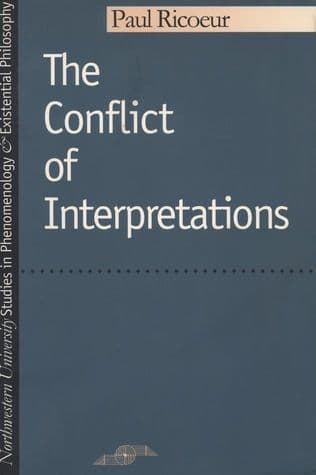
The Conflict of Interpretations: Essays in Hermeneutics

Ricœur's central argument is that the human sciences of the 1960s—linguistics, semiology, ethnology, psychoanalysis—had generated a genuine 'conflict of interpretations' that philosophy could neither ignore nor adjudicate from above. His method is a long detour through structuralism and a hermeneutics of suspicion (Freud, Marx, Nietzsche) to show that explanation and understanding are not rivals but complementary moments in a single interpretive arc, opening onto a revised, capable subject rather than the 'dead' subject of structuralist polemic.
Key Insights
✦What is the central claim of The Conflict of Interpretations, and what does it reject?
Ricœur argues that the interpretive disciplines of the 1960s—psychoanalysis, structuralist linguistics, semiology—produce a genuine conflict of interpretations that philosophy cannot dissolve by fiat. The book rejects two positions: a 'short path' hermeneutics that appeals directly to meaning or the sacred without passing through explanatory analysis, and a structuralist reduction that treats the subject as a mere effect of linguistic or unconscious systems. Ricœur's wager is that the conflict itself is productive. By passing through the hermeneutics of suspicion—Freud, Marx, Nietzsche—philosophy can arrive at a richer, more chastened understanding of the self, one that has lost its immediate transparency but not its capacity for responsible existence.
✦What is the 'hermeneutics of suspicion,' and what role does it play in the book?
The hermeneutics of suspicion names the interpretive strategy that treats surface meanings as masks for hidden forces—unconscious drives, economic relations, or will to power. Ricœur associates it primarily with Freud, Marx, and Nietzsche, though the book's extended engagement is with Freud's psychoanalytic interpretation. The suspicion hermeneutic is not simply an enemy to be refuted; it is a necessary passage. By submitting to a reading that distrusts consciousness, the philosopher learns that the cogito is not master in its own house. The book's dialectical claim is that suspicion and a restored hermeneutics of trust are not mutually exclusive alternatives but moments in a single interpretive arc, and that the self that emerges from this trial is more, not less, capable of ethical existence.
✦How does The Conflict of Interpretations relate to Ricœur's Freud and Philosophy?
The two books are closely intertwined, and The Conflict of Interpretations extends and consolidates the earlier work. Freud and Philosophy, published in 1965, offered the sustained confrontation with psychoanalysis and introduced the contrast between a hermeneutics of suspicion and a hermeneutics of trust. The Conflict of Interpretations, appearing in 1969, collects essays from the intervening years that apply and complicate that framework across structuralism, biblical exegesis, and the question of the subject. The later volume thus functions as a testing ground for the Freud book's central distinction, showing how it holds up when confronted with Lévi-Strauss, the structuralist 'death of the subject,' and the problem of demythologizing. Readers who want the systematic argument should begin with Freud and Philosophy; those who want to see it at work across disciplines should read the essays collected here.
✦Why does the English edition credit Don Ihde as editor, and what does that mean for the text?
The English translation was published by Northwestern University Press in 1974, edited by Don Ihde, a philosopher of technology and a sympathetic reader of phenomenology . The French original, Le conflit des interprétations, is not a monograph but a collection of essays drawn largely from articles published between 1960 and 1969 . Ihde's editorial role therefore involved selecting and arranging the essays for an English-speaking readership, a mediation that shapes the volume's coherence. The book does not present itself as a single continuous argument; its force derives from the juxtaposition of Ricœur's engagements with psychoanalysis, structuralism, and biblical hermeneutics. Readers approaching the English edition should treat it as a curated introduction to Ricœur's hermeneutic project in its most polemical decade.
✦How does Ricœur's position differ from Gadamer's philosophical hermeneutics?
Ricœur shares with Gadamer the conviction that understanding is historically situated and linguistically mediated, but he resists Gadamer's tendency to absorb method into ontology. Where Gadamer treats the human sciences' methodological concerns as secondary to the event of understanding, Ricœur insists on a critical moment: explanation and understanding must be dialectically related, not collapsed into one another. This difference is sharpened in Ricœur's later debate with Habermas over the critique of ideology, where he positions himself between Gadamer's trust in tradition and Habermas's suspicion of it. In The Conflict of Interpretations, the Gadamerian influence is present but not dominant; the book's interlocutors are Freud and the structuralists, and its aim is to show that hermeneutics can survive their challenge without surrendering to either dogmatism or reductionism.
✦What is a common misreading of the book's treatment of structuralism?
A common misreading assumes that Ricœur was a structuralist or that he simply adopted the structuralist 'death of the subject.' The essays make clear that he takes structuralism seriously as a method while refusing its philosophical conclusions. He grants that linguistic and semiological analysis can explain the objective structure of texts and myths, but he argues that explanation is not the whole of interpretation. The structuralist moment must be passed through, not embraced as final. Ricœur's target is the claim that the subject is nothing but an effect of structure. His counter-claim is that the subject can be rediscovered, but only after the detour through objectifying analysis—a subject no longer immediate and transparent, but capable of appropriation and responsibility.
✦How has the book's argument held up since its publication?
The book's central distinction between a hermeneutics of suspicion and a hermeneutics of trust has proven remarkably durable, even as the specific debates it addresses have shifted. The structuralist 'death of the subject' no longer dominates the intellectual landscape as it did in 1969, but Ricœur's dialectical response to reductionism remains a resource for anyone navigating between naive trust and corrosive suspicion. Contemporary scholarship continues to draw on the book's framework: a 2024 study applies its suspicion-restoration dialectic to the methodology of Christian biblical interpretation, arguing that historical criticism and theological hermeneutics are complementary rather than opposed . The volume's essays on Freud and structuralism are now historical documents in part, but the model of interpretation they defend remains active in hermeneutic philosophy and philosophy of religion.
Wealthy Psyche is an intellectual archive. We do not host, distribute, or sell book copies — physical or digital. We provide structured knowledge to help you think better, faster.