


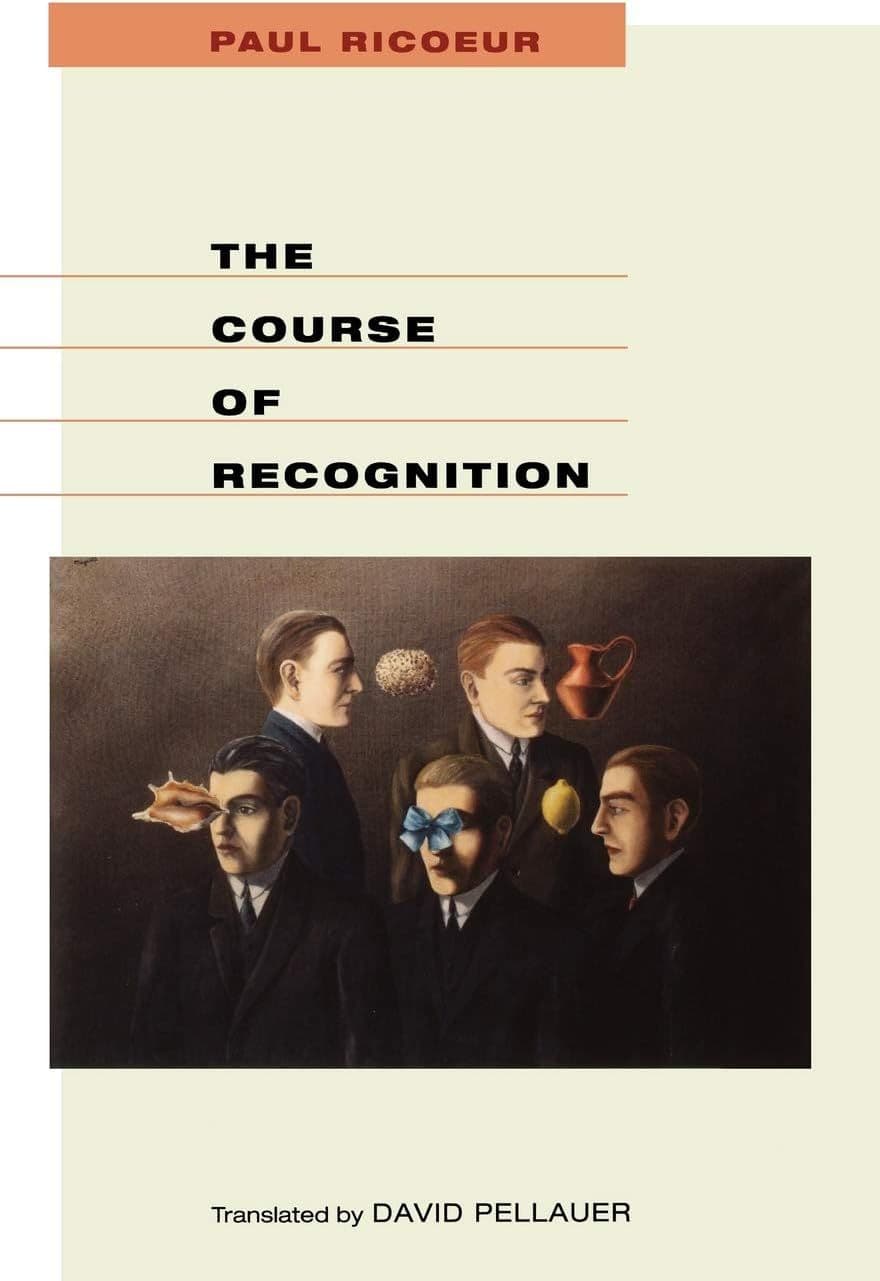
The Course of Recognition

Ricœur's final book argues that recognition is not one concept but a course traversed in three distinct philosophical registers: recognition as identification (knowing something as the same), recognition of oneself (the capable, promising self), and mutual recognition (the struggle for esteem and the states of peace that interrupt it). The book's wager is that a hermeneutics of mutual recognition must pass through the gift and the dialectic of struggle and agape, without resolving the tension between them into a final synthesis.
Key Insights
✦What is the central claim of The Course of Recognition, and what does it reject?
Ricœur argues that recognition is not a single phenomenon but a course with three irreducible dimensions: identification, self-recognition, and mutual recognition. The book rejects the assumption, common in Hegelian and Honnethian traditions, that the struggle for recognition is the whole story. Ricœur insists that alongside the struggle there are 'states of peace'—moments of mutual recognition that are not merely tactical pauses but genuine experiences of reciprocity and gratitude . At the same time, he refuses to resolve the tension between struggle and peace into a final synthesis. The course of recognition remains open, and its most complete form, mutual recognition, is approached through the mediating figure of the gift rather than achieved once and for all.
✦What three forms of recognition does the book distinguish, and why does the order matter?
The book proceeds through recognition as identification (knowing an object or person as the same over time, with attention to Kant's account of time-consciousness), recognition of oneself (the capable human being who remembers and promises), and mutual recognition (the social and juridical struggle for esteem) . The order matters because Ricœur is not simply cataloguing uses of a word. He is showing that mutual recognition cannot be understood without the prior analyses: the self who struggles to be recognized must first be a self capable of self-recognition, and that capacity is itself rooted in the more basic act of identifying something as something. The course is a progression of deepening, but it does not culminate in a stable possession; each stage retains its own tensions.
✦How does Ricœur's treatment of recognition differ from Axel Honneth's?
Ricœur largely agrees with Honneth's continuation of the Hegelian theme, including the three spheres of recognition (love, rights, solidarity), but he identifies a structural risk: the struggle for recognition can become a 'bad infinite,' perpetually unsatisfied and thus interminable . Honneth's framework, on Ricœur's reading, lacks a counterweight to this endlessness. Ricœur proposes agape—unconditional generosity—as a complement that can interrupt the struggle without negating it. This is not a rejection of Honneth but a modification: the states of peace are not the goal of the struggle but its grace, and they introduce an excess that social theory cannot generate on its own. Critics have argued that this recourse to agape risks minimizing the conflictual dimension of social praxis.
✦Why does the gift play such a large role in the book's account of mutual recognition?
The gift is the symbolic mediator of mutuality. Ricœur draws on Marcel Mauss's account of the gift cycle and Marcel Hénaff's interpretation of ceremonial gifts as mutual symbolic recognition, but he finds both insufficient: Mauss explains the obligation to reciprocate but not the gratuity of giving, while Hénaff captures the symbolic relation but leaves no room for generosity . Ricœur's solution is to read the gift through the lens of agape, so that the exchange of gifts becomes a pledge of recognition that does not demand return, even as it invites it. The gift thus symbolizes a mutuality in which each person is simultaneously giver and receiver, and it opens the possibility of states of peace without abolishing the asymmetry that makes recognition meaningful.
✦What does 'states of peace' mean in the book, and are they achievable?
States of peace are moments of mutual recognition that interrupt the interminable struggle—experiences of gratitude, festivity, and shared joy in which recognition is given and received without the logic of demand and counter-demand . Ricœur adopts the phrase from Luc Boltanski and treats these states not as utopian ideals but as fragile, real occurrences that testify to a dimension of human relations irreducible to conflict. They are not achievable in any definitive or institutional sense; they cannot be planned or guaranteed. Their importance lies in what they reveal: that the struggle for recognition is not the only truth about human coexistence, and that generosity and forgiveness are not merely moral supplements but constitutive possibilities of mutual recognition.
✦How faithful is David Pellauer's English translation, and what was the book's original form?
The French original, Parcours de la reconnaissance: Trois études, was published by Éditions Stock in 2004, a year before Ricœur's death . The book grew out of lectures delivered at the Institute for the Human Sciences in Vienna, which explains its tripartite structure and its essayistic texture . David Pellauer's English translation, published by Harvard University Press in 2005, is the standard edition and is generally reliable, though Ricœur's late prose is dense and occasionally, by his own standards, obscure—particularly in the sections on the gift, where the argument moves through Mauss, Lévi-Strauss, and Hénaff with considerable compression . No major textual controversy surrounds the edition, but readers should note that the book is a series of studies rather than a systematic treatise, and its unity is that of a course rather than a deductive system.
✦What is a common misreading of the book's relationship to Hegel?
A common misreading treats The Course of Recognition as a straightforward extension or completion of Hegel's struggle for recognition. Ricœur is certainly indebted to Hegel, and the book's third study engages the Phenomenology directly. But his aim is not to perfect the Hegelian dialectic; it is to show that recognition cannot be reduced to the struggle, and that the struggle itself points beyond itself toward states of peace that Hegel's framework cannot accommodate without remainder. The misreading flattens the book into a contribution to recognition theory in the Honnethian mode, missing Ricœur's insistence on the gift, agape, and the irreducible plurality of recognition's forms. The book is as much a meditation on the limits of the struggle as it is an account of the struggle itself.
Wealthy Psyche is an intellectual archive. We do not host, distribute, or sell book copies — physical or digital. We provide structured knowledge to help you think better, faster.