


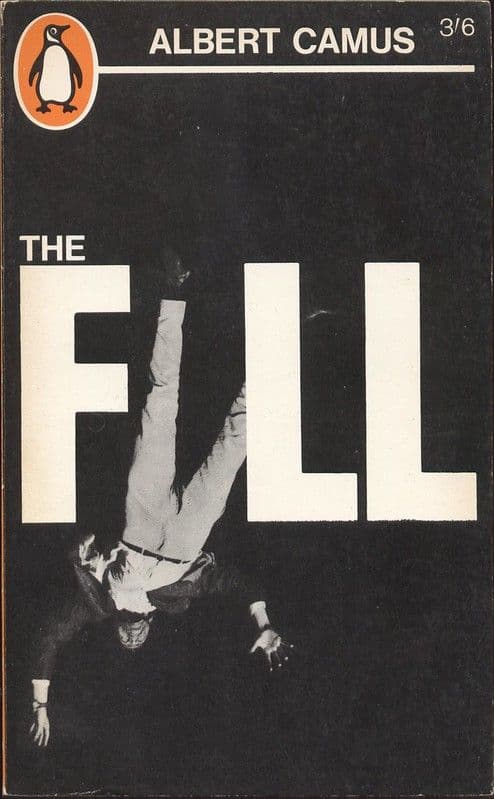
The Fall (La Chute)
Camus's final completed novel is a dramatic monologue delivered by Jean-Baptiste Clamence, a former Parisian defense lawyer now styling himself a 'judge-penitent' in an Amsterdam bar. The book's central mechanism is not a straightforward confession but a calculated performance: Clamence recounts his fall from civic virtue to self-loathing, then turns the logic of guilt outward, implicating his listener—and by extension the reader—in a shared culpability. This is not the absurdist heroism of Sisyphus but a darker study in duplicity, judgment, and the impossibility of innocence after the twentieth century's catastrophes.
Key Insights
✦What is the central mechanism of The Fall, and how does it differ from a conventional confession?
Clamence's monologue is not an act of contrition but a calculated performance designed to entrap his listener. He confesses his vanity, his cowardice on the bridge, and his exploitation of others, but the confession itself becomes a new form of superiority: by declaring himself utterly guilty, he claims the right to judge everyone else as equally guilty. As he eventually admits, confessing allows him to start again with a lighter heart—repentance becomes a pleasure rather than a penance. This is the book's distinctive thesis: the judge-penitent does not renounce judgment but universalizes it, turning confession into an instrument of power over the listener.
✦How has The Fall's argument been received and critiqued since its publication?
Early reception was polarized. Sartre's eulogy called it 'perhaps the most beautiful and the least understood' of Camus's books, while many readers found Clamence's manipulations repellent rather than illuminating. A major strand of later criticism, led by Shoshana Felman, reads the novel as a response to the Holocaust, arguing that Clamence's failure to save the drowning woman allegorizes the impossibility of witnessing catastrophe. This reading has been challenged by scholars such as Colin Davis, who notes the near-absence of explicit textual support for the Holocaust connection and warns against overreading the novel as a historical testimony rather than a study in ethical ambiguity.
✦Is The Fall a philosophical novel in the same sense as The Myth of Sisyphus?
No, and Camus himself did not treat it as one. Where The Myth of Sisyphus builds an argument through essays, The Fall proceeds aphoristically and dramatically, leaving propositions undeveloped and inviting the reader to draw conclusions. Brian Fitch has argued that the novel is designed less to persuade through logic than to unsettle the reader, engineering a kind of 'fall' in the act of reading itself. The philosophical content is embedded in the rhetoric of Clamence's voice rather than in a systematic doctrine, which is why critics disagree about whether the book endorses or merely dramatizes its narrator's nihilism.
✦What specific concept did The Fall introduce, and where does it appear in later thought?
The 'judge-penitent' is the novel's signature concept: a figure who confesses his own guilt in order to assume the position of universal judge. The term has since been used in literary criticism, psychoanalytic theory, and discussions of confessional culture to describe the paradox by which public self-accusation can become a form of moral authority. It is frequently invoked in analyses of contemporary memoir and social media confession, where the performance of vulnerability can function as a claim to authenticity that silences dissent. Within Camus studies, the figure represents a turning point away from the heroic solitude of Sisyphus toward a more suspicious view of the self's relationship to others.
✦How does The Fall relate to Camus's break with Sartre and the intellectual climate of the 1950s?
The novel was written in the aftermath of Camus's public rupture with Sartre and the circle of Les Temps Modernes following the publication of The Rebel in 1951, which had been attacked for its critique of revolutionary violence. Some critics read Clamence's relentless self-justification and his manipulation of his listener as an indirect satire of the Parisian intellectual milieu and its culture of judgment. René Girard and others have suggested that the novel reflects Camus's weariness with the bitter exchanges of the postwar period, though this biographical reading risks reducing the novel's broader ethical inquiry to a roman à clef. The text itself never names Sartre or the disputes directly.
✦What is the most common misreading of The Fall?
The most persistent misreading takes Clamence at his word. Because he is frank about his vices, readers often assume his confession is sincere and that the novel is a straightforward moral warning against hypocrisy. But Clamence explicitly warns his listener that confessional authors 'write chiefly in order not to confess,' and he admits near the end that he has 'settled in' duplicity. The novel's irony is structural: the reader who accepts Clamence's self-accusation as truth has already been positioned as the dupe. A related error is to read the book as a nihilistic endorsement of Clamence's worldview, when Camus's construction of the monologue suggests a critique of the judge-penitent's circular logic rather than an embrace of it.
✦How faithful are English translations of The Fall, and what editorial issues arise?
The first English translation, by Justin O'Brien in 1957, has been the standard version for decades, but it has drawn criticism for smoothing out the rhythmic and colloquial qualities of Clamence's French, which shifts between barroom slang and lawyerly eloquence. More recent translations have sought to capture the performative texture of the monologue more closely. The novel poses a particular challenge for translators because Clamence's voice is the entire book: there is no third-person narration to anchor interpretation, and small choices about tone, irony, and ambiguity can significantly alter how manipulative or sincere the narrator appears. Readers working from translations should keep in mind that Clamence's rhetoric is the novel's central object, not merely its vehicle.
Wealthy Psyche is an intellectual archive. We do not host, distribute, or sell book copies — physical or digital. We provide structured knowledge to help you think better, faster.