


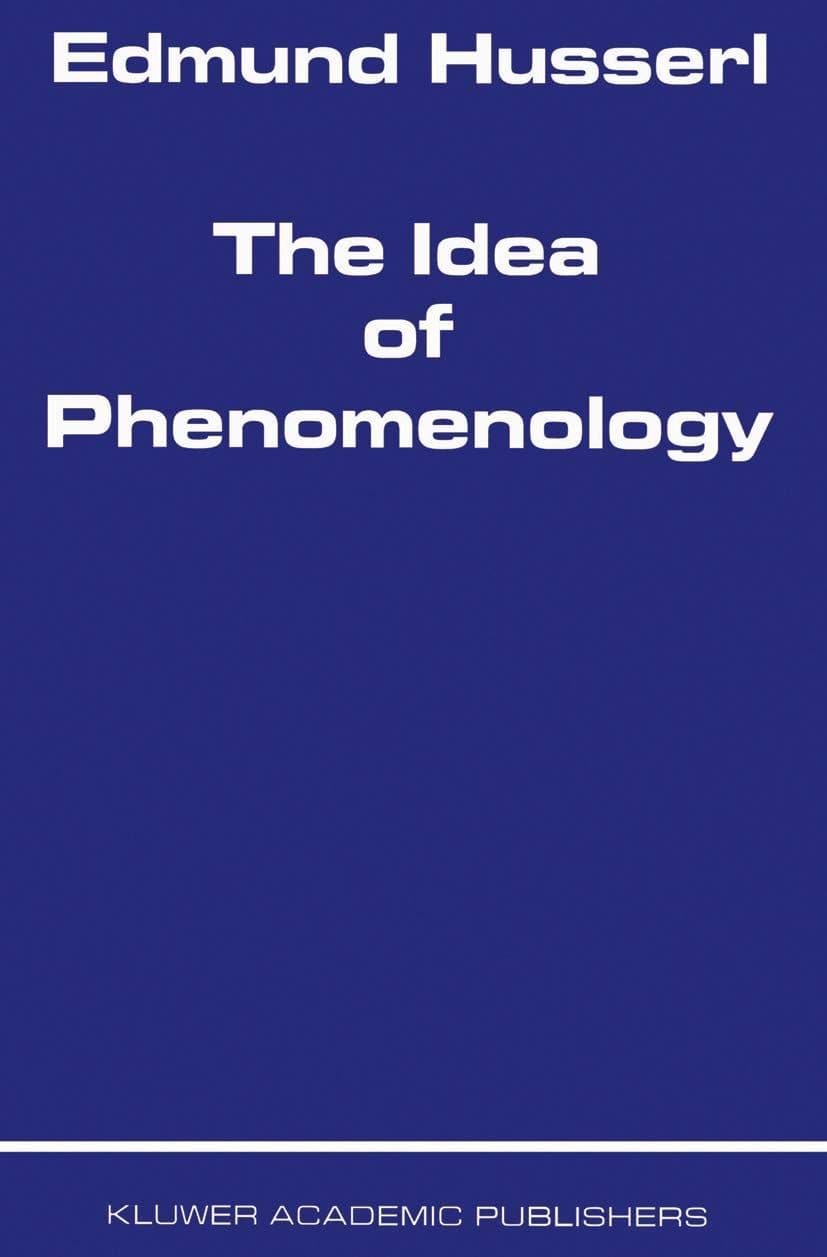
The Idea of Phenomenology
Husserl's five 1907 Göttingen lectures mark his first public presentation of transcendental phenomenology after the crisis that followed the Logical Investigations. The central claim is that the possibility of knowledge cannot be secured by psychology or by the sciences of fact, but only by a phenomenology that turns from the objects of experience to the modes in which they appear. Husserl introduces the phenomenological reduction—the suspension of the natural attitude—as the method that discloses the realm of pure phenomena and the Absolute Consciousness in which all objectivity is constituted.
Key Insights
✦What is the central claim of The Idea of Phenomenology, and what does it reject?
The central claim is that the possibility of knowledge cannot be secured by the sciences of fact, including psychology, but only by a phenomenology that turns from objects to the modes in which they appear. Husserl delivered these five lectures in Göttingen in 1907 as his first public presentation of transcendental phenomenology after the crisis that followed the Logical Investigations . He rejects every form of naturalism that would ground knowledge in psychological processes or empirical regularities. The lectures introduce the phenomenological reduction as the method that suspends the natural attitude and discloses the realm of pure phenomena, the 'science of pure phenomena' that alone can answer sceptical worries about human knowledge .
✦What is the phenomenological reduction, and why is it introduced here for the first time?
The phenomenological reduction is the method of suspending the natural attitude—the unquestioned assumption that the world exists independently of consciousness—in order to turn attention to the pure phenomena given in experience. The lectures contain the first straightforward exposition of this reduction, which is why the volume is indispensable for anyone interested in phenomenology . Husserl needed the reduction because the crisis of the Logical Investigations had left him unable to explain how objective knowledge is possible. By bracketing the question of existence, consciousness can be examined as the source of all meaning and validity. The reduction is not a denial of the world but a methodological shift that reveals the constitutive work of transcendental subjectivity.
✦How does this work relate to the 'Great Phenomenological Schism' among Husserl's students?
The lectures mark the moment when Husserl's phenomenology began its transformation from descriptive psychology into transcendental idealism, a shift that baffled many of his students and drew criticism from realists such as Adolf Reinach, Max Scheler, and Roman Ingarden . This division between transcendental and realist phenomenologists is often called the first schism in the phenomenological movement. The 1907 lectures are a key document for understanding the turn that provoked it, because they show Husserl working out the transcendental perspective that would define his later philosophy. For critics like Edith Stein and Ingarden, the reduction seemed to trap consciousness within its own representations and to undermine the realist ambitions of the earlier phenomenological project.
✦What is the publication and translation history of the work?
Husserl delivered the five lectures in Göttingen from April 26 to May 2, 1907 . They were edited by Walter Biemel and first published in 1950 as Die Idee der Phänomenologie in Husserliana II, with a summary Husserl wrote on the night of the last lecture . The first English translation, by William P. Alston and George Nakhnikian, was published by Martinus Nijhoff in The Hague in 1964 . A new translation by Lee Hardy appeared from Kluwer Academic in 1999 . The 1964 Alston-Nakhnikian edition remains widely cited, though Hardy's translation is preferred by some scholars for its updated terminology and introduction.
✦How does The Idea of Phenomenology relate to the Logical Investigations and Ideas I?
The lectures occupy a transitional position. Husserl had referred to the Logical Investigations (1900–1901) as the 'breakthrough' of phenomenology, but after their publication he entered the most profound philosophical crisis of his life, unable to provide a satisfactory account of the possibility of human knowledge . The 1907 lectures are his first public working-out of the position he would hold for the rest of his life: transcendental phenomenology. They anticipate the systematic development of Ideas I (1913), which would present the reduction and the transcendental ego in full. The lectures are thus the seed of the later system, compressed into five short presentations that retain the urgency of a philosopher working through a crisis.
✦What is a common misconception about the lectures' status as a published work?
A frequent misconception is that The Idea of Phenomenology was a book Husserl published in his lifetime. It was not. The lectures were delivered in 1907, but the German text was not published until 1950, twelve years after Husserl's death, edited by Walter Biemel as volume II of the Husserliana critical edition . The English translation followed in 1964. This means the work's reception history is entirely posthumous: it could not influence the phenomenological movement of the 1910s and 1920s directly, but it has become essential for later scholars seeking to understand the genesis of transcendental phenomenology. Reading it as a published statement from 1907 would misrepresent its textual status.
Wealthy Psyche is an intellectual archive. We do not host, distribute, or sell book copies — physical or digital. We provide structured knowledge to help you think better, faster.