


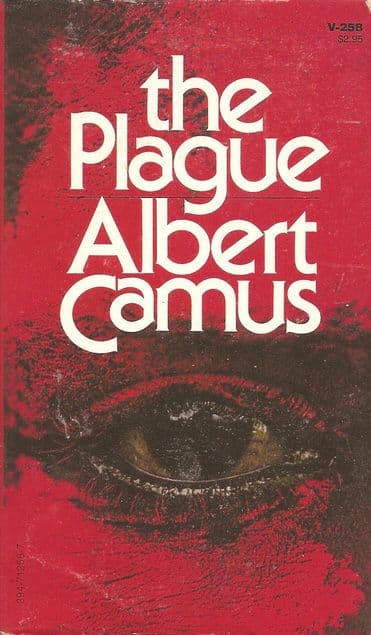
The Plague (La Peste)
Camus's 1947 novel chronicles a plague outbreak in the Algerian city of Oran, following Dr. Rieux and a small circle of volunteers as they fight an epidemic that quarantines the city and kills indiscriminately. The book's distinctive argument is not that heroism defeats catastrophe but that lucid, unglamorous solidarity—the daily refusal to accept suffering as inevitable—constitutes the only honest response to absurdity when metaphysical answers are unavailable. Rieux's sanitary squads act without hope of ultimate victory, and Camus treats this persistent, limited engagement as a form of revolt that neither surrenders to despair nor claims the authority of heroism.
Key Insights
✦What is the central argument of The Plague, and how does it differ from The Stranger's absurdism?
The Plague does not abandon the absurd but moves beyond the solitary confrontation with it. Andrew Edgar argues that the novel advocates a response that goes beyond Meursault's aestheticism, showing that even without foundational meaning, characters can constitute themselves through a 'hermeneutic circle' between present action and overarching project . Where The Stranger ends with Meursault's solitary lucidity, The Plague insists that lucidity must be enacted collectively: Rieux and his volunteers do not defeat the plague, and they do not claim to. What distinguishes them is their refusal to accept suffering as someone else's problem, a refusal that Camus presents as the practical form of revolt rather than as heroism.
✦How has the novel's allegorical status been debated, and what does the Holocaust reading add or distort?
When The Plague appeared in 1947, most French critics read it as an allegory of the German Occupation, and Philip Thody notes that this reading, while widespread, risks limiting the novel to a single historical experience . A later strand of criticism, associated with Shoshana Felman and Nelly Wolf, pushes further, reading the sanitary squads as figures for the Sonderkommandos and the novel as a meditation on the Holocaust. Dominique Rabaté objects that the text never explicitly identifies the plague with Nazism, and that the crematoria in the novel serve prophylactic rather than genocidal functions . The allegory is available to readers but not mandated by the text, which is why the novel has lent itself to successive crises from AIDS to COVID-19.
✦What role does Paneloux's faith play in the novel's argument, and how does Camus treat it?
Father Paneloux's sermons initially interpret the plague as divine punishment, a position that the novel treats with respect but not endorsement. After witnessing the death of a child, Paneloux delivers a second sermon that abandons the language of punishment for a demand of total surrender to divine will—a shift that Mark Orme and other critics read as Camus's diagnosis of the psychological cost of theodicy under extreme suffering. Paneloux then refuses medical treatment when he falls ill, a choice that can be read as fidelity to his second sermon or as a final evasion of the solidarity the novel values. Camus does not resolve the ambiguity, but the narrative's structural sympathy lies with Rieux's refusal to explain suffering rather than with Paneloux's attempts to justify it.
✦How does The Plague relate to The Rebel and the cycle of revolt?
The Plague is the first major work in what Camus called the cycle of revolt, which also includes The Just Assassins and The Rebel . Where The Myth of Sisyphus asked whether life is worth living, The Plague asks what action is possible when absurdity takes the form of shared catastrophe. The sanitary squads embody the principle that The Rebel would later theorize: that rebellion against suffering generates solidarity rather than isolation, and that this solidarity imposes limits on what the rebel may do. The Plague does not yet confront the political question of revolutionary violence that dominates The Rebel, but it establishes the ethical groundwork—the refusal to accept suffering as inevitable, combined with a refusal to claim absolute authority—on which that later argument depends.
✦What is the most common misreading of the novel's treatment of heroism?
The most common misreading takes the novel as a celebration of heroism, with Rieux and Tarrou as moral exemplars whose courage in the face of death offers a model for emulation. But the novel explicitly resists this framing. Rieux tells Tarrou that the fight against the plague is not a matter of heroism but of common decency, and Camus's narrator repeatedly undercuts grand gestures in favor of ordinary persistence. C. Fred Alford notes that even Grand, the minor functionary endlessly rewriting his novel's first sentence, is presented as an everyday hero precisely because his contribution is unremarkable and sustained . The novel's ethical force lies in its insistence that decency is available to anyone willing to act, not in the exceptional virtue of its protagonists.
✦How has Stuart Gilbert's English translation shaped the novel's reception?
Gilbert's 1948 translation, published by Knopf in the United States, has been the standard English version for over seventy-five years . It was produced relatively soon after the French publication and has been praised for its readability, but it has also been criticized for occasionally flattening Camus's prose and for choices that obscure the novel's tonal shifts between clinical chronicle and philosophical reflection. No major rival translation has displaced it in mainstream Anglophone publishing, though later editions have added introductions and critical apparatus. Readers working from English should keep in mind that the novel's narrator, Rieux, adopts a deliberately restrained, almost medical register, and that translation choices can either preserve or soften this restraint, affecting how the novel's ethical stance is perceived.
Wealthy Psyche is an intellectual archive. We do not host, distribute, or sell book copies — physical or digital. We provide structured knowledge to help you think better, faster.