


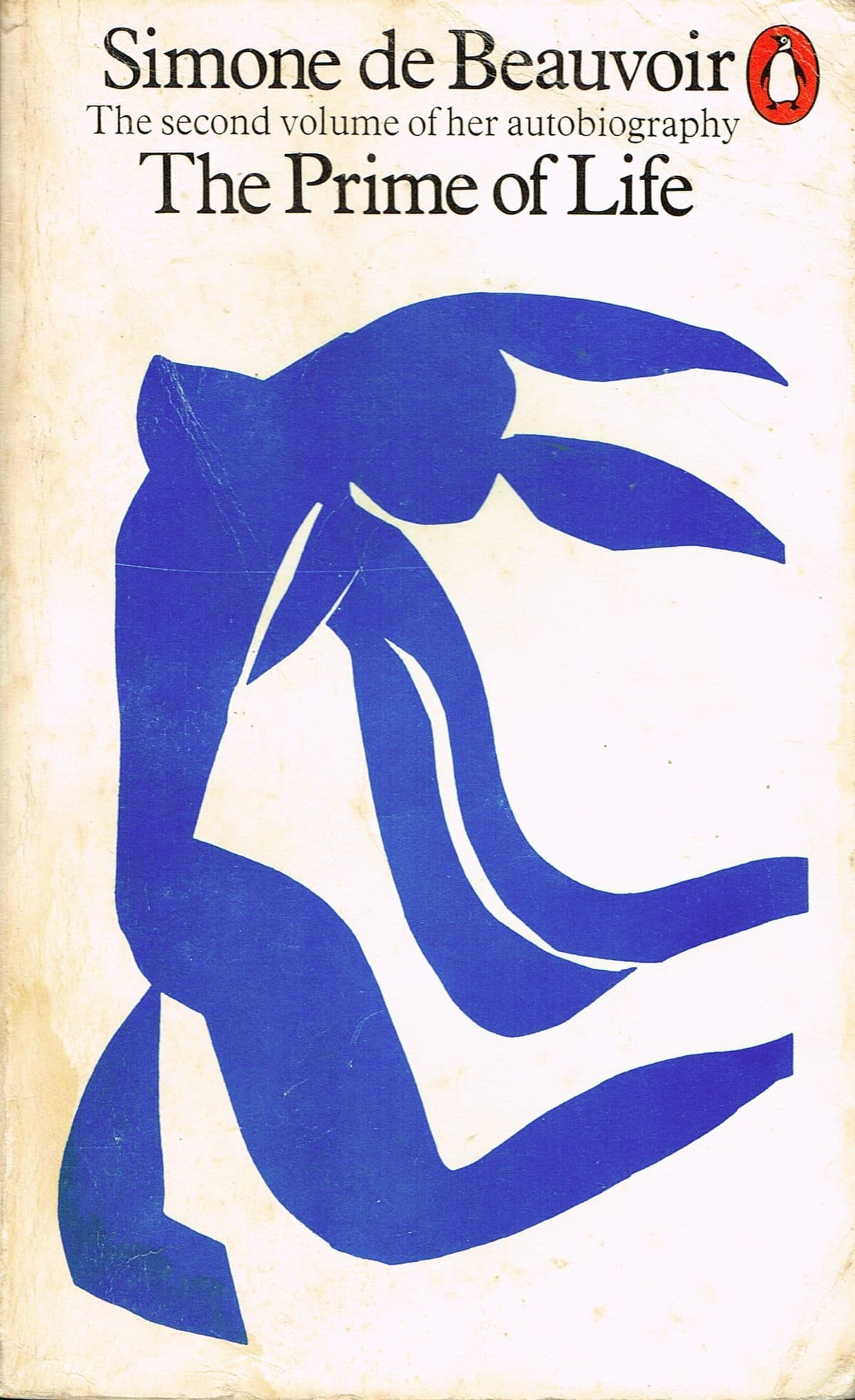
The Prime of Life

The second volume of Beauvoir's autobiography covers 1929 to 1944, the years in which she became a writer and formed the partnership with Sartre that would define her public life. Its distinctive mechanism is the retroactive construction of a 'prime'—a period of freedom, work, and happiness—that Beauvoir presents as exemplary while acknowledging, in the act of narration, the blindness that made it possible. The book is less a confession than a demonstration: it shows how a woman fashioned an autonomous existence out of the conventions of her time, and it invites the reader to measure the cost of that fashioning against the political catastrophes unfolding around her.
Key Insights
✦What is the central argument of The Prime of Life, and what does it reject?
The book's central argument is that a woman can fashion an autonomous existence—through work, intellectual partnership, and the refusal of conventional domesticity—without fully escaping the blind spots of her class and moment. Beauvoir presents the years 1929 to 1944 as her 'prime,' a period of freedom and productivity, but the narrative is structured around a retrospective admission: she and Sartre were 'blind to political reality,' absorbed in their individual happiness while history moved toward catastrophe . What the book rejects is the fantasy of a pure, unconditioned freedom. The 'prime' is real, but it is bought at the cost of a willed ignorance, and Beauvoir's narration refuses to separate the achievement from the blindness that made it possible.
✦Why did this volume become a guide for young women in the 1960s and 1970s, and what did it offer that The Second Sex did not?
Ann Curthoys argues that in the 1960s and 1970s, Beauvoir's feminist ideas were often absorbed through her autobiographies rather than through The Second Sex, because the memoirs demonstrated in concrete detail how a woman might actually live a liberated life . Where The Second Sex analyzed the structures of oppression, The Prime of Life showed the daily practices—work habits, living arrangements, the negotiation of an unconventional relationship—through which one woman had rejected marriage and motherhood without collapsing. For young female readers, the book functioned as a model for 'the fashioning of a new kind of feminine self,' not merely a theory of freedom but a demonstration of its exercise .
✦What does Beauvoir's own retrospective term 'schizophrenia' reveal about the book's self-understanding?
Beauvoir reports that Sartre applied the term 'schizophrenia' to her during this period, and she takes it up to describe her own condition: a determination to be happy that rendered her 'blind to political reality' . The term is important because it reveals that The Prime of Life is not a triumphalist memoir. Beauvoir is not claiming that her 'prime' was exemplary in every respect; she is claiming that it was exemplary in its freedom and its work, and that this exemplarity coexisted with a refusal of history that she can no longer endorse. The retrospective frame allows her to hold both judgments at once: the life was worth living, and the blindness was real.
✦How does the book relate to the volumes that precede and follow it in Beauvoir's autobiography?
The Prime of Life is the second of four volumes, following Memoirs of a Dutiful Daughter (1958) and preceding Force of Circumstance (1963). The first volume covers childhood and education; the second covers the formation of her adult identity and her partnership with Sartre; the third covers the war years and the postwar period up to 1962. The Prime of Life occupies a pivotal position because it narrates the construction of the life that the later volumes will test against history. The relative neglect of the middle volumes compared to the first is notable: Memoirs of a Dutiful Daughter is more widely read and taught, perhaps because its portrait of a girl's intellectual awakening is more accessible than the second volume's dense account of Parisian intellectual life in the 1930s.
✦What is the most common misreading of the book's account of the Sartre-Beavoir relationship?
The most persistent misreading treats the book as a celebration of a 'perfect' open relationship, a model of freedom without cost. But the memoir is more honest than that. It describes the negotiation of an unconventional partnership as work—work that required sacrifices, negotiations, and occasional pain—rather than as a spontaneous harmony. The retrospective narration also registers the limitations of the arrangement: the book does not claim that the couple's freedom was available to everyone, or that it was achieved without blindness. A related error treats the memoir as a straightforward historical document, when the French scholarship on Beauvoir's memoirs emphasizes that they are constructed narratives with deliberate selection and composition, not transparent records of a period .
✦What are the translation and publication issues surrounding The Prime of Life in English?
The English translation is by Peter Green, first published in 1962 by the World Publishing Company in the United States and Andre Deutsch in the United Kingdom . The French original, La Force de l'âge, was published by Gallimard in 1960 . Green's translation has been the standard English version for over sixty years and has been reissued in multiple editions, including Penguin paperbacks and a 1994 Da Capo Press edition . The translation is generally serviceable but has not been subjected to the same scrutiny as the standard translations of Beauvoir's philosophical works. Readers should be aware that the memoir is long and detailed, and that its engagement with the political and intellectual history of the 1930s presupposes a familiarity that many English-language readers will not possess.
Wealthy Psyche is an intellectual archive. We do not host, distribute, or sell book copies — physical or digital. We provide structured knowledge to help you think better, faster.