


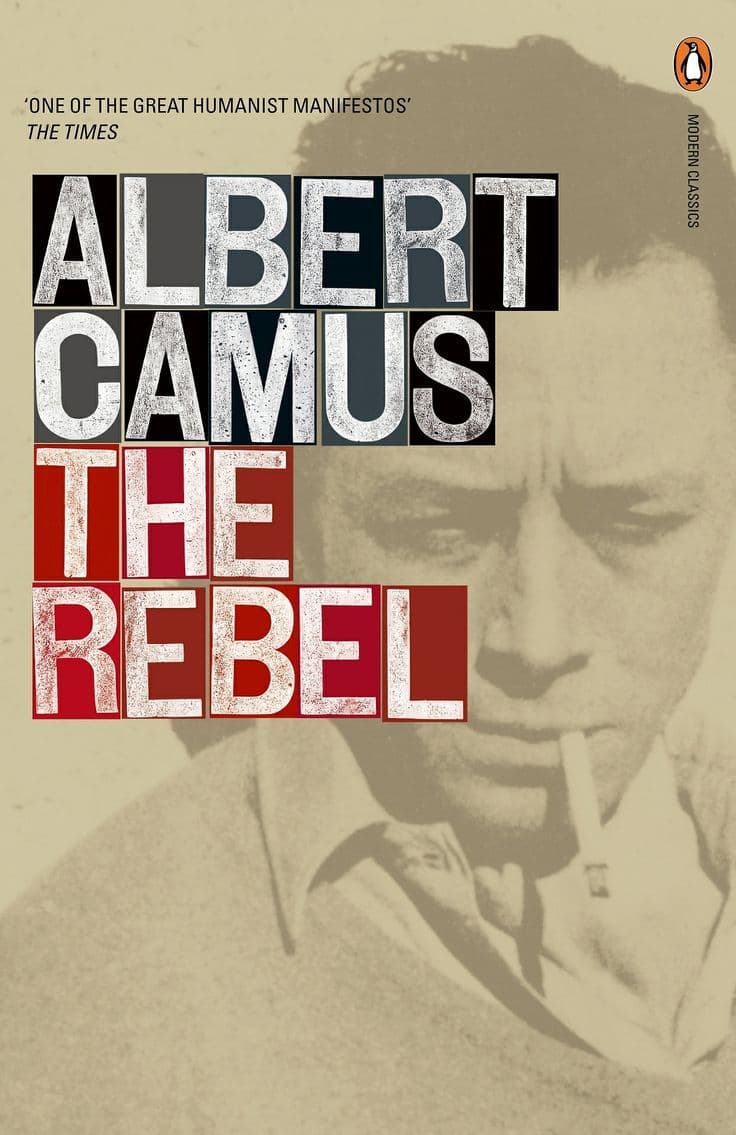
The Rebel (L'Homme révolté)
Camus's 1951 essay traces the history of revolt from its metaphysical origins through the French and Russian revolutions to conclude that rebellion, properly understood, generates solidarity rather than license: 'I rebel, therefore we are.' The book's distinctive argument is that revolt contains its own internal limit, a refusal to accept either oppression or the murderous logic of revolutionary absolutism. This limit is what separates rebellion from revolution, and it is what Camus believes the twentieth century's ideological religions—whether Marxist or nihilist—have systematically betrayed.
Key Insights
✦What is the central argument of The Rebel, and how does it distinguish rebellion from revolution?
Camus argues that the impulse to rebel is a primary human response to injustice, and that this impulse carries within it an implicit limit: the rebel refuses to be treated as a thing, and in doing so affirms a value that applies to all humans, not merely to himself. This is the meaning of the formulation that rebellion says 'I rebel, therefore we are'—the individual act of refusal generates solidarity rather than solipsism . Revolution, by contrast, betrays this origin when it subordinates present human beings to a future ideal, justifying murder and oppression in the name of historical necessity. The book's target is any politics that treats human lives as means rather than ends, whether that politics presents itself as Marxist, nihilist, or reactionary.
✦How did the publication of The Rebel trigger the rupture with Sartre and the Les Temps Modernes circle?
The confrontation began with Francis Jeanson's hostile review in the May 1952 issue of Les Temps Modernes, which described The Rebel as 'a great book that failed' and accused Camus of a 'Red Cross morality' that evaded political responsibility . Camus responded with a letter addressed to the journal's director rather than to Jeanson, and Sartre replied in August with a brutal public break, accusing Camus of philosophical incompetence and of installing a 'violent and ceremonial dictatorship' within himself . The exchange was immediately understood as a political realignment: Camus became identified with anti-communist leftism while Sartre consolidated his position as the leading fellow-traveller of the French left . The friendship was permanently ended.
✦What does Camus mean by 'limits' in rebellion, and has this idea held up since 1951?
Camus's concept of limit is both descriptive and normative. Descriptively, he claims that rebellion, when it becomes conscious of itself, discovers that it cannot demand freedom for itself while denying it to others; the logic of refusal is inherently universalizing. Normatively, this limit functions as a criterion for distinguishing authentic revolt from its ideological counterfeits, which treat history as an absolute and therefore license any crime as historically necessary. Critics have charged that this position is politically impotent, as Sartre argued, because it offers no program for action and treats all violence as morally equivalent regardless of its context . Defenders counter that the twentieth century's catastrophes vindicated Camus's suspicion of revolutionary absolutism, even if his alternative remains underdeveloped as a political doctrine.
✦How does The Rebel relate to The Myth of Sisyphus and the rest of Camus's work?
The Rebel extends the absurdist framework of The Myth of Sisyphus into the political domain, asking the question the earlier essay deferred: if life has no ultimate meaning, what justifies the refusal to accept injustice, and what prevents that refusal from becoming another form of tyranny? Camus treats the two books as stages in a single inquiry, moving from the solitary confrontation with absurdity to the discovery that rebellion implicates the rebel in a community of others . The later Resistance, Rebellion, and Death then applies this framework to specific historical episodes—the Resistance, Hungary, Algeria—testing whether the ethics of limits can survive concrete political pressure. The three books together form a trajectory rather than a doctrine.
✦What is the most common misreading of The Rebel's political position?
The most persistent misreading treats The Rebel as a quietist or conservative text, a retreat from politics into moral purity that counsels inaction in the face of injustice. This reading was consolidated by Sartre's attack, which accused Camus of refusing to side with the oppressed and of justifying quietism through his refusal to distinguish between masters and slaves . But Camus explicitly engaged in political struggle throughout his career, from his Resistance journalism to his interventions on Algeria and capital punishment. The book's argument is not that action is impossible but that action must be constrained by an awareness of its own limits—that the rebel must refuse to become an oppressor in the act of opposing oppression. Whether this position is coherent or merely a recipe for paralysis remains the central point of dispute.
✦How has Anthony Bower's English translation of The Rebel been received?
Bower's 1953 translation, published by Hamish Hamilton, has been the standard English version for over seventy years and remains the text in Penguin editions . It has been criticized for flattening Camus's prose and for sometimes obscuring the precision of his historical and philosophical references, which range across Hegel, Marx, Nietzsche, and the Russian nihilists. Later Penguin editions have added introductions by Olivier Todd, but the translation itself has not been replaced by a major rival version. Readers working from English should keep in mind that The Rebel is a dense and allusive text, and that Camus's arguments depend on a network of historical examples whose force can be difficult to recover without attention to the French context of 1951.
Wealthy Psyche is an intellectual archive. We do not host, distribute, or sell book copies — physical or digital. We provide structured knowledge to help you think better, faster.